What this is
A search service that understands a codebase and refreshes itself on push.
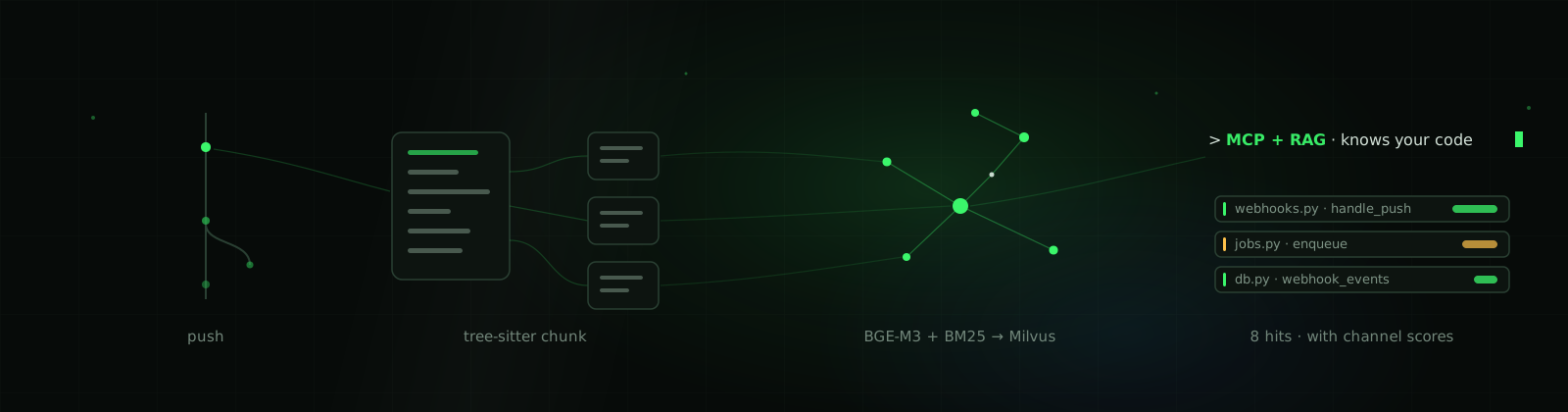
You pick a repo from Azure DevOps, GitHub or a local directory. It is cloned, split into code units with tree-sitter, and written to Milvus with BGE-M3 (dense) and BM25 (sparse). At query time a symbol-shaped query goes to BM25 and a plain sentence goes to dense. When a push lands, only the changed files are re-indexed.
uv run rag add-local ~/code/my-api --name my-api
uv run rag ask "how are webhook events queued?" -r my-api
The hard part of RAG over a codebase is not the vector search. Four things are hard, and every decision in this project was made against them:
- Finding a symbol exactly.
handleAuthCallbackis invisible to an embedding. - Connecting a question in one language to code in another.
- Not going stale when the repo moves.
- Being able to say "no answer" when there isn't one.
Nothing here ships unmeasured
Every retrieval decision has a number behind it, produced by rag eval against a
golden set with negative cases. A flag default does not change until a JSON lands
under evals/results/. "It feels better" is not a result — and two of the decisions
below went the opposite way from what was expected.
New to this? Take the ladder first
The RAG ladder is the general version of this story: six rungs, each one a repair to a failure on the rung below, with a runnable naive RAG at the bottom and GraphRAG at the top. It tells you which rung you actually need — and rung 0 is "don't build a RAG at all", which is the right answer more often than it gets said.
The pipeline, in five stages
-
Azure / GitHub / local, a push webhook with a poller behind it, a single-worker queue, and change detection by content hash.
The trap it closes: a git diff has edge cases for renames, mode changes and force-pushes. A sha256 manifest has none, and local directories take the same path.
-
tree-sitter chunking on real syntax boundaries, secret redaction before anything is stored, BGE-M3 embeddings, one Milvus collection with dense and BM25 side by side.
The trap it closes: a fixed-size window cuts a function in half, and the embedding of an over-long chunk becomes an average that represents nothing.
-
A regex router, dense and BM25 channels, RRF behind a flag, a cross-encoder that was measured and turned off, and three bands for "no answer".
The trap it closes: kNN has no concept of "nothing is close". It returns eight chunks for a question about a five-star resort too — and that is where hallucination starts.
-
A cited answer layer, an LLM provider chain that ends at a local model, and an MCP server sharing the same retriever with the HTTP API.
The trap it closes: an uncited sentence is invisible. Requiring
[n]on every claim makes a fabrication something you can see. -
A golden set with negative cases, Recall@k / MRR / abstain / false_weak, and a ledger where every decision is a row.
The trap it closes: a threshold measured on one model and one corpus is not universal. The eval report prints the calibration you need to move it.
The flow
flowchart LR
    SOURCE["Azure / GitHub / local"] -->|"clone / fetch"| WORKING["working copy"]
    HOOK["push webhook · poller"] --> QUEUE["job queue"] --> WORKING
    WORKING -->|"sha256 manifest diff"| CHANGED["changed files"]
    CHANGED -->|"tree-sitter chunk<br>delete + rewrite"| MILVUS[("Milvus<br>dense + BM25")]
flowchart LR
ASK["POST /ask"] --> SEARCH["POST /search"] --> ROUTE{"a symbol?"}
ROUTE -->|yes| BM25["BM25"] --> HIT["8 hits<br>with channel scores"]
ROUTE -->|no| DENSE["dense<br>(flags: hybrid RRF · rerank)"] --> HIT
HIT -->|"if /ask"| ANSWER["LLM → cited answer"]Sixty seconds
Three tools: search_code finds candidates, read_code opens the rest of a file
(only files that are indexed), list_repos says what is connected. The agent
decides; the retriever's job is to offer candidates and be honest about how sure
it is.
What the numbers say
Full tables, the corpus they came from, and the caveats are in Measurement.
| Decision | Result |
|---|---|
| Query routing (symbol → BM25) | MRR 0.678 → 0.690, free; always-hybrid is worse (0.604) |
| BGE-M3 over MiniLM | Turkish prose Recall@8 0.684 vs 0.04 |
| Cross-encoder rerank | MRR 0.690 → 0.514, p50 2–4 s → turned off |
| tree-sitter vs plain windows | +0.024 recall, +0.09 MRR — nearly all of it on symbols and non-English prose |
| Chunk enrichment (LLM descriptions) | Turkish prose MRR 0.778 → 0.932, false_weak halved |
| Three-band abstention | 0.846 abstain on negatives at a 4.8% false-alarm rate; a reranker gate cost 28.6% |
| Conservative secret scrubbing | 247 false positives → 2 on the same repo |