3. The motor on the box (sim2real)
The question
Section titled “The question”In the Open Duck model every joint can produce at most ±3.23 N·m (open_duck_mini_v2.xml:49, class sts3215, forcerange). That value is not made up: the Open Duck team identifies the motor model from the real STS3215 (7.4 V) servo with BAM and takes forcerange from it (Open_Duck_Mini docs/sim2real.md).
The torque printed on the servo’s box is lower:
- The STS3215 catalog rating is 19 kg·cm ≈ 1.86 N·m. soyeon24/open-duck-mini-v2-build uses it as the “rated” value.
- RobotShop lists 19.5 kg·cm ≈ 1.91 N·m at 6 V. We found no catalog figure for 7.4 V.
So the simulator’s limit is ~70 % above the catalog rating. We don’t know which one is closer to the real robot: we did not measure hardware, and BAM’s value and a catalog stall torque may not measure the same thing. The question of this chapter: how much does the policy lean on the torque the simulator gives it, and what happens when the limit drops to the catalog value?
Experiment 1: no retraining, different worlds
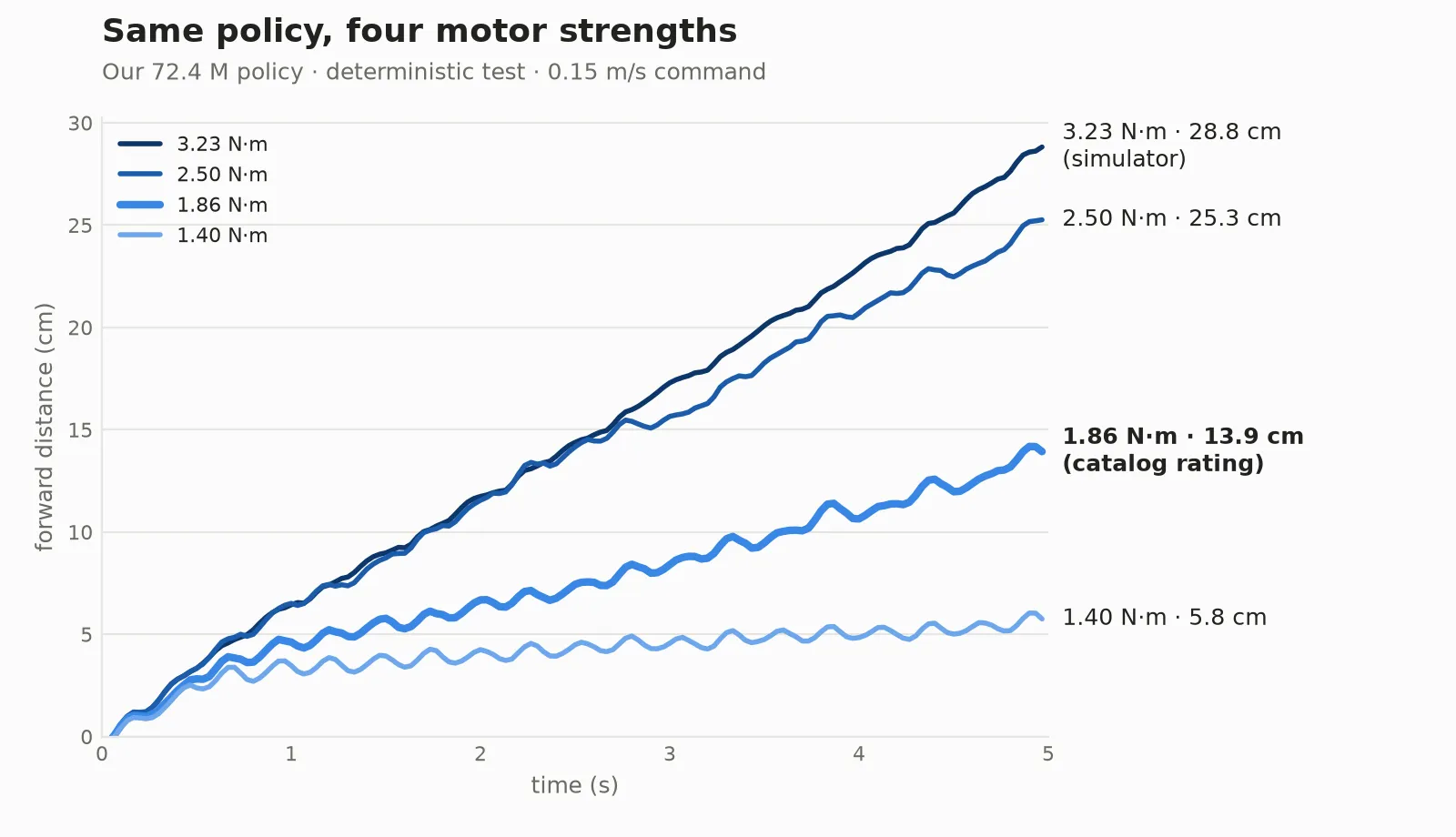
Section titled “Experiment 1: no retraining, different worlds”We measured trained policies without changing them, only changing the world. Deterministic test, 5 s, flat floor, no pushes, 0.15 m/s.
| World | Our 72.4 M | 9 stochastic (ours) | Ready-made BEST_WALK_ONNX |
|---|---|---|---|
| Normal (3.23 N·m) | 28.8 cm | 0/9 fell, mean 22.1 cm | 58.5 cm · 8+8 steps |
| Floor friction 0.5 (normal 0.6) | 24.9 cm | 0/9, mean 20.6 cm | 57.3 cm |
| Mass ×1.1 | 27.9 cm | 0/9, mean 18.1 cm | 56.1 cm |
| Mass ×1.2 | 24.7 cm | – | 54.3 cm |
| Torque 2.5 N·m | 25.3 cm | – | 52.3 cm |
| Torque 2.2 N·m | 19.9 cm | – | – |
| Torque 1.86 N·m (catalog) | 13.9 cm (−52 %) | 0/9, mean 9.2 cm | 40.2 cm (−31 %) · 8+5 steps |
| Torque 1.6 N·m | 9.8 cm | – | 27.3 cm · 8+0 steps |
| Torque 1.4 N·m | 5.8 cm | – | 19.5 cm · 7+0 steps |
What do we see?
- The loss is not linear: 3.23 → 2.5 costs only 12 %, while 2.5 → 1.86 halves the distance.
- No duck falls over; a weak motor slows it down instead of knocking it over. soyeon24 reports the same.
- At 1.6 N·m the ready-made policy can no longer step with its right foot (8+0).
- The friction and mass tests are not enough to say “robust to what was randomized”: the changes are not the same size and we ran no ablation. Floor friction was not even randomized during training (see the box below).
To reproduce, use scripts/sim2real/eval_world.py, a copy of eval_checkpoint.py that changes the world through environment variables:
FORCE=1.86 .venv/bin/python -I scripts/sim2real/eval_world.py external/Open_Duck_Playground \ results/2026-10-24/onnx/ckpt_072437760.onnx out/f186.mp4 --no_video # "dx_m": 0.1393FLOOR_FRIC=0.5 .venv/bin/python -I scripts/sim2real/eval_world.py ... # slippery floorMASS_SCALE=1.2 .venv/bin/python -I scripts/sim2real/eval_world.py ... # every part 20 % heavierFORCE_RAND=1.40,1.90 WSEED=3 .venv/bin/python -I scripts/sim2real/eval_world.py ... # random per jointAll worlds in one command: python3 scripts/sim2real/sweep.py out/sweep a=<onnx> b=<onnx>. Results: results/2026-10-27-sim2real/eval_trained_policy/.
Why it halves: knee torque
Section titled “Why it halves: knee torque”eval_world.py also records joint torque at every physics step (a "torque" summary in the output, a time series for both knees in the JSON). In simulation (3.23) our policy drives its knees above the catalog rating 37–39 % of the time. As the limit drops, the knees sit at the limit more often:
| Limit | Distance | Knee > 1.86 (left/right) | Knee at the limit (left/right) |
|---|---|---|---|
| 3.23 | 28.8 cm | 36.7 % / 39.2 % | 7.4 % / 4.5 % |
| 2.5 | 25.3 cm | 39.8 % / 42.2 % | 25.2 % / 22.7 % |
| 2.2 | 19.9 cm | 43.1 % / 42.1 % | 34.5 % / 34.8 % |
| 1.86 | 13.9 cm | – | 42.3 % / 49.0 % |
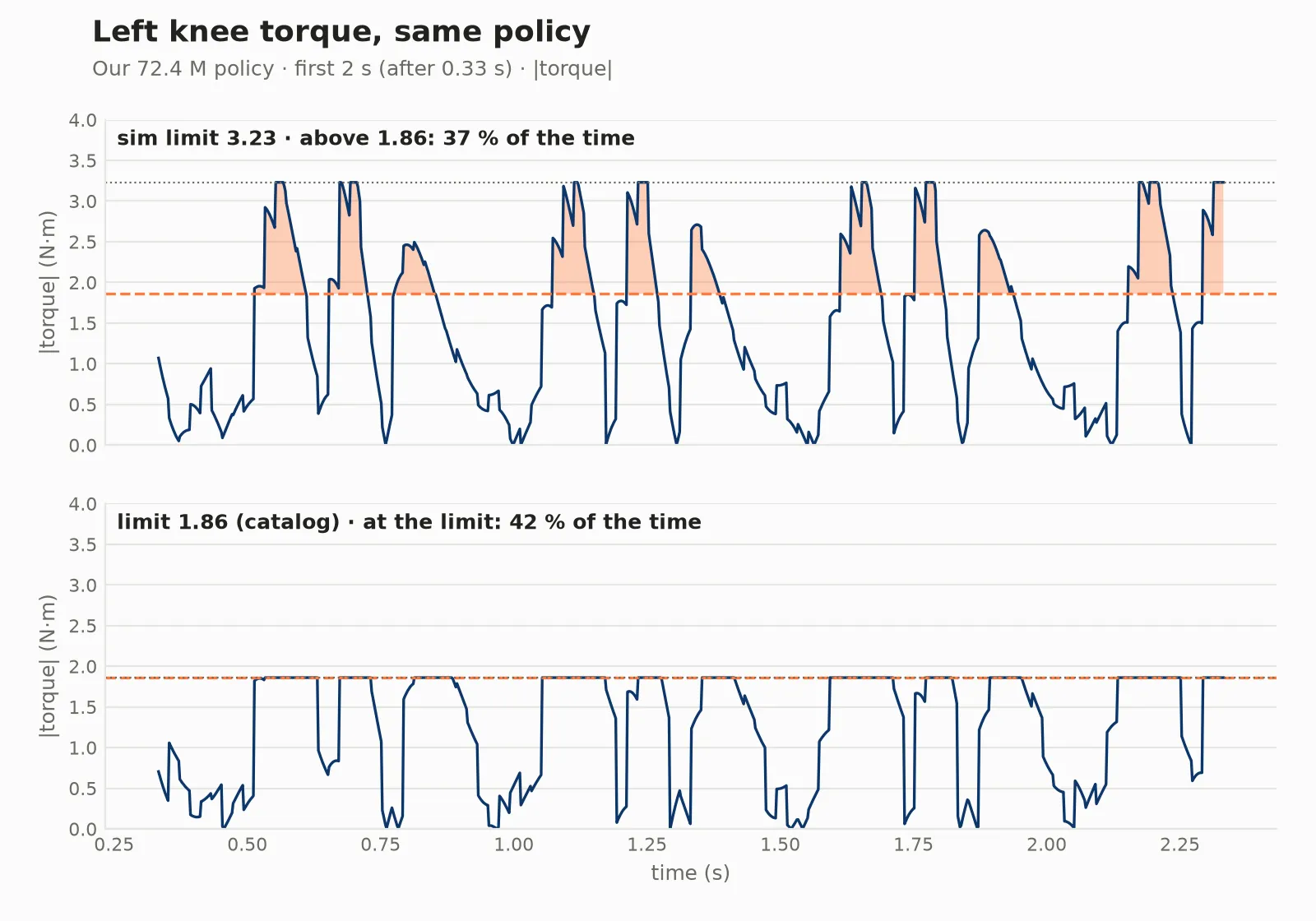
The policy learned a gait for the torque the simulator gives it. Without that torque it sends the same commands, but the knees cannot deliver what it asks for.
Experiment 2: retraining from a warm start (failed)
Section titled “Experiment 2: retraining from a warm start (failed)”Three runs, all from the 68.4 M checkpoint, 10 M steps each. Rewards, physics and the official randomization are the same; only the torque limit differs. Policy and observation normalizer were restored, the value net started from scratch.
| Run | Torque limit | End (10 M) |
|---|---|---|
tork186 |
fixed 1.86 N·m on every joint | 2.5 cm, no steps |
tork_rand |
U(1.40, 1.90) N·m per env and joint | 3.4 cm, no steps |
kontrol323 |
official 3.23 N·m | 10.3 cm, no steps |
Even the control run lost its gait (26.3 cm at 5 M, 9.9 cm at 7.5 M). So the problem is not only the weak motor but the warm start with a reset value net itself. The weak-motor runs lost the gait by 2.5 M, the control by 7.5 M. That is why experiment 3 starts from scratch.
Files: results/2026-10-27-sim2real/warm_start/.
Experiment 3: from scratch, random motor strength
Section titled “Experiment 3: from scratch, random motor strength”The same recipe as part 1: same env, rewards, randomization, PPO settings, seed 0, 72 M steps. The only change: a torque limit of U(1.40, 1.90) N·m per env and per joint, around the catalog rating. The two run_config.json files differ only in force_limit and the start time.
.venv/bin/python -I scripts/sim2real/train_sim2real.py external/Open_Duck_Playground runs/scratch_rand \ --force_rand 1.40 1.90 --devices 6 --envs_per_dev 256 --num_timesteps 72000000 --num_evals 19 --seed 0Result (4.7 hours, Mac CPU): no gait at 72 M steps.
- The final checkpoint walks in no world: 0.9–1.5 cm, 0 steps. At the catalog limit 1.2 cm; 9 stochastic seeds average 0.8 cm, none falls.
- All 8 checkpoints between 36 and 72 M behave the same (best 3.7 cm, 0 steps). In the clean test it stands, doesn’t fall, but takes no steps.
- During training (62–73 M average) the reward is 51.3 and the episode length 2.47 s. Over the same range the part 1 run reaches 77.8 and 3.50 s; it is ahead from 10 M on.
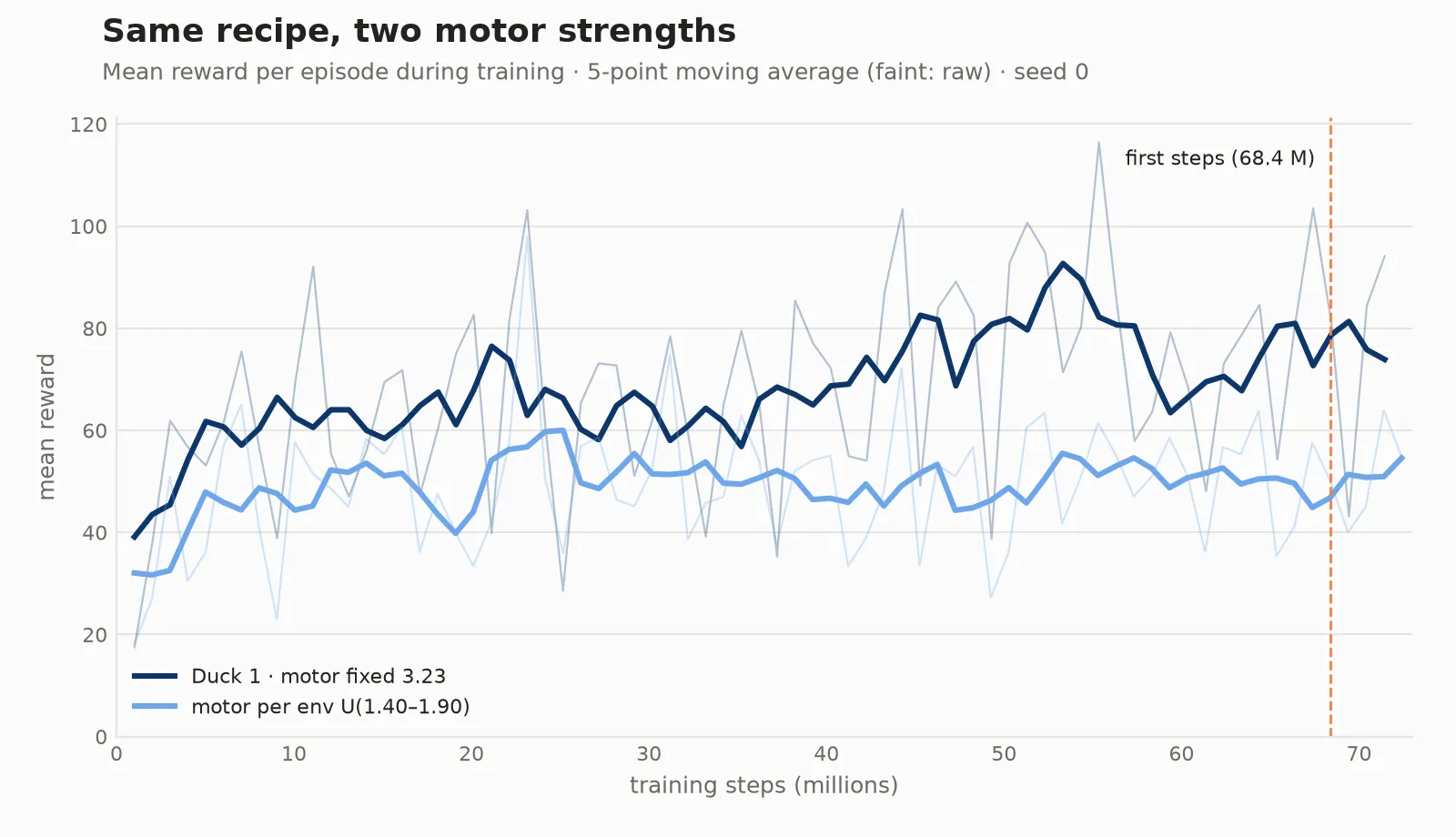
Interim result: domain randomization is the known fix for a weaker motor, but walking with a weak motor is a harder problem, and the same budget was not enough. soyeon24 fixed the motor at 1.86 and found a gait after 300 M steps (0.130 m/s; their own fork, simulation only). Their random runs with the same 1.40–1.90 range also walked at 300 M, but the result varied a lot with the seed.
Files: results/2026-10-27-sim2real/scratch_rand/ (logs, the final checkpoint in onnx/ and params/, the checkpoint scan in eval/).
Continuing to 301 M
Section titled “Continuing to 301 M”The same run, from the 72.4 M checkpoint, restoring policy, value net and normalizer, seed 1 (9.2 hours):
.venv/bin/python -I scripts/sim2real/train_sim2real.py external/Open_Duck_Playground runs/scratch_rand_cont \ --force_rand 1.40 1.90 --restore results/2026-10-27-sim2real/scratch_rand/params/ckpt_072437760.pkl \ --restore_value --step_offset 72437760 --devices 6 --envs_per_dev 256 --num_timesteps 228000000 --num_evals 57 --seed 1Result: it walked at the catalog torque, then forgot. We tried all 57 checkpoints at 1.86 N·m:
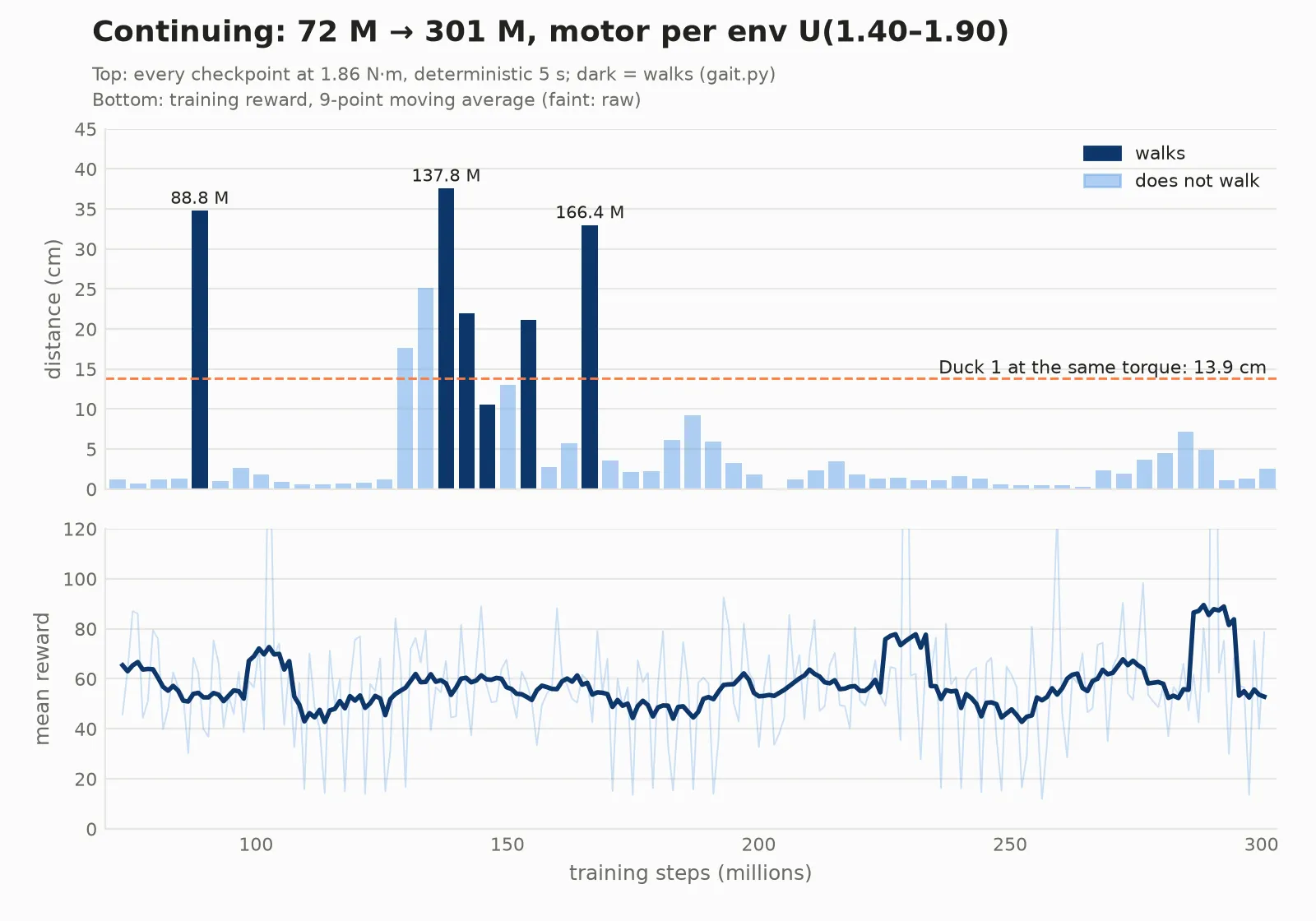
- First gait at 88.8 M: 34.8 cm. Duck 1’s policy covered 13.9 cm at the same torque; the new policy goes 2.5 times as far. The very next checkpoint stands still again.
- 137.8–166.4 M: 5 of 8 checkpoints walk; the best is 137.8 M, 37.6 cm.
- None walks after 170 M. The final checkpoint (301.2 M) stands still at 1–4 cm, even with the motor back at 3.23 (3.9 cm).
- The reward does not show this. The mean training reward does not drop while the gait disappears: 53–62 at 72–95 M, 64 at 260–301 M. Reading the reward curve and picking “the latest checkpoint is the best” would be wrong here.
The two walking checkpoints in other worlds (deterministic 5 s, none fell):
| World | 88.8 M | 137.8 M | Duck 1 72.4 M |
|---|---|---|---|
| 3.23 N·m (sim) | 49.9 cm | 49.1 cm | 28.8 cm |
| 2.5 N·m | 40.2 cm | 48.1 cm | 25.3 cm |
| 1.86 N·m (catalog) | 34.8 cm | 37.6 cm | 13.9 cm |
| 1.4 N·m | 20.5 cm | 21.2 cm | 5.8 cm |
random 1.40–1.90 (WSEED=0) |
28.6 cm | 26.3 cm | – |
| 1.86 + mass ×1.2 | 30.8 cm | 28.5 cm | – |
| 1.86, 6 stochastic seeds | 14.6–19.7 cm | 15.5–21.0 cm | mean 9.2 cm (9 seeds) |
Walking or sliding: the step counter was wrong
Section titled “Walking or sliding: the step counter was wrong”The foot_steps counter in eval_world.py counts a step when a foot rises more than 4 mm above its lowest point and comes back down. In the Open Duck gait the feet rise only ~1 cm, and the counter misses it: it counts even Duck 1’s walking 72.4 M policy as 0+2 steps. During training watch_ckpts.py waited for “≥ 4 steps” and caught none of the walking checkpoints.
Instead, scripts/sim2real/gait.py looks, after the first 0.5 s, at how many times each foot’s height oscillates around its mean, how high it lifts, and whether the two feet alternate (negative left/right correlation).
| Policy, 1.86 N·m | Distance | Oscillations (L/R) | Lift (L/R) | L/R correlation |
|---|---|---|---|---|
| Duck 1 72.4 M at 3.23 (reference gait) | 28.8 cm | 8 / 8 | 11.0 / 10.8 mm | −0.34 |
| 88.8 M | 34.8 cm | 7 / 8 | 9.1 / 11.2 mm | −0.33 |
| 137.8 M | 37.6 cm | 8 / 8 | 9.9 / 8.7 mm | −0.24 |
| 133.7 M (sliding) | 25.1 cm | 8 / 16 | 9.8 / 4.2 mm | 0.03 |
| 301.2 M | 2.5 cm | 8 / 6 | 1.3 / 4.9 mm | 0.06 |
Rule: more than 10 cm, and at least 4 oscillations and 5 mm of lift on both feet. 133.7 M covers 25 cm, but its right foot only jitters; by this rule it does not walk. watch_ckpts.py now uses this rule and logs every checkpoint until training ends (--exit_on_walk stops at the first walking one).
python3 scripts/sim2real/gait.py results/2026-10-27-sim2real/scratch_rand_cont/eval/f186/ckpt_137809920.jsonLesson
Section titled “Lesson”- Domain randomization worked for the weaker motor, but not by 72 M: the gait found at 68 M with the sim torque appeared at 88.8 M with torque around the catalog value. Once it appeared, it went further than the old policy.
- Longer training is not better training. The gait disappeared after 170 M and did not come back.
- The mean reward does not tell walking from standing. Keep your checkpoints and measure each one with your own test; ours is 5 s at 1.86 N·m plus
gait.py.
We don’t know yet why it forgot, and we don’t guess about what we have not measured.
Files: results/2026-10-27-sim2real/scratch_rand_cont/: logs, onnx/ (88.8 · 137.8 · 166.4 · 301.2 M), params/ (88.8 · 137.8 · 301.2 M), eval/checkpoint_scan_f186.csv (57 checkpoints), eval/worlds_and_noise.json, eval/f186/ (full measurements of 4 checkpoints).