01 · The world as text: MJCF and URDF
| Part | 1 · Simulation |
| Run type | CPU · Mac or Colab CPU |
| Prerequisites | none |
| Learn first | Python for AI Engineering · Python Environments |
| Time | ~30 min |
| Code | experiments/01-world-as-text/experiment.py · notebook |
| Status | ✅ done |
Act on this lesson
Tick each step when you have done it. Saved in this browser only.
A robot model is a text file: every number the engine uses is either written in it or filled in by a documented default.
The problem
Section titled “The problem”A file that loads is not necessarily physically right. MuJoCo’s own reference warns that a number of public URDF models have inertias that look arbitrary and are too large (XML reference · compiler/inertiafromgeom). If you cannot read the file, you cannot tell which masses, inertias, limits and gains you are simulating. Here you read MJCF, write a 15-line world, see what the defaults do to it, and open the real SO-101 model.
Before you read · 2 questions. Guess first; the lesson tells you why.
1. In vacuum, a 1 kg cube and a 100 g cube are released 40 cm above the tabletop. Which one lands first?
- The 1 kg cube, because gravity pulls it ten times harder.
- Both land at the same step, because the force grows with mass and so does the inertia.
- The 100 g cube, because it has less inertia to overcome.
Why: , so mass cancels. In Part A both cubes reach the tabletop at step 143 (analytic 0.2856 s).
2. A geom in an MJCF file has a size but no mass and no density, and its body has no <inertial>. What does the compiler do?
- It stops with an error, because the body has no mass.
- It gives the body zero mass, so the body cannot move.
- It weighs the geom as a uniform solid at the default density of 1000 kg/m³, without a warning.
Why: A missing number is never an error; it is a default you did not choose. geom/density defaults to 1000 kg/m³ (MJCF in one table), and Build it, Step 1 reproduces the compiler’s mass .
Core idea
Section titled “Core idea”In plain words
Section titled “In plain words”A model file is a recipe: ingredients (rigid parts, shapes, joints, motors) and amounts (sizes, masses, gains). Whatever it leaves out, the engine fills in from a documented list of defaults, the way a cook assumes “room temperature”. A missing number is never an error; it is a default you did not choose.
MuJoCo compiles the file once into two objects: mjModel holds what stays constant (masses, sizes, gains, the timestep), mjData what changes (positions, velocities, contact forces). A simulation is a loop that updates mjData using mjModel.
Mass needs the most care. Either the file states it for each part (<inertial>), or the compiler computes it from the shapes as uniform solids; a compiler setting decides which. With the wrong rule, a thin decorative shell is weighed as a solid block of water.
flowchart TD
    F["MJCF or URDF text file"] --> C["compiler<br/>+ documented defaults"]
    C --> M["mjModel<br/>constants: masses, sizes, gains, timestep"]
    M --> S["mj_step(model, data)"]
    D["mjData<br/>state: positions, velocities, contacts"] --> S
    S -- "next state" --> D
Loading a model, as code
Section titled “Loading a model, as code”import mujoco
m = mujoco.MjModel.from_xml_string(xml) # compile: text -> constants, gaps filled by defaultsd = mujoco.MjData(m) # state, initialised from the fileprint(m.opt.timestep, sum(m.body_mass)) # always print what was filled in for youfor _ in range(1000): mujoco.mj_step(m, d) # advance the state by one timestep# Build it, Step 1 writes what the compiler computes for a body without <inertial>| Quantity | Formula |
|---|---|
| inertia of a uniform box | , and cyclically for |
| mass inferred from a geom | |
| orientation (quaternion) | , scalar first |
| free-fall time | |
| air-drag deceleration | with |
is mass; are the box’s full side lengths; (inertia) measures how hard a body is to spin about an axis; is density, volume; is a unit axis and in the quaternion row the angle; is drop height, gravity, speed, the area facing the flow.
Math details: inertia inference, quaternions and the drag estimate
Box inertia. For uniform density, ; integrating over a side gives per unit mass, so . Inference treats every geom as solid, a hollow shell or visual mesh included.
Quaternion. MuJoCo stores , first; 1 0 0 0 is “no rotation” (Modeling · Frame orientations). Other libraries put last (lesson 06).
Why mass cancels in vacuum. Gravity’s force is , so the acceleration does not depend on : every cube falls in .
Why air delays light cubes. MuJoCo’s drag model adds a deceleration (Fluid forces). Assume drag is small, so the speed is still . The deceleration is then ; integrating it twice over the fall time gives the distance lost:
It is proportional to .
Go deeper: Python for AI Engineering, Python Environments (AIEFS); MuJoCo XML reference, MuJoCo Modeling.
MJCF in one table
Section titled “MJCF in one table”MJCF is MuJoCo’s XML format. A body is a rigid part with its own frame; nested bodies form the kinematic tree. A geom is a shape attached to a body. A joint gives a body a degree of freedom (dof), one independent way to move.
| Element | What it is | Attributes you will touch |
|---|---|---|
option | global physics settings | timestep (default 0.002 s), integrator (default Euler), gravity, density/viscosity (default 0: no air), cone |
worldbody | the fixed root of the tree | static geoms (floor, table) |
body | a rigid frame in the kinematic tree | pos, quat relative to the parent |
geom | a shape for collision and, by default, for mass | type, size (half-lengths for a box), mass or density (default 1000 kg/m³), friction, solref/solimp |
joint | a degree of freedom between a body and its parent | type (hinge, slide, ball, free), axis, range, damping, armature |
inertial | explicit mass properties of a body | mass, pos (centre of mass), diaginertia or fullinertia |
default / class / childclass | named templates of attribute values | e.g. every servo joint gets the same damping and armature |
actuator | something that produces force | motor, position, velocity, general; joint, gear, ctrlrange, forcerange |
sensor | quantities written to mjData.sensordata | jointpos, framequat, touch, … |
Mass and inertia: written or inferred
Section titled “Mass and inertia: written or inferred”At runtime only body mass properties exist; geom masses are used only at compile time (geom/mass). compiler/inertiafromgeom picks the rule:
| Value | Behaviour |
|---|---|
auto (default) | infer from the body’s geoms only if the body has no <inertial> |
true | always infer from geoms, overriding <inertial> |
false | every body must have <inertial> |
URDF and MJCF
Section titled “URDF and MJCF”URDF is the robot format of the ROS ecosystem.
| URDF | MJCF | |
|---|---|---|
| Tree | link + joint | nested body + joint |
| Mass | inertial per link | inertial, or inferred from geoms |
| Actuators, sensors, solver, contact parameters | not part of the format | first-class elements |
| Templates | none | default classes |
MuJoCo loads a subset of URDF directly, plus a custom <mujoco> block for compiler options (Modeling · URDF extensions). Menagerie documents each conversion in the model’s README: the Go2 went URDF → MJCF, then got a freejoint, <default> classes and tuned foot contacts (Menagerie · unitree_go2); the SO-101 starts from the manufacturer’s MJCF, switches to implicitfast and adds collision primitives (Menagerie · robotstudio_so101).
Build it
Section titled “Build it”You will now compute by hand what the compiler fills in (mass and inertia from shapes) and what mj_step does to a falling cube, in about 60 lines of NumPy, checking each step against MuJoCo. Type the steps into your own file and run it after each step. The finished functions are in physai/sim.py; uv run python experiments/01-world-as-text/build.py runs all five steps with the checks (output in build_output.txt).
Step 1 · Mass and inertia of a solid shape
Section titled “Step 1 · Mass and inertia of a solid shape”A body without <inertial> gets the mass and the inertia of its geoms as uniform solids. MJCF sizes are half-lengths (size=".1 .1 .1" is a 20 cm box); cylinders and capsules give radius and half-length along .
def solid_inertia(kind, size, density): """Mass and principal inertia of a uniform solid, with MuJoCo's `size` convention (half-lengths).""" if kind == "box": # size = half-sides (x, y, z) a, b, c = 2 * np.asarray(size, float) mass = density * a * b * c return mass, mass / 12 * np.array([b * b + c * c, a * a + c * c, a * a + b * b]) if kind == "sphere": # size = (radius,) r = size[0] mass = density * 4 / 3 * np.pi * r**3 return mass, np.full(3, 2 / 5 * mass * r * r) r, h = size[0], 2 * size[1] # cylinder/capsule: radius, half-length along z m_cyl = density * np.pi * r * r * h i_xx, i_zz = m_cyl * (3 * r * r + h * h) / 12, m_cyl * r * r / 2 if kind == "cylinder": return m_cyl, np.array([i_xx, i_xx, i_zz]) m_sph = density * 4 / 3 * np.pi * r**3 # capsule: cylinder plus two hemispherical caps i_xx += m_sph * (2 * r * r / 5 + h * h / 4 + 3 * h * r / 8) i_zz += m_sph * 2 * r * r / 5 return m_cyl + m_sph, np.array([i_xx, i_xx, i_zz])rho = mass / solid_inertia(kind, size, 1.0)[0] # a geom with mass="..." fixes the densitym_ours, i_ours = solid_inertia(kind, size, rho) # compare with m.body_mass[1], m.body_inertia[1]== Step 1. Solid shapes: our mass and inertia vs MuJoCo's compiler ==geom size (m) mass (kg) I_xx I_yy I_zz max rel. errbox [0.1, 0.1, 0.1] 0.1000 6.6667e-04 6.6667e-04 6.6667e-04 1.1e-16box [0.1, 0.05, 0.02] 0.5600 5.4133e-04 1.9413e-03 2.3333e-03 0.0e+00sphere [0.04] 0.2681 1.7157e-04 1.7157e-04 1.7157e-04 0.0e+00cylinder [0.03, 0.1] 1.5268 5.4329e-03 5.4329e-03 6.8707e-04 2.2e-16capsule [0.03, 0.1] 0.6786 3.4383e-03 3.4383e-03 2.9518e-04 2.2e-16The first row is the Experiment’s 100 g cube: 6.6667·10⁻⁴ kg·m², as printed there.
Step 2 · Several geoms, one body
Section titled “Step 2 · Several geoms, one body”With several geoms, the compiler adds the masses, puts the centre of mass (COM) at their weighted mean, and moves each geom’s inertia there with the parallel-axis theorem: a part at offset from the COM adds .
def combine_parts(masses, positions, inertias): """One rigid body from parts (axis-aligned principal inertias at given positions): mass, COM, 3x3 inertia.""" masses, positions = np.asarray(masses, float), np.asarray(positions, float) mass = masses.sum() com = masses @ positions / mass inertia = np.zeros((3, 3)) for m_i, p, i_diag in zip(masses, positions, inertias): r = p - com # parallel-axis theorem: shift each part to the COM inertia += np.diag(i_diag) + m_i * (r @ r * np.eye(3) - np.outer(r, r)) return mass, com, inertia== Step 2. One body from two parts: a 1 kg box above a 0.5 kg sphere ==mass 1.5000 kg (body_mass 1.5000) · COM z 0.03333 m (body_ipos z 0.03333)inertia about the COM, diagonal: [0.0155 0.0155 0.002167] kg m^2body_inertia: [0.0155 0.0155 0.002167] kg m^2max rel. error 2.2e-16; each part alone about the COM would give I_xx 0.002167 (no parallel-axis term)Without the parallel-axis term the body would look seven times easier to tip over. MuJoCo stores the result in principal axes (body_inertia plus the rotation body_iquat); here the parts lie on the axis, so the matrix is already diagonal.
Step 3 · One fall, step by step
Section titled “Step 3 · One fall, step by step”MuJoCo’s default Euler updates the velocity first, then moves with the new one (lesson 02 explains why the order matters):
def semi_implicit_euler(x, v, accel, h, c_implicit=0.0):    """Update the velocity first, then move with the new one (MuJoCo's Euler).
    c_implicit: damping per unit inertia treated implicitly, v' = v + h a / (1 + h c), as MuJoCo's    Euler does for joint damping and implicitfast for every velocity-dependent force (lesson 05).    """    v_new = v + h * accel(x, v) / (1 + h * c_implicit)    return x + h * v_new, v_new
The fall itself is a loop until the bottom face crosses the tabletop:
zs, z, v = [0.9], 0.9, 0.0while z - 0.10 > 0.40: # bottom face still above the tabletop z, v = semi_implicit_euler(z, v, lambda z, v: -9.81, 0.002) zs.append(z)== Step 3. Free fall by hand (velocity first, then position) vs mj_step, vacuum ==light: lands at step 143 · max |z_ours - z_mujoco| over the fall 1.1e-16 mheavy: lands at step 143 · max |z_ours - z_mujoco| over the fall 1.1e-16 manalytic sqrt(2 * 0.40 / 9.81) = 0.2856 s = step 142.8The Experiment’s landing step, 143, and its heights to one rounding step. Mass never enters the loop.
Step 4 · Air drag
Section titled “Step 4 · Air drag”With density > 0, MuJoCo replaces each body by the uniform box with the same mass and inertia and applies quadratic drag on each face, (Fluid forces). The box comes from inverting Step 1’s box formula:
def inertia_box(mass, inertia): """Full side lengths of the uniform box with this mass and principal inertia (MuJoCo's drag shape).""" i_x, i_y, i_z = inertia return np.sqrt(6 / mass * np.array([i_y + i_z - i_x, i_x + i_z - i_y, i_x + i_y - i_z]))def quadratic_drag(v, box, rho): """Drag force on a box moving at v (box axes): -1/2 rho * (area facing each axis) * |v| v.""" area = np.array([box[1] * box[2], box[0] * box[2], box[0] * box[1]]) return -0.5 * rho * area * np.abs(v) * vAdd the drag to the acceleration, -9.81 + quadratic_drag(v, box, 1.2)[2] / mass, and drop both cubes again:
== Step 4. Drag from the equivalent inertia box vs MuJoCo's qfrc_fluid ==inertia box of the 100 g cube: [0.2 0.2 0.2] m (the geom is 0.2 m)v_z = -1.0 m/s · our drag 0.024000 N · qfrc_fluid 0.024000 Nv_z = -2.8 m/s · our drag 0.188160 N · qfrc_fluid 0.188160 Nair drop by hand: light lands at step 145, heavy at step 143 · light is 1.10 cm higher when heavy lands · delay 4.08 msmax |z_ours - z_mujoco| for the light cube over its fall: 0.0e+00 mThe Experiment’s numbers exactly: steps 145 and 143, 1.10 cm, 4.08 ms. The Math details estimate (1.15 cm) is an approximation; this loop is the simulation itself.
Step 5 · The whole sweep
Section titled “Step 5 · The whole sweep”== Step 5. The mass sweep with air, from our own integrator (heavy = 1 kg) ==light 5 g · delay 93.44 mslight 10 g · delay 46.25 mslight 20 g · delay 22.59 mslight 50 g · delay 8.65 mslight 100 g · delay 4.08 mslight 200 g · delay 1.81 mslight 500 g · delay 0.45 mslight 1000 g · delay 0.00 msThe Observe table, row for row, from your own code.
What you keep
Section titled “What you keep”physai.sim now has solid_inertia, combine_parts, inertia_box, quadratic_drag and semi_implicit_euler; lesson 02 adds explicit Euler and RK4 beside the last one, lesson 05 uses its implicit-damping option. tests/test_01_world_as_text.py pins them to MuJoCo; run uv run pytest tests/test_01_world_as_text.py after you change anything.
Use it
Section titled “Use it”In practice the compiler does Steps 1–2; read the result back:
m = mujoco.MjModel.from_xml_path(path("robotstudio_so101", "so101.xml"))b = m.body("upper_arm").idm.body_mass[b], m.body_ipos[b] # mass, COM in the body framem.body_inertia[b], m.body_iquat[b] # principal inertia and the rotation to its axessum(m.body_mass) # 0.6454 kg: print it after every loadmujoco.mj_setTotalmass(m, 0.70) # rescales every body's mass AND inertiaEach format names them differently:
| Format | Mass | Centre of mass | Inertia |
|---|---|---|---|
MJCF <inertial> | mass | pos | diaginertia (with quat) or fullinertia (6 numbers) |
URDF <inertial> | <mass value> | <origin xyz rpy> | <inertia ixx ixy ixz iyy iyz izz> |
compiled mjModel | body_mass | body_ipos | body_inertia (principal) + body_iquat |
Traps:
- Half-lengths. MJCF box
sizeis half the side, URDF<box size>the full side: a copied number is off by 8 in volume. - Principal axes.
body_inertiais diagonal in the framebody_iquat, not the body frame; for the SO-101upper_armthey differ. - Editing arrays.
m.body_mass[b] = ...leavesbody_inertiaunchanged (and with it the drag box of Step 4);mj_setTotalmassscales both.
Check after building · 2 questions.
1. In Build it, Step 2, a 1 kg box sits above a 0.5 kg sphere. Why is the body’s 0.0155 kg·m² and not 0.002167 kg·m², the sum of the two parts’ own inertias?
- Each part’s inertia must be moved to the common COM with the parallel-axis term .
- MuJoCo doubles the inertia of bodies with more than one geom.
- The sphere is weighed at the default density instead of its
mass.
Why: combine_parts adds for each part at offset from the COM and matches body_inertia to 2.2e-16; without that term the body would look seven times easier to tip over.
2. In Build it, Step 4, your own loop with quadratic_drag lands the light cube at step 145, exactly as mj_step does. Where does the area in the drag formula come from?
- From the collision geom’s
size, read at every step. - From a fixed default area of 1 m² that
densityscales. - From the body’s mass and inertia, through the uniform box with the same mass and inertia (
inertia_box).
Why: MuJoCo’s drag model replaces each body by its equivalent inertia box; for the 100 g, 20 cm cube that box is 0.2 m on each side, and the drag matches qfrc_fluid (0.024000 N at 1 m/s). This is also why editing body_mass alone changes the drag shape (Use it).
Experiment
Section titled “Experiment”A · 15 lines, two cubes
Section titled “A · 15 lines, two cubes”<mujoco> <option gravity="0 0 -9.81"/> <worldbody> <geom type="plane" size="2 2 .1"/> <geom name="table" type="box" size=".35 .25 .4"/> <body name="light" pos="-.13 0 .9"> <freejoint/> <geom type="box" size=".1 .1 .1" mass=".1"/> </body> <body name="heavy" pos=".13 0 .9"> <freejoint/> <geom type="box" size=".1 .1 .1" mass=".1"/> </body> </worldbody></mujoco>Two 20 cm cubes, bottom faces 40 cm above a tabletop. <freejoint/> gives a body all six directions of motion. There is no inertial, so mass properties come from the geoms. The script edits lines 8 and 12 (masses) and, for air, line 2:
def make_xml(light_kg=0.1, heavy_kg=1.0, air=False): lines = list(LINES) lines[7] = lines[7].replace('mass=".1"', f'mass="{light_kg:g}"') lines[11] = lines[11].replace('mass=".1"', f'mass="{heavy_kg:g}"') if air: lines[1] = ' <option gravity="0 0 -9.81" density="1.2"/>' # air density, kg/m³ return "\n".join(lines)Predict. In vacuum, does the 1 kg cube land before the 100 g cube? With density="1.2", which one is late, and how does the delay scale with mass?
Run. experiment.py, MuJoCo 3.17.0, NumPy 2.5.4, Apple M5, deterministic (two runs give identical output, saved in output.txt).
Observe. Compiled defaults: timestep 0.002 s, density 0, viscosity 0, integrator Euler. The 100 g cube’s inferred inertia is 6.6667·10⁻⁴ kg·m² per axis, its body quaternion [1 0 0 0].
In vacuum both cubes reach the tabletop at step 143 (analytic = 0.2856 s). With air, the heavy cube lands at step 143 and the light one at step 145; when the heavy one lands the light one is 1.10 cm higher, an interpolated delay of 4.08 ms.
| light cube (heavy = 1 kg) | delay in vacuum | delay with density="1.2" |
|---|---|---|
| 5 g | 0.00 ms | 93.44 ms |
| 10 g | 0.00 ms | 46.25 ms |
| 20 g | 0.00 ms | 22.59 ms |
| 50 g | 0.00 ms | 8.65 ms |
| 100 g | 0.00 ms | 4.08 ms |
| 200 g | 0.00 ms | 1.81 ms |
| 500 g | 0.00 ms | 0.45 ms |
| 1 kg | 0.00 ms | 0.00 ms |
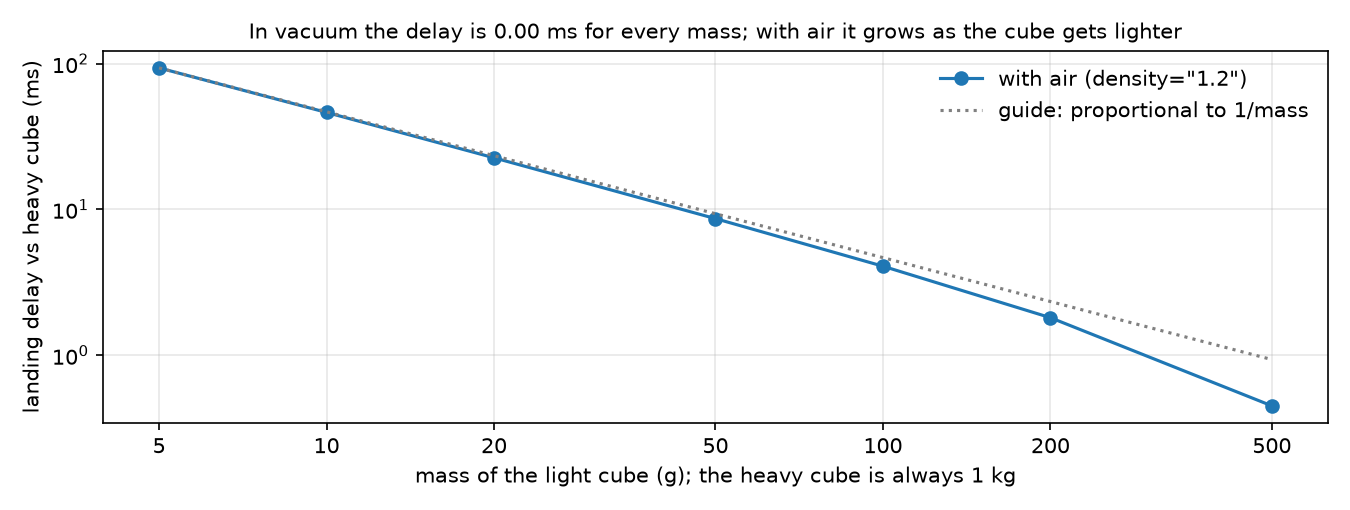
Mass cancels in vacuum (). With air the delay scales roughly as , because the drag deceleration is divided by the mass; the curve bends below the guide near 1 kg because the heavy cube is slowed a little too. The hand estimate from Math details, , gives 1.28 cm − 0.13 cm = 1.15 cm against 1.10 cm simulated. This is MuJoCo’s drag model, not a measurement of a real cube.
B · The real SO-101 file
Section titled “B · The real SO-101 file”m = mujoco.MjModel.from_xml_path(path("robotstudio_so101", "so101.xml"))print(m.nbody, m.njnt, m.nu, sum(m.body_mass))| Quantity (compiled model) | Value |
|---|---|
| bodies (including world) | 9 |
| joints | 6, all hinge (6 dof) |
| actuators | 6, gain fixed + bias affine = <position> servos, kp 998.22, kv 2.731 |
| geoms / sensors | 50 / 0 |
bodies with explicit <inertial> | 7 of 8; camera_mount is inferred from its geoms |
| total mass | 0.6454 kg |
option | timestep 0.005 s, implicitfast, elliptic cone |
Gain fixed plus bias affine is how MuJoCo stores a position servo (lesson 05). The file also sets iterations, ls_iterations and impratio.
Break it
Section titled “Break it”Compile the same SO-101 file with inertiafromgeom="true", so every body’s <inertial> is replaced by geom inference at density 1000 kg/m³ (the default, water):
| file as written | inertiafromgeom="true" | |
|---|---|---|
| total mass | 0.6454 kg | 2.3565 kg (×3.65) |
| shoulder mass | 0.1000 kg | 0.4018 kg |
| upper_arm mass | 0.1030 kg | 0.4551 kg |
| upper_arm largest principal inertia (inertia about the axis that is hardest to spin) | 1.509·10⁻⁴ kg·m² | 9.178·10⁻⁴ kg·m² |
Nothing errors and the model still simulates. Inference treats every geom in the default inertiagrouprange (0–5), visual meshes included, as a solid at 1000 kg/m³ (compiler/inertiagrouprange, geom/density). A gravity-compensation torque or a system-identification fit (estimating physical parameters from logged motion) on such a model would be off by the same factor. Always print sum(m.body_mass) after loading.
On the real robot
Section titled “On the real robot”- The Menagerie SO-101 masses come from the manufacturer’s MJCF and have not been compared with a scale here. Not yet measured on the real arm.
- Procedure: weigh the assembled follower arm without base clamp and cables, compare with 0.6454 kg, and attribute any gap (screws, cables, print infill) before trusting simulated torques.
- The real arm’s motors are listed in the LeRobot SO-101 guide: six STS3215 servos with 1/345 gearing on the follower.
Check yourself
Section titled “Check yourself”Quick check · 2 questions. Click an answer.
1. With density="1.2" (air), how does the light cube’s landing delay depend on its mass?
- It does not; air slows every cube by the same amount.
- It grows with mass, because a heavier cube pushes more air aside.
- Roughly as , because the drag deceleration is divided by the mass.
Why: The delay table in Part A falls from 93.44 ms at 5 g to 0.45 ms at 500 g and follows the guide line.
2. The SO-101 file is compiled with inertiafromgeom="true". What happens?
- It compiles and simulates without any error, but the total mass becomes 2.3565 kg instead of 0.6454 kg.
- The compiler stops, because the explicit
<inertial>elements conflict with the setting. - Nothing changes, because geoms carry no mass of their own.
Why: In Break it, inference treats every geom, visual meshes included, as a solid at 1000 kg/m³, so the mass grows ×3.65 with no warning. Always print sum(m.body_mass).
- Easy. Set
gravity="0 0 -1.62". In vacuum, do the two cubes still land at the same step? Predict the analytic time first. - Medium. Add a third cube: 100 g but 10 cm. In air, is it faster or slower than the 20 cm, 100 g cube? Reason from , then run it.
- Hard. Write an MJCF body with a 30 cm capsule geom (
mass="0.2") and an explicit<inertial>with ten times the capsule’s inertia. Compile withauto,trueandfalse, and printbody_massandbody_inertiafor each. Which setting fails to compile, and why?
Answers
Section titled “Answers”- Yes: in vacuum mass never enters. Check the step count against .
- Faster: a quarter of the frontal area at the same mass, so is four times smaller.
autokeeps your<inertial>,truereplaces it with the capsule’s inferred inertia (solid_inertia("capsule", ...)from Build it predicts it), andfalsecompiles because the body has<inertial>; it fails only for bodies without one.
Takeaways and sources
Section titled “Takeaways and sources”- MJCF =
option+ a tree ofbody/joint/geom+actuator/sensor; everything not written takes a documented default. - Mass properties are either explicit (
<inertial>) or inferred from geoms at uniform density;inertiafromgeomdecides, and the wrong choice changed the SO-101 mass by a factor of 3.65 without any error. - MuJoCo quaternions are scalar-first,
1 0 0 0= identity.
Next: lesson 02 · Time integration and the timestep.
Sources
- MuJoCo XML reference:
option,geom,joint,inertial,compiler/inertiafromgeom,inertiagrouprange. - MuJoCo Modeling: default classes, frame orientations, URDF extensions.
- MuJoCo Fluid forces.
- MuJoCo Menagerie:
robotstudio_so101(Apache-2.0) andunitree_go2READMEs (pinned commit inexperiments/common/menagerie.py). - LeRobot SO-101 guide.
- Our numbers:
experiments/01-world-as-text/output.txt.