16 · Grasping and scripted pick-and-place
| Part | 4 · Dynamics and control |
| Run type | CPU · Mac or Colab CPU |
| Prerequisites | 10, 13 |
| Learn first | none |
| Time | ~60 min |
| Code | experiments/16-grasping-and-pick-place/experiment.py |
| Status | ✅ done |
Act on this lesson
Tick each step when you have done it. Saved in this browser only.
A grasp holds when friction can carry the load. Everything else in pick-and-place, IK, trajectories, the state machine, exists to put two jaws where that is true.
The problem
Section titled “The problem”Part 7 trains policies from demonstrations, and the cheapest come from a script that already works. A scripted pick in simulation is easy to fake: weld the cube to the gripper when the jaws close and every attempt “succeeds”. The physical question: with a real contact model and no attachment, when does an SO-101 lift a 3 cm cube, and when does it squeeze it out, drop it, or never close? The answer comes from the friction cone of lesson 04, measured on 240 simulated grasps.
Before you read · 2 questions. Guess first; the lesson tells you why.
1. You pinch a cube between two fingertips on opposite faces and lift it. What carries its weight?
- The squeeze itself, since the normal forces point upward.
- Nothing; the cube is held by the shape of the fingers.
- Friction at the fingertips, at most μ times the total squeeze.
Why: The jaws press horizontally; only friction acts upward, . Build it, Step 2 - the contact forces on a held 0.4 kg cube sum to 3.924 N upward, exactly .
2. On a slippery cube, does a stronger jaw always make the grasp more reliable?
- No; a hard squeeze while the jaws still move can shoot the cube out.
- Yes; more squeeze always means more friction.
- Yes, as long as the friction-cone ratio is above 1.
Why: The wet-soap picture of Core idea. Part B at μ = 0.05 - the 2.94 N·m cap (ratio 15.11) held 7/10 and shot 3 cubes out, the 1.0 N·m cap held 10/10.
Core idea
Section titled “Core idea”In plain words
Section titled “In plain words”Pinch a cube between two fingers and nothing holds it from below: friction at the fingertips carries the whole weight, at most grip coefficient × squeeze. A heavier cube slides out. A wet bar of soap is the low-friction case: you squeeze harder, and if you squeeze while the fingers still move, the soap shoots away.
A scripted pick-and-place is a small state machine, like a traffic light: each state has an action (arm target, jaw open or closed) and an exit condition (a timer, or something sensed). The script moves the open jaws above the cube, lowers them, closes until the sensors say the grip has formed, lifts and holds.
stateDiagram-v2
    [*] --> settle
    settle --> pre: 0.3 s
    pre --> down: 1.2 s
    down --> close: 0.8 s
    close --> lift: both jaws touch, jaw speed below 0.05 rad/s for 0.1 s
    close --> lift: timeout 4 s (lift anyway)
    lift --> hold: 1.0 s
    hold --> [*]: 0.8 s, then test success
The grasp test and the state machine as code
Section titled “The grasp test and the state machine as code”ratio = mu * (N1 + N2) / (m * g) # N1, N2: normal forces of the two jaws (mj_contactForce)holds = ratio >= 1.0 # below 1 the cube slides out of the jaws
state = "settle"while state != "done": command_arm_and_jaw(state) # IK + min-jerk target, jaw open or closed if state == "close": # sensed, not timed (timeout 4 s) if both_jaws_touch() and jaw_still(speed=0.05, for_s=0.1) or timed_out(4.0): state = "lift" elif time_in_state() >= DURATION[state]: state = NEXT[state] # settle -> pre -> down -> close; lift -> hold -> done| Formula | What it says |
|---|---|
| friction can carry the weight (Lynch & Park, ch. 12) | |
| the same as a ratio: the friction-cone margin | |
| the heaviest cube a given squeeze can lift |
Here is the jaw–cube friction coefficient, the normal forces of the two jaws on the cube, the cube mass and = 9.81 m/s². The grasp is antipodal: the two contact normals point at each other, the jaws press horizontally and only friction acts upward.
Gripper and friction. The SO-101 has a fixed jaw and a hinged moving jaw (gripper joint) driven by an STS3215 position servo. Commanded to the closed limit on a 3 cm cube, the servo pushes until it reaches its torque cap, so the cap and the jaw lever set the squeeze. The jaw pads have friction 1 and priority 1; the cube gets priority 2 so that its μ is the one MuJoCo uses (Use it).
The states. pre moves the open jaws to 5.5 cm above the cube centre, down to 4 mm below it, close ramps the jaw shut over 0.3 s while the arm holds, lift rises to 7 cm above the centre. Arm targets come from damped-least-squares IK on the 5 arm joints (lesson 10), blended with the quintic of lesson 13. Success, physically: at the end the cube bottom is ≥ 4 cm above the floor and touches both jaws.
Math details: the friction cone, the squeeze and why the lift needs a little more
Coulomb friction. At each contact the tangential force is at most (lesson 04). The two tangential forces carry the weight, with each , hence .
Squeeze from the torque cap. A stalled servo pushes with its cap ; at jaw lever the moving jaw presses with about , and the fixed jaw pushes back as hard so the cube stays balanced. So : the force is not split between the jaws.
The lift. Accelerating the cube upward at needs , slightly more than a static ratio of 1. During closing the jaw pushes the cube sideways; if a contact force leaves its cone then, the cube slips away before the static test applies.
Go deeper: lesson 04 · Friction; Lynch & Park, Modern Robotics, ch. 12; MuJoCo Modeling · contact parameters.
Build it
Section titled “Build it”You will write the grasp test, the squeeze formula and the pick state machine in about 90 lines of NumPy and drive the Experiment’s SO-101 with them; MuJoCo’s contact forces and SciPy are the referees. The finished functions are in physai/grasp.py; uv run python experiments/16-grasping-and-pick-place/build.py runs the five steps in about 5 s (output in build_output.txt).
Step 1 · The friction-cone test
Section titled “Step 1 · The friction-cone test”def cone_ratio(mu, normal_forces, mass, g=9.81): """Friction-cone margin of an antipodal grasp: mu (N1 + N2) / (m g). Below 1 the object slides out.""" return mu * np.sum(normal_forces) / (mass * g)def max_mass(mu, normal_forces, g=9.81): """The heaviest object this squeeze can hold by friction alone.""" return mu * np.sum(normal_forces) / gThe check recomputes the ratio columns of parts A–C from the squeeze printed in output.txt:
== Step 1. The friction-cone ratio from the Experiment's own squeeze forces (output.txt) ==part A: 6 rows, max |ours - printed ratio| = 0.01part B: 4 rows, max |ours - printed ratio| = 0.00part C: 8 rows, max |ours - printed ratio| = 0.00max_mass: mu 0.05, 12.74 N -> 0.065 kg; mu 0.3, 16.25 N -> 0.497 kgThe 0.01 is the rounding of the printed squeeze. At μ = 0.3, 16.25 N could hold 0.497 kg at rest, yet part C drops 0.45 kg: the lift needs more (Step 5).
Step 2 · Look inside a held grasp
Section titled “Step 2 · Look inside a held grasp”def cone_use(f_contact, mu): """How much of its friction cone a contact uses: |tangential| / (mu * normal), from a contact-frame force (normal, tangent1, tangent2), the order mj_contactForce returns. Above 1 it slides.""" f = np.asarray(f_contact, float) return np.hypot(f[1], f[2]) / (mu * f[0])The check sums the vertical force on the cube over all jaw contacts and asks how much of its cone each contact uses:
== Step 2. Inside a held grasp (end of the hold, cube in the air) ==case contacts sum Fz N m g N max cone usemu 1.0, 30 g 18 0.294 0.294 0.037mu 0.3, 0.4 kg 7 3.924 3.924 1.000Friction alone carries exactly the weight. With 30 g and μ = 1 the busiest contact uses 3.7 % of its cone; at 0.4 kg and μ = 0.3 (ratio 1.24) some contacts sit at the edge (1.000) and the others carry the rest.
Step 3 · The squeeze from the torque cap
Section titled “Step 3 · The squeeze from the torque cap”def squeeze_from_cap(tau_max, r_jaw): """Squeeze of a stalled parallel jaw: the moving jaw presses tau/r, the fixed jaw pushes back as hard, so N1 + N2 = 2 tau / r (the force is not split between the jaws).""" return 2 * tau_max / r_jawThe jaw lever is measured: the moment arm of the moving-jaw contacts about the hinge, weighted by normal force. The jaw’s static friction lets it press with plus or minus that loss:
== Step 3. Squeeze from the jaw torque cap (mu = 0.05, 30 g, nominal position) ==jaw friction loss 0.052 N m; band = 2 (tau +- loss) / r cap N m r_jaw cm 2 tau / r N band N squeeze N N fixed / N moving 1.00 7.37 27.13 [25.72, 28.54] 26.12 1.002 0.50 7.42 13.47 [12.07, 14.87] 12.66 1.001 0.30 7.44 8.07 [6.67, 9.47] 6.68 1.004The squeeze lies inside the band at every cap and the jaws press equally (ratio 1.00): each carries about , the total is . These are single picks at the nominal position; the tables average 10 positions.
Step 4 · The state machine
Section titled “Step 4 · The state machine”def minjerk(u): """Minimum-jerk blend 0 -> 1 over u in [0, 1]: zero velocity and acceleration at both ends.""" u = min(1.0, max(0.0, u)) return u ** 3 * (10 - 15 * u + 6 * u * u)class PickMachine: """settle -> pre -> down -> close -> lift -> hold -> done. Timed states end after their duration; close ends on a sensed condition: both jaws touch and the jaw is still for `still_time` (or a timeout)."""
NEXT = dict(settle="pre", pre="down", down="close", close="lift", lift="hold", hold="done") MOVES = dict(settle=("home", "home"), pre=("home", "pre"), down=("pre", "down"), lift=("down", "lift"), hold=("lift", "lift"))
def __init__(self, durations, close_timeout=4.0, still_speed=0.05, still_time=0.1, t0=0.0): self.dur, self.timeout = durations, close_timeout self.still_speed, self.still_time = still_speed, still_time self.state, self.t_state, self.still_since, self.close_s = "settle", t0, None, float("nan")
def command(self, now, poses, jaw_open, jaw_closed): """Arm joint targets and jaw target for this step: min-jerk between poses; in close, a jaw ramp.""" t = now - self.t_state if self.state == "close": u = minjerk(t / self.dur["close_ramp"]) return poses["down"], jaw_open + u * (jaw_closed - jaw_open) a, b = self.MOVES[self.state] q = poses[a] + minjerk(t / self.dur[self.state]) * (poses[b] - poses[a]) return q, jaw_open if self.state in ("settle", "pre", "down") else jaw_closed
def update(self, now, both_touch=False, jaw_speed=0.0): """Call after every physics step with what the sensors say; returns the (possibly new) state.""" t = now - self.t_state if self.state == "close": settled = both_touch and abs(jaw_speed) < self.still_speed and t > self.dur["close_ramp"] if not settled: self.still_since = None elif self.still_since is None: self.still_since = now if self.still_since is not None and now - self.still_since >= self.still_time: self.close_s = t # the grip formed: lift self.state, self.t_state = "lift", now elif t > self.timeout: self.state, self.t_state = "lift", now # lift anyway; the success test will tell elif t >= self.dur[self.state] - 1e-9: self.state, self.t_state = self.NEXT[self.state], now return self.stateThe loop asks for targets, steps MuJoCo and reports what the jaws sense:
while sm.state != "done": d.ctrl[arm], d.ctrl[jaw] = sm.command(d.time, poses, G_OPEN, G_CLOSE) mujoco.mj_step(m, d) nf, nm = jaw_contacts(m, d) # normal force from each jaw (mj_contactForce) sm.update(d.time, nf > 0 and nm > 0, d.qvel[jaw_dof])Check against the Experiment’s scripted_pick from the same start:
== Step 4. Our state machine vs the Experiment's scripted_pick (nominal pick) ==minjerk: s(0.5) = 0.500, peak speed 1.8750 (15/8 = 1.875), |v|, |a| at the ends < 6e-04 (finite differences)ours: held, lift 7.37 cm, jaw forces 39.84 / 39.83 N, close 0.474 s, 2287 stepsExp.: success True, lift 7.37 cm, jaw forces 39.84 / 39.83 N, close 0.474 s, 2287 steps; max |qpos ours - Exp.| = 0.0e+00Identical to the last bit over 2287 steps, and the blend starts and ends at rest.
Step 5 · Outcomes and their uncertainty
Section titled “Step 5 · Outcomes and their uncertainty”def pick_outcome(lift, touches_both, closed, min_lift=0.04): """Physical success test: lifted at least min_lift (m) and still in both jaws; else why it failed.""" if lift >= min_lift and touches_both: return "held" return "dropped" if closed else "not closed"def wilson(k, n, z=1.96): """Wilson 95 % interval for a success rate of k out of n trials.""" p = k / n den = 1 + z * z / n c = (p + z * z / (2 * n)) / den h = z * math.sqrt(p * (1 - p) / n + z * z / (4 * n * n)) / den return max(0.0, c - h), min(1.0, c + h)The check reruns three sweep rows with your machine and compares the Wilson interval with SciPy’s:
== Step 5. Three sweep rows rerun with our machine (10 positions, seed 0) ==row held / not closed / dropped squeeze N ratio Wilson 95% vs SciPyA mu 0.03 2 / 8 / 0 12.29 1.25 [0.06, 0.51] 5.6e-06C 0.4 kg 10 / 0 / 0 16.25 1.24 [0.72, 1.00] 7.4e-06C 0.45 kg 0 / 0 / 10 16.47 1.12 [0.00, 0.28] 7.4e-06Parts A and C, number for number. SciPy uses = 1.95996…, you use 1.96, hence the 1e-5.
What you keep
Section titled “What you keep”physai.grasp now has cone_ratio, max_mass, cone_use, squeeze_from_cap, minjerk, PickMachine, pick_outcome, wilson. Lesson 26 records demonstrations with the scripted pick, and lesson 25 reports success rates with Wilson intervals. Test: uv run pytest tests/test_16_grasping_and_pick_place.py.
Use it
Section titled “Use it”MuJoCo decides the contact physics; your code sets and reads it:
geom.priority = 2; geom.friction = [mu, 0.03, 0.003]; geom.condim = 4 # MjSpec: whose mu counts, sliding + torsionm.opt.cone # 1 = elliptic in the SO-101 model, 0 = pyramidalmujoco.mj_contactForce(m, d, k, f6) # contact k: f6[:3] = (normal, tangent1, tangent2), then torqueson_geom2 = d.contact[k].frame.reshape(3, 3).T @ f6[:3] # world frame; normal points geom1 -> geom2ci = scipy.stats.binomtest(k, n).proportion_ci(method="wilson")| Piece | physai / this lesson | MuJoCo | SciPy |
|---|---|---|---|
| friction coefficient that counts | μ in cone_ratio | geom with higher priority, else element-wise max of friction | |
| contact force | cone_use(f) input, (normal, t1, t2) | mj_contactForce, contact frame, normal first | |
| success interval | wilson(k, n) | binomtest(k, n).proportion_ci(method="wilson") |
Sources: MuJoCo Modeling · contact, mjContact, mj_contactForce; SciPy binomtest.
Three traps:
- Sign and frame.
mj_contactForceis in the contact frame, whose normal points fromgeom1togeom2: flip the sign when the cube isgeom1(Step 2). - Pyramidal cones have more rows. With
cone="pyramidal",efc_forceholds pyramid-edge forces per contact, not (normal, tangents); read forces throughmj_contactForce. - SciPy’s default interval is not Wilson.
proportion_ci()defaults tomethod="exact"(Clopper–Pearson, wider); passmethod="wilson"to match the tables.
Check after building · 2 questions.
1. A stalled jaw servo presses the moving jaw on the cube with about . What is the total squeeze ?
- About , split between the two jaws.
- About , because the fixed jaw pushes back with the same force.
- It depends on μ, since friction adds to the normal force.
Why: Build it, Step 3 - the two jaws press equally (fixed / moving 1.001 at 0.5 N·m) and the squeeze, 12.66 N, lies inside the band = [12.07, 14.87] N with = 7.42 cm.
2. You report part C’s 10/10 with scipy.stats.binomtest(10, 10).proportion_ci() and get a different interval than the table’s [0.72, 1.00]. Why?
- SciPy uses = 1.95996 instead of 1.96, which moves the bound visibly.
- The default method is
"exact"(Clopper–Pearson), which is wider; passmethod="wilson". - SciPy expects the number of failures, not successes.
Why: Use it, traps. With method="wilson" Step 5 agrees with SciPy to 7.4e-06; the difference only explains that last 1e-5.
Experiment
Section titled “Experiment”The pick is one function Part 7 imports to record demonstrations:
def scripted_pick(model, data, cube_pos, record=False): """Runs settle -> pre -> down -> close -> lift -> hold in (model, data). Returns success, lift_cm, squeeze_N, close_s, ... and with record=True the per-step (time, state, qpos, ctrl) trajectory."""Setup: SO-101 (Menagerie scene.xml, timestep 2 ms), 3 cm cube, condim 4, cube friction μ, mass m, jaw torque cap τ (default 2.94 N·m). Every sweep value runs 10 cube positions uniform in a 2 × 2 cm square around (22, 0) cm, seed 0. Script: experiments/16-grasping-and-pick-place/experiment.py. MuJoCo 3.17.0, NumPy 2.5.4, Python 3.14, Apple M5, deterministic, ~30 s.
Nominal pick (μ 1.0, 30 g, default cap): success, cube bottom at 7.37 cm, IK error 0.18 mm, jaw forces 39.84 / 39.83 N, 2287 recorded steps. A squeeze of about 80 N on a 0.29 N cube never tests friction, so parts A and C use a 0.5 N·m cap.
Predict: with τ = 0.5 N·m the squeeze is about 13 N, so for 30 g the cone fails below μ ≈ 0.02. Will the measured boundary sit there?
A. Friction sweep (30 g, τ = 0.5 N·m). “close” = time in the close state, “squeeze” = when it ends (means over trials where the jaw closed). “Wilson 95%” is the range of true success rates consistent with k of n; with 10 trials it is wide. “Ejected”: cube ended more than 30 cm away.
| μ | success | Wilson 95% | close | squeeze | held / not closed / dropped; ejected | |
|---|---|---|---|---|---|---|
| 0.005 | 0/10 | [0.00, 0.28] | – | – | – | 0 / 10 / 0; 10 |
| 0.01 | 0/10 | [0.00, 0.28] | – | – | – | 0 / 10 / 0; 10 |
| 0.015 | 0/10 | [0.00, 0.28] | – | – | – | 0 / 10 / 0; 10 |
| 0.02 | 0/10 | [0.00, 0.28] | 1.59 s | 14.21 N | 0.97 | 0 / 9 / 1; 8 |
| 0.03 | 2/10 | [0.06, 0.51] | 1.62 | 12.29 | 1.25 | 2 / 8 / 0; 7 |
| 0.05 | 10/10 | [0.72, 1.00] | 1.63 | 12.74 | 2.16 | 10 / 0 / 0; 0 |
| 0.1 | 10/10 | [0.72, 1.00] | 1.63 | 13.26 | 4.51 | 10 / 0 / 0; 0 |
| 0.3 | 10/10 | [0.72, 1.00] | 1.58 | 14.24 | 14.52 | 10 / 0 / 0; 0 |
| 1.0 | 10/10 | [0.72, 1.00] | 1.56 | 14.91 | 50.65 | 10 / 0 / 0; 0 |
The boundary lies between μ = 0.03 and 0.05, near the prediction, but the failures below it are not drops after the lift. In 47 of the 48 failed trials at μ ≤ 0.03 the jaw never settled: the cube left the jaws while they closed (45 ejected). Low friction fails at the squeeze, before the weight matters. The ejection distances reflect MuJoCo’s soft contact at very low μ, not real speeds.
B. Jaw torque cap (30 g, μ = 0.05):
| τ [N·m] | success | close | squeeze | ratio | held / not closed / dropped; ejected |
|---|---|---|---|---|---|
| 2.94 | 7/10 | 0.96 s | 88.93 N | 15.11 | 7 / 1 / 2; 3 |
| 1.0 | 10/10 | 0.91 | 27.23 | 4.63 | 10 / 0 / 0; 0 |
| 0.5 | 10/10 | 1.63 | 12.74 | 2.16 | 10 / 0 / 0; 0 |
| 0.3 | 10/10 | 2.65 | 7.04 | 1.20 | 10 / 0 / 0; 0 |
| 0.2 | 0/10 | – | – | – | 0 / 10 / 0; 5 |
| 0.15 | 0/10 | – | – | – | 0 / 10 / 0; 0 |
| 0.1 | 0/10 | – | – | – | 0 / 10 / 0; 0 |
Squeeze grows roughly in proportion to the cap (7.04 → 12.74 → 27.23 N; Step 3). Below 0.3 N·m the jaw closes so slowly against its damping (0.60 N·m·s/rad) and friction loss (0.052 N·m) that it never settles within the 4 s timeout (close time 0.91 → 1.63 → 2.65 s as the cap drops). At 2.94 N·m, 3 of 10 cubes are shot out: more force is not always a better grasp.
C. Mass sweep (μ = 0.3, τ = 0.5 N·m):
| m [kg] | 0.03 | 0.1 | 0.2 | 0.3 | 0.4 | 0.45 | 0.5 | 0.7 |
|---|---|---|---|---|---|---|---|---|
| success | 10/10 | 10/10 | 10/10 | 10/10 | 10/10 | 0/10 | 0/10 | 0/10 |
| squeeze [N] | 14.24 | 14.95 | 15.52 | 15.87 | 16.25 | 16.47 | 16.61 | 16.90 |
| 14.52 | 4.57 | 2.37 | 1.62 | 1.24 | 1.12 | 1.02 | 0.74 | |
| outcome | held | held | held | held | held | dropped | dropped | dropped |
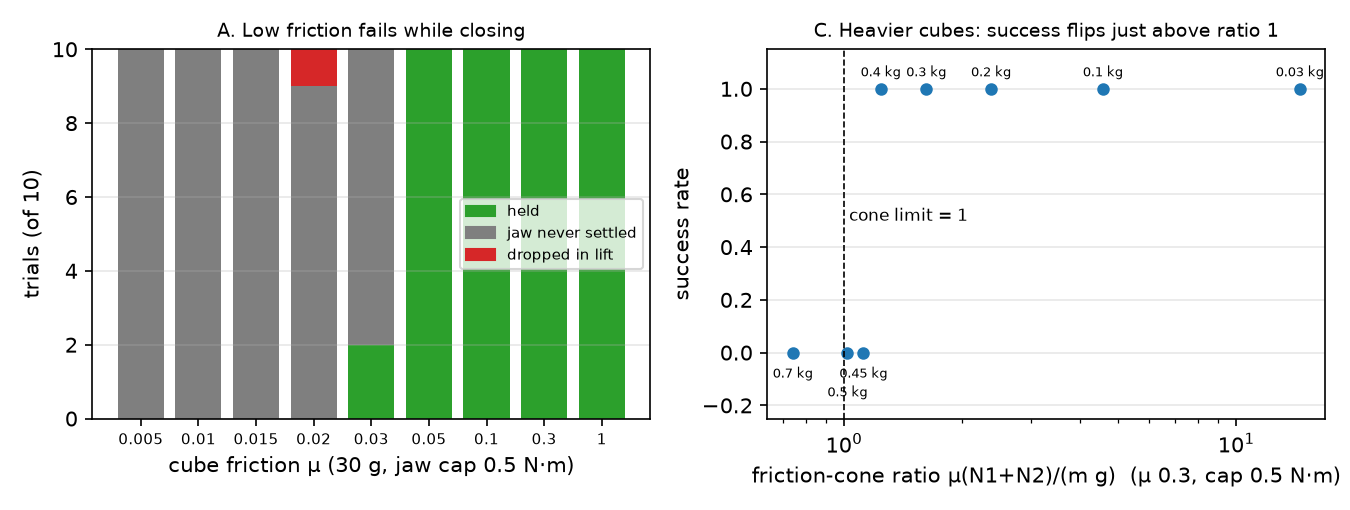
Here the cone is the whole story: every mass with mean ratio ≥ 1.24 holds in all trials, every mass with ratio ≤ 1.12 drops during the lift. The boundary sits slightly above 1: the extra force to accelerate the cube upward.
Break it
Section titled “Break it”Lower μ (part A) or raise the mass (part C) and the grasp fails two ways. Heavy cube, ratio ≤ 1.12: it slides down between the jaws during the lift, as the cone predicts. Slippery cube, μ ≤ 0.015: all 10 cubes per value are expelled while the jaw closes. Even at μ = 0.03, static ratio 1.25, 8 of 10 grasps never form. A cone check on the final grasp is necessary but not sufficient: closing must keep the contacts inside their cones too.
On the real robot
Section titled “On the real robot”- SO-101 / LeRobot. At connect, LeRobot limits the gripper servo with
Max_Torque_Limit500,Protection_Current250 andOverload_Torque25 (so_follower.py). Their value in newton-metres at the jaw is not documented there; the Menagerie cap of 2.94 N·m is a model parameter, not a measurement. - Not yet measured on the real arm. Procedure: 3 cm cubes of two surface finishes, weighed; run the scripted pick (joint offsets from calibration) 20 times per cube at fixed positions; score with the same physical test (lifted ≥ 4 cm, held 1 s); report k/n with a Wilson interval.
- Sim-to-real gaps. Real friction differs between static and kinetic and varies with dust and wear (MuJoCo has one μ), and pads deform. Expect the boundary to move; the method carries over.
Check yourself
Section titled “Check yourself”Quick check · 2 questions. Click an answer.
1. In part C a 0.45 kg cube has a friction-cone ratio of 1.12, above 1, yet all 10 lifts drop it. Why?
- Lifting accelerates the cube upward, which needs , a bit more than the static test.
- The jaw never closes on a heavy cube.
- The ratio is computed with the wrong μ, because the jaw pads have priority.
Why: Every mass with ratio ≥ 1.24 held, every mass with ratio ≤ 1.12 dropped during the lift (part C). The cube was given priority 2, so its μ is the one that counts.
2. At μ ≤ 0.03 (30 g, cap 0.5 N·m) almost every grasp fails. When does it fail?
- After the lift, when the cube slides down between the jaws.
- During the
downstate, when the open jaws knock the cube over. - While the jaws are closing; the cube leaves them before the grip forms.
Why: In 47 of the 48 failed trials at μ ≤ 0.03 the jaw never settled on the cube (part A). A cone check on the final grasp is necessary but not sufficient.
- Easy. With squeeze = 12.74 N and μ = 0.05, what is the heaviest cube the cone condition allows?
- Medium. Why does the script end
closeon a sensed condition instead of after a fixed 0.6 s? Use part B’s close times. - Hard. Make the
closestate also check that the cube has not moved more than 5 mm since the jaw ramp started, and abort (re-open, re-approach) if it has. Rerun part A. Predict first: does success at μ = 0.03 improve?
Answers
Section titled “Answers”- kg.
- Close time ranges from 0.91 s (τ 1.0 N·m) to 2.65 s (τ 0.3 N·m). A fixed 0.6 s is shorter than all of them, so it would lift before the jaw settled; a timer long enough for the slowest cap wastes time at the fast ones.
- Not computed here; run it.
Takeaways and sources
Section titled “Takeaways and sources”- The friction cone predicts the lift: with the squeeze measured, ratio ≥ 1.24 held 50/50 trials and ratio ≤ 1.12 dropped 30/30 (part C).
- At low μ the grasp fails earlier, during closing (47 of 48 failures at μ ≤ 0.03); squeeze scales with the jaw cap, and too low a cap never closes within 4 s.
scripted_pick(andphysai.grasp.PickMachine) is a physically verified demonstration generator: state machine, IK, min-jerk, a sensed close condition, no weld.
Next: Part 5 · lesson 17 · Sensors, noise and filtering; the demonstrations are used in lesson 26.
Sources:
- Lynch & Park, Modern Robotics, ch. 12 (Grasping and Manipulation).
- MuJoCo Modeling · contact parameters (priority, friction),
mj_contactForce; Menagerierobotstudio_so101(Apache-2.0). - LeRobot
so_follower.py(read 2026-10-27). - All measured numbers:
experiments/16-grasping-and-pick-place/output.txtandbuild_output.txt.