02 · Time integration and the timestep
| Part | 1 · Simulation |
| Run type | CPU · Mac or Colab CPU |
| Prerequisites | 01 |
| Learn first | Calculus for Machine Learning · Numerical Stability |
| Time | ~30 min |
| Code | experiments/02-timestep/experiment.py · notebook |
| Status | ✅ done |
Act on this lesson
Tick each step when you have done it. Saved in this browser only.
A simulator does not let time flow; it jumps by
dtand looks for contacts only where it lands.
The problem
Section titled “The problem”Unitree’s open training code for its legged robots (Isaac Gym) steps physics at sim.dt = 0.005 s and lets the policy act every decimation = 4 steps, i.e. 50 decisions per second (legged_robot_config.py). Why 5 ms and not 20? MuJoCo calls the timestep “the single most important parameter” for the speed–accuracy trade-off (XML reference · option/timestep). A concrete failure: a 5 cm cube dropped from 1 m onto a 1 cm tabletop ends up on the floor. Which dt values cause it, and is “smaller is always safe” true?
Before you read · 2 questions. Guess first; the lesson tells you why.
1. From dt = 25 ms on, the “contact seen” column says no. What does that mean?
- One step (10.93 cm or more) jumps over the whole overlap zone, and collisions are only checked at the step instants.
- The solver discards contacts that arrive faster than a speed limit.
- The integration error pushes the cube sideways past the tabletop.
Why: Missed contact, failure mode 1 under Observe; the step column reads 10.93–21.87 cm for 25–50 ms, and contact detection never runs along the path.
2. The cube goes through the tabletop at some timestep. You halve the timestep. Is the drop now guaranteed to be safer?
- Yes, a smaller step always catches the contact earlier.
- No; in this scene the result is not monotonic in
dt, and 0.5 ms fails where 2 ms stays. - Only if the integrator is changed to RK4 at the same time.
Why: In the sweep, 0.5 and 1 ms go through (too-soft contact), 2 ms stays at a lowest centre of 29.60 cm, and 12 and 20 ms survive by where the last contact-free step lands.
Core idea
Section titled “Core idea”In plain words
Section titled “In plain words”A simulator works like a strobe light in a dark room: it flashes once per timestep, computes where everything is at that instant, and jumps to the next flash. Nothing between two flashes is ever computed.
Collisions are found only at the flashes. A fast cube above a thin tabletop at one flash and below it at the next never touches the table. A flash that catches the cube inside the slab pushes it out through the nearer face, the bottom one once the cube’s centre is past the middle. And a soft contact can let a cube caught on the right side sink past the middle anyway.
So the timestep is not only an accuracy knob: with the body’s speed and the obstacle’s thickness, it decides whether a contact exists at all.
flowchart TD
    S["state at time t<br/>position q, velocity v"] --> CD["collision detection<br/>only at this q"]
    CD --> F["gravity + contact forces<br/>give acceleration a"]
    F --> V["v = v + h·a"]
    V --> Q["q = q + h·v<br/>(with the new v)"]
    Q -- "t = t + h" --> S
One timestep, as code
Section titled “One timestep, as code”h = 0.002 # timestep in seconds (MuJoCo's default)while t < t_end: contacts = detect(q) # overlaps at THIS position only, never along the path a = acceleration(q, v, contacts) # gravity plus contact forces, divided by mass v = v + h * a # update the velocity first ... q = q + h * v # ... then move with the NEW velocity: a jump of v*h t = t + h| Quantity | Formula |
|---|---|
| semi-implicit Euler step | |
| distance jumped in one step | |
| speed after a free fall from height |
is position, velocity, acceleration, the timestep (dt), time, gravity and the drop height.
Math details: why "semi-implicit", and what an integrator can and cannot fix
Discretizing. Physics is a differential equation, , . An integrator replaces it with a rule that jumps from to . MuJoCo computes accelerations in continuous time, then integrates (Computation · Numerical integration).
Explicit vs semi-implicit Euler. Explicit Euler moves with the old velocity, ; semi-implicit Euler, MuJoCo’s Euler, with the new one. On a spring, , explicit Euler multiplies the amplitude by every step, gaining energy at any . Semi-implicit Euler’s step matrix has determinant 1 and eigenvalues on the unit circle while ; beyond that it blows up (Build it, Step 3; again in lessons 03 and 05).
What integrators change. The others treat more force terms implicitly (solved at the new state) or evaluate forces several times per step (RK4). That helps stiff damping and smooth motion; none adds continuous collision detection.
Why the mid-plane matters. For a thin slab, the shortest way out of the overlap is downward once the cube’s centre is past the slab’s mid-plane, and the measured contact normal flips exactly there (items 2 and 3 under Observe below).
Go deeper: Calculus for Machine Learning, Numerical Stability (AIEFS); MuJoCo Computation · Integrators.
Contact is checked only at the steps
Section titled “Contact is checked only at the steps”Three things can go wrong for a fast body and a thin obstacle:
| Failure | Condition | Result |
|---|---|---|
| missed contact | no step lands in overlap | the engine never sees the table |
| wrong-side overlap | first overlap already past the slab’s mid-plane | the box–box contact normal points down; the solver pushes the cube through |
| too-soft contact | contact seen on the right side, but the soft constraint lets the cube sink past the mid-plane | the normal flips during the impact |
The contact normal is the direction the contact pushes along. The third failure is set by solref, the contact’s softness (lesson 03), not by the timestep.
Integrators
Section titled “Integrators”An integrator turns accelerations into the next velocity and position. “Implicit” evaluates a force term at the new, unknown state (a linear solve, but it tolerates stiff forces); “explicit” at the current state.
integrator | What is implicit | What it improves |
|---|---|---|
Euler (default) | joint damping only | cheapest; the docs keep it for compatibility and recommend implicitfast |
implicitfast | all velocity-dependent forces except Coriolis/centrifugal | stiff damping, actuator kv, drag |
implicit | the same plus Coriolis/centrifugal (LU solve) | coupled rotating chains (multi-link pendula) |
RK4 | none; 4th-order multi-stage | accuracy of smooth motion, 4 force evaluations per step |
discrete | velocity and position stiffness, solved together with constraints | stiff springs and position servos far beyond the explicit limit |
Source: Computation · Integrators, option/integrator. Whether it matters for the falling cube is measured below.
Build it
Section titled “Build it”You will now write three integrators, measure where each becomes unstable, and reproduce the Experiment’s “centre at 1st overlap” column without a physics engine, in about 50 lines of NumPy. Type the steps into your own file and run it after each step. The finished functions are in physai/sim.py; uv run python experiments/02-timestep/build.py runs all four steps with the checks (output in build_output.txt).
Step 1 · Three ways to take a step
Section titled “Step 1 · Three ways to take a step”Each stepper takes the state , a function accel(x, v) and the step , and returns the next state. Explicit Euler moves with the old velocity, semi-implicit Euler (MuJoCo’s Euler, written in lesson 01) with the new one, and RK4 averages four slopes:
def explicit_euler(x, v, accel, h): """Move with the old velocity, then update it.""" return x + h * v, v + h * accel(x, v)def semi_implicit_euler(x, v, accel, h, c_implicit=0.0): """Update the velocity first, then move with the new one (MuJoCo's Euler).
c_implicit: damping per unit inertia treated implicitly, v' = v + h a / (1 + h c), as MuJoCo's Euler does for joint damping and implicitfast for every velocity-dependent force (lesson 05). """ v_new = v + h * accel(x, v) / (1 + h * c_implicit) return x + h * v_new, v_newdef rk4(x, v, accel, h): """Classic fourth-order Runge-Kutta on (x, v): four force evaluations per step.""" k1x, k1v = v, accel(x, v) k2x, k2v = v + h / 2 * k1v, accel(x + h / 2 * k1x, v + h / 2 * k1v) k3x, k3v = v + h / 2 * k2v, accel(x + h / 2 * k2x, v + h / 2 * k2v) k4x, k4v = v + h * k3v, accel(x + h * k3x, v + h * k3v) return (x + h / 6 * (k1x + 2 * k2x + 2 * k3x + k4x), v + h / 6 * (k1v + 2 * k2v + 2 * k3v + k4v))The test bed is a 1 kg mass on a 1 Hz spring, with rad/s, built in MuJoCo as a slide joint with stiffness = :
== Step 1. Our steppers vs mj_step on a 1 Hz spring (h = 10 ms, 500 steps) ==semi_implicit_euler vs integrator=Euler: max |x_ours - qpos| = 5.6e-17 mrk4 vs integrator=RK4 : max |x_ours - qpos| = 4.8e-16 mexplicit_euler: no MuJoCo integrator moves with the old velocity; checked against its formula in Step 2Step 2 · Energy
Section titled “Step 2 · Energy”A spring should keep its energy forever. After 1000 steps at a comfortable = 0.063:
== Step 2. Energy after 1000 steps, relative to the start (h = 10 ms, h*w = 0.063) ==explicit_euler E/E0 = 51.422174semi_implicit_euler E/E0 = 0.999350rk4 E/E0 = 0.999999formula for explicit Euler (1 + h^2 w^2)^n = 51.422174Explicit Euler multiplies the energy by exactly per step (Math details): 51 times after ten seconds. Semi-implicit Euler wobbles around the right value without drift; RK4 loses a little.
Step 3 · The stability limit
Section titled “Step 3 · The stability limit”Each stepper on a linear force is a 2 × 2 matrix acting on . Apply one step to and to get its columns; its largest |eigenvalue| is the growth per step:
def step_growth(step, h, k, c=0.0, **kw): """Largest |eigenvalue| of one step on a = -k x - c v: above 1, every step amplifies the motion.""" accel = lambda x, v: -k * x - c * v # noqa: E731 cols = [step(x, v, accel, h, **kw) for x, v in ((1.0, 0.0), (0.0, 1.0))] return np.abs(np.linalg.eigvals(np.array(cols).T)).max()== Step 3. Growth per step on the undamped spring vs h*w == h*w explicit_euler semi_implicit rk4 max |x| over 10 steps: ours (semi-implicit) / MuJoCo Euler 0.5 1.118034 1.000000 0.999895 0.1022 m / 0.1022 m (started at 0.1) 1.0 1.414214 1.000000 0.993905 0.1 m / 0.1 m (started at 0.1) 1.9 2.147091 1.000000 0.800899 0.3202 m / 0.3202 m (started at 0.1) 2.1 2.325941 1.877328 0.682240 116.4 m / 116.4 m (started at 0.1) 2.8 2.973214 5.663429 0.930667 4.123e+06 m / 4.123e+06 m (started at 0.1) 2.9 3.067572 6.250000 1.193063 1.083e+07 m / 1.083e+07 m (started at 0.1)Semi-implicit Euler is exactly neutral (1.000000) up to and explodes beyond it, in your code and in MuJoCo alike, step for step. Below the limit the orbit is bounded but distorted: at = 1.9 the mass swings to 0.32 m from a 0.1 m start. Explicit Euler grows at every . RK4 damps slightly, holds at = 2.8 and fails at 2.9. This is the that lessons 03 and 05 meet as contact stiffness and servo gain.
Step 4 · The first overlapping step
Section titled “Step 4 · The first overlapping step”Before the first overlap there is no contact, so free fall with your stepper predicts where the cube lands relative to the slab:
def first_overlap(z0, h, top, bottom, half, g=9.81): """Free fall with MuJoCo's Euler from rest at z0: centre height at the first step a cube of half-size `half` overlaps a slab between `bottom` and `top`, or None if a step jumps over the slab.""" z, v = z0, 0.0 while z + half > bottom: z, v = semi_implicit_euler(z, v, lambda x, u: -g, h) if z - half < top and z + half > bottom: return z return None== Step 4. Drop onto the 1 cm tabletop: centre at the first overlapping step (cm) ==dt (ms) ours MuJoCo side of the mid-plane (29.5 cm) 0.5 32.32 32.32 above 1 32.21 32.21 above 2 31.99 31.99 above 3 31.34 31.34 above 4 32.43 32.43 above 6 32.00 32.00 above 8 29.80 29.80 above 10 28.47 28.47 below: pushed out downward 12 30.69 30.69 above 15 27.36 27.36 below: pushed out downward 20 30.72 30.72 above 25 - - no step overlaps: missed contact 30 - - no step overlaps: missed contact 40 - - no step overlaps: missed contact 50 - - no step overlaps: missed contactThe Experiment’s column, every row, including the wrong-side overlaps (10, 15 ms) and the four timesteps that jump over the slab. What happens after the first overlap needs lesson 03’s contact model.
What you keep
Section titled “What you keep”physai.sim now has explicit_euler, semi_implicit_euler, rk4, step_growth and first_overlap. Lesson 03 runs step_growth on the contact spring, lesson 05 on a position servo. tests/test_02_timestep.py pins them to MuJoCo; run uv run pytest tests/test_02_timestep.py after you change anything.
Use it
Section titled “Use it”In MuJoCo the timestep and the integrator are two fields of m.opt, and mj_step applies them:
m.opt.timestep = 0.005m.opt.integrator = mujoco.mjtIntegrator.mjINT_IMPLICITFAST # or mjINT_EULER, mjINT_RK4, ...for _ in range(n_substeps): # physics steps per control decision mujoco.mj_step(m, d)Tools split “physics step” and “control step” under different names:
| Tool | Physics step | Control step |
|---|---|---|
| MuJoCo | m.opt.timestep | your loop: how many mj_step calls per action |
| Gymnasium MuJoCo envs | model.opt.timestep | frame_skip steps per env.step(); env.dt = timestep * frame_skip |
legged_gym (The problem) | sim.dt = 0.005 s | decimation = 4 physics steps per action |
SciPy solve_ivp | adaptive, method="RK45" by default | – (not a control loop) |
Traps:
- “Euler” is semi-implicit. MuJoCo’s
Eulermatchessemi_implicit_euler, not the textbook method (Step 1). - Split stepping ignores RK4. With
integrator="RK4",mj_step1followed bymj_step2(the split used to set controls mid-step) reproducessemi_implicit_euler, notrk4: we checked it on the Step 1 spring. env.dtis not the timestep. A Gymnasium policy acts everyframe_skipphysics steps; a rate computed frommodel.opt.timestepalone is off by that factor.
Check after building · 2 questions.
1. In Build it, Step 2, explicit Euler ends with 51.422174 times the spring’s starting energy after 1000 steps at = 0.063. Where does that number come from?
- Round-off error that piles up over 1000 steps.
- The spring’s damping, which explicit Euler gets wrong.
- Every step multiplies the energy by exactly , and = 51.422174.
Why: Moving with the old velocity makes the step matrix’s determinant ; the printed formula and the simulation agree to six decimals. The spring has no damping, and semi-implicit Euler stays at 0.999350.
2. Build it, Step 4 reproduces the Experiment’s “centre at 1st overlap” column for every dt with a free-fall loop and no contact model. Why is that enough?
- Before the first overlapping step no contact exists, so the cube is in free fall, and MuJoCo’s
Euleris the same semi-implicit step. - MuJoCo turns off contacts for fast bodies.
- The contact force is too small to matter at 4.37 m/s.
Why: Contacts are found only at sampled states, and the first one can appear only at the first overlapping step; up to there first_overlap and mj_step compute the same heights (Step 1 shows the steppers agree to 5.6e-17 m).
Experiment
Section titled “Experiment”Scene: floor, a 24 × 24 × 1 cm tabletop with its top at 30 cm (mid-plane 29.5 cm), and a 5 cm, 100 g cube starting 97.5 cm above it.
XML = """<mujoco>  <worldbody>    <geom name="floor" type="plane" size="2 2 0.1"/>    <geom name="table" type="box" size="0.12 0.12 0.005" pos="0 0 0.295"/>    <body name="cube" pos="0 0 1.30">      <freejoint/>      <geom type="box" size="0.025 0.025 0.025" mass="0.1"/>    </body>  </worldbody></mujoco>"""
m = mujoco.MjModel.from_xml_string(XML)m.opt.timestep = dt_ms / 1000          # <- the swept number
For each dt the script records the cube centre at the first step that overlaps the tabletop (where a contact can first appear), whether any table contact was found, the lowest centre during the impact, and the result. It repeats the sweep with a stiffer contact, solref="0.005 1" on both geoms (the contact uses the average of the two geoms’ values; for dt above 2.5 ms the solver raises 0.005 to 2·dt, see lesson 03).
Predict. Impact speed is = 4.37 m/s, so a step covers 0.87 cm at 2 ms and 4.37 cm at 10 ms. Where does the cube go through?
Run. experiment.py, MuJoCo 3.17.0, NumPy 2.5.4, Apple M5, deterministic; output in output.txt.
| dt (ms) | step (cm) | centre at 1st overlap (cm) | contact seen | lowest centre (cm) | default solref | solref 0.005 1 |
|---|---|---|---|---|---|---|
| 0.5 | 0.22 | 32.32 | yes | — | through | stayed |
| 1 | 0.44 | 32.21 | yes | — | through | stayed |
| 2 | 0.87 | 31.99 | yes | 29.60 | stayed | stayed |
| 3 | 1.31 | 31.34 | yes | — | through | stayed |
| 4 | 1.75 | 32.43 | yes | 30.54 | stayed | stayed |
| 6 | 2.62 | 32.00 | yes | 30.84 | stayed | stayed |
| 8 | 3.50 | 29.80 | yes | 29.65 | stayed | stayed |
| 10 | 4.37 | 28.47 | yes | — | through | through |
| 12 | 5.25 | 30.69 | yes | 30.69 | stayed | stayed |
| 15 | 6.56 | 27.36 | yes | — | through | through |
| 20 | 8.75 | 30.72 | yes | 30.72 | stayed | stayed |
| 25, 30, 40, 50 | 10.93–21.87 | — | no | — | through | through |
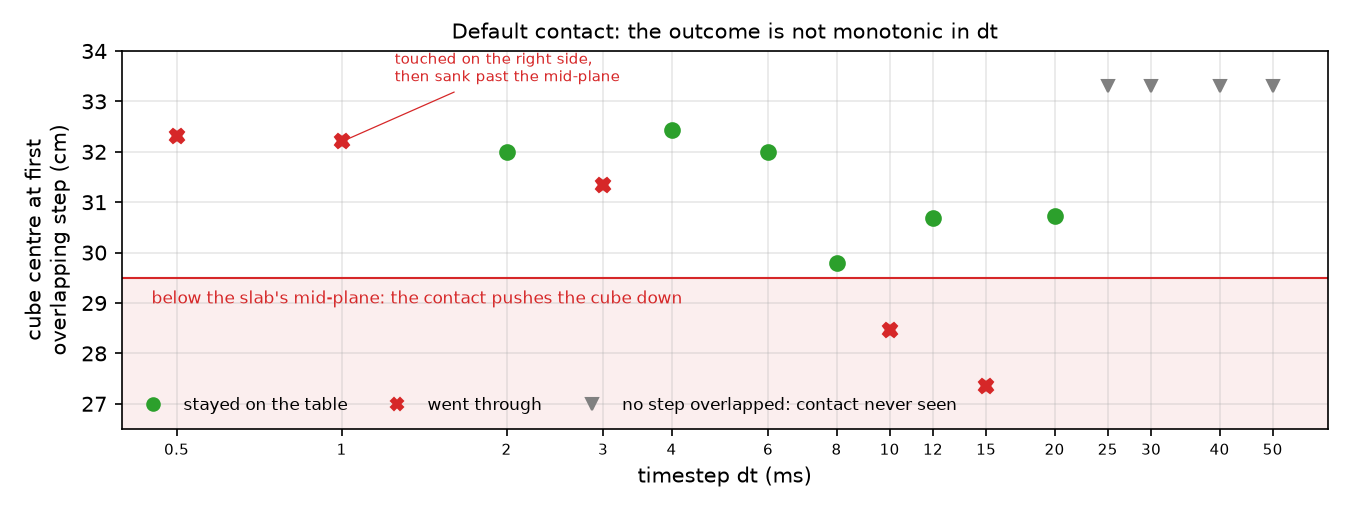
Observe. All three failure modes appear:
- Missed contact, ≥ 25 ms. No step lands in overlap; no contact is ever generated.
- Wrong-side overlap, 10 and 15 ms. The first overlapping step already has the centre below 29.5 cm. At 10 ms the first table contact (t = 0.460 s) is 1.97 cm deep and the normal acting on the cube has z = −1.00: correct force magnitude, wrong direction. A stiffer contact cannot help.
- Too-soft contact, 0.5, 1 and 3 ms. The first overlap is on the correct side; at 1 ms the first contact (t = 0.447 s) is 0.29 cm deep with normal z = +1.00. The soft contact still lets the 4.37 m/s cube sink: at t = 0.463 s its centre reaches 29.49 cm, just below the mid-plane (about 3 cm into a 1 cm slab), the normal flips and the cube falls through. The surviving 2 ms run bottoms out at 29.60 cm, 0.1 cm from flipping. With
solref="0.005 1"all of these stay.
The result is not monotonic in dt: “smaller is safer” fails at 0.5 and 1 ms, “a step thinner than the slab is safe” at 3 ms, and 12 and 20 ms survive by the luck of where the last contact-free step lands (Build it, Step 4 predicts those landing points).
Break it
Section titled “Break it”Keep dt and change only the integrator (default contact):
| dt | Euler | implicitfast | RK4 | discrete |
|---|---|---|---|---|
| 1 ms | through | through | through | through |
| 2 ms | stayed (29.60) | stayed (29.60) | through | through |
| 8 ms | stayed (29.65) | stayed (29.65) | through | through |
| 10 ms | through | through | through | through |
| 25 ms | through | through | through | through |
No integrator rescues any failing case, and RK4 and discrete fail two cases that Euler survives: each resolves the impact differently, and with the Euler run only 0.1 cm from flipping, that difference decides. The integrator turns forces into motion between detections; it does not sweep the path between sampled states or stiffen a soft contact. Candidate fixes are thicker collision geoms or a stiffer solref, each checked by a sweep like this one. What integrators do fix (stiff damping, stiff servos) is measured in lesson 05.
On the real robot
Section titled “On the real robot”- The Menagerie SO-101 sets
timestep="0.005"andintegrator="implicitfast"(so101.xml). A gripper finger closing on a thin object (a card, a cable) is the same geometry as this cube and slab. - Procedure: before trusting a grasp in simulation, run the grasp at 5, 2 and 1 ms and compare the final object pose. A result that changes with
dtis a simulation artefact, not a property of the grasp. Not yet measured on the real arm; no real-world counterpart has been compared. - In RL (reinforcement learning),
decimationdecouples control rate from physics rate: the policy can run at 50 Hz while physics runs at 200 Hz.
Check yourself
Section titled “Check yourself”Quick check · 2 questions. Click an answer.
1. At dt = 10 ms the cube falls through the 1 cm tabletop even with the stiff solref="0.005 1". Why can stiffness not help?
- No contact is ever generated at this timestep.
- The first overlapping step already has the centre below the slab’s mid-plane, so the contact normal points down from the start.
- The Euler integrator loses energy at large steps and the cube sinks.
Why: In the sweep table the centre at first overlap is 28.47 cm, below the 29.5 cm mid-plane; the first contact has normal z = −1.00 at t = 0.460 s.
2. At dt = 1 ms with the default contact the cube also goes through. Which change makes it stay?
- Halving the timestep to 0.5 ms.
- Switching the integrator to RK4.
- A stiffer contact,
solref="0.005 1".
Why: This is the too-soft case; the first contact is on the right side, but the cube sinks to 29.49 cm and the normal flips. With solref 0.005 1 it stays; 0.5 ms and RK4 both still go through.
- Easy. Make the tabletop 4 cm thick (
size="0.12 0.12 0.02", top face kept at 30 cm). Which failure mode should disappear first, and why? - Medium. Drop the cube from 3 m. Compute the impact speed, then rerun the sweep. Does the set of failing
dtvalues grow or shrink? - Hard. For each
dtin 0.5–20 ms, find the largestsolreftimeconst (at dampratio 1) for which the cube stays. Plot it. Explain why it cannot fix 10 and 15 ms.
Answers
Section titled “Answers”- The too-soft mode: the centre must now sink 2 cm below the top face instead of 0.5 cm before the normal can flip. Measure the rest.
- Impact speed is with the new height; faster impacts sink deeper and step further.
first_overlapfrom Build it predicts the new first-overlap column before you run anything. - At 10 and 15 ms the first overlapping step is already below the mid-plane, so the very first contact points down, whatever its stiffness.
Takeaways and sources
Section titled “Takeaways and sources”- Semi-implicit Euler jumps by ; contact is detected only at step instants.
- In this scene three failure modes coexist: missed contact (large
dt), wrong-side overlap (mediumdt), too-soft contact (anydt, fixed bysolref). The result is not monotonic indt. - Changing the integrator fixed none of them; validate contact-critical behaviour by sweeping
dt.
Next: lesson 03 · Contact: soft constraints, solref and solimp.
Sources
- MuJoCo XML reference · option:
timestep(default 0.002),integrator. - MuJoCo Computation · Numerical integration and Integrators.
unitree_rl_gym·legged_robot_config.py:dt = 0.005,decimation = 4(read 2026-10-27).- Menagerie · robotstudio_so101.
- Gymnasium
MujocoEnvsource (dt = model.opt.timestep * frame_skip), version 1.4.0. - Our numbers:
experiments/02-timestep/output.txt,build_output.txt.