12 · Joint control: PD, PID, gravity feedforward and position servos
| Part | 4 · Dynamics and control |
| Run type | CPU · Mac or Colab CPU |
| Prerequisites | 05, 11 |
| Learn first | Calculus for Machine Learning |
| Time | ~60 min |
| Code | experiments/12-joint-control/experiment.py · notebook |
| Status | ✅ done |
Act on this lesson
Tick each step when you have done it. Saved in this browser only.
A policy says “joint to this angle”. Two numbers, Kp and Kd, decide how the joint gets there, and they cannot fix gravity on their own.
The problem
Section titled “The problem”The Unitree Go2 has 12 leg joints. In Unitree’s open training code each is driven by the same PD rule (proportional–derivative: a spring plus a damper) with stiffness = 20 (Kp, N·m/rad), damping = 0.5 (Kd, N·m·s/rad), control_type = 'P' (go2_config.py):
# legged_robot.py · _compute_torquestorques = self.p_gains*(actions_scaled + self.default_dof_pos - self.dof_pos) - self.d_gains*self.dof_velreturn torch.clip(torques, -self.torque_limits, self.torque_limits)(legged_robot.py). The policy updates the target every 20 ms (sim.dt = 0.005, decimation = 4, legged_robot_config.py); Unitree’s stand-up example for the real Go2 uses Kp = 60, Kd = 5 (go2_stand_example.cpp). Why do these numbers work, what do they get wrong, and what does an SO-101 servo do instead?
Before you read · 2 questions. Guess first; the lesson tells you why.
1. A PD joint holds a link out against gravity. Why does it settle below the target?
- The derivative term slowly drains the motor’s energy.
- The spring term only produces torque from an error, so some error must remain to hold the weight.
- The simulator’s timestep is too large.
Why: At rest . In part B, Kp 20 leaves 8.342° and Kp 80 still 2.106°; the sag shrinks with Kp but never reaches zero.
2. What does a hobby position servo, like the SO-101’s, take as its command?
- A target angle; a PD loop inside the motor turns the error into torque, up to its torque cap.
- A torque, which it applies directly.
- A joint speed, which it integrates into an angle.
Why: In the Menagerie model each STS3215 is a position actuator, force clipped at ±2.94 N·m (Core idea, Servo).
Core idea
Section titled “Core idea”In plain words
Section titled “In plain words”Picture the joint tied to its target by a spring (stiffness Kp, pulls harder the further away) and a shock absorber (strength Kd, resists speed). Stiff spring, weak absorber: fast, then it bounces (overshoot); strong absorber: no bounce, sluggish. The sweet spot depends on how heavy the joint is.
The controller repeats every millisecond: measure, compare, correct. A spring only pushes when stretched, so to hold a weight the joint settles a little below its target (sag). Three ways out: a stiffer spring (less sag, never zero), an integral term that pushes harder the longer the error lasts (slow, can overshoot), or feedforward: add the weight’s torque from the model before any error appears.
A hobby servo like the SO-101’s runs this loop inside the motor: you send a target angle, and it pushes back with at most its torque cap.
flowchart TD
    R["target angle q*"] --> E["compare<br/>error e = q* − q"]
    E --> PD["PD<br/>Kp·e − Kd·q̇"]
    FF["gravity feedforward<br/>g(q) from the model"] --> S["add"]
    PD --> S
    S --> C["torque cap<br/>clip to ±τmax"]
    C --> J["joint + load<br/>inertia, gravity"]
    J -- "measure q, q̇" --> E
The control loop as code
Section titled “The control loop as code”integ = 0.0while True: # every dt (1 ms here; inside the servo on a real arm) q, qd = read_joint() # measure: angle [rad], velocity [rad/s] e = q_target - q # compare: distance to the target [rad] tau = kp * e - kd * qd # correct: spring toward target, damper against speed integ += e * dt # PID only: running sum of past error [rad*s] tau += ki * integ # PID only: push harder the longer the error lasts tau += gravity_torque(q) # feedforward only: cancel the known load (qfrc_bias) tau = np.clip(tau, -tau_max, tau_max) # the motor cannot give more than its cap apply_torque(tau)| Formula | What it tells you |
|---|---|
| the PD law (spring + damper) | |
| the closed loop is a mass–spring–damper | |
| speed; settling time scales as | |
| shape: below 1 overshoot, 1 critical, above 1 creep | |
| for | fraction of the step swung past the target |
| the sag : spring balances gravity |
, , : angle, target, speed; : motor torque; : the joint’s inertia (lesson 11, the diagonal of ); in N·m/rad, in N·m·s/rad; : natural frequency; : damping ratio; ; : gravity torque. Kp sets the speed, Kd the shape.
Servo. In the Menagerie model each STS3215 is a position actuator, force with , , clipped at ±2.94 N·m (so101.xml): a PD loop with a torque cap.
Math details: the second-order system, overshoot and why gravity needs more than PD
Closed loop. The PD law in , divided by : . The roots oscillate for and include a slow real root for , so overdamping settles slowly again.
Overshoot. For the step response oscillates at and first peaks at , which gives the overshoot formula. At fixed every time constant is a multiple of , so quadrupling Kp halves the settling time.
Gravity sag. At rest : a non-zero for any finite (Build it, Step 4 solves it).
Integral action. With an equilibrium needs ; the price is a third-order loop and windup. Feedforward instead leaves the gravity-free error dynamics, if the model is right.
Go deeper: Linear Systems; Lynch & Park, Modern Robotics, ch. 11 (Robot Control).
Build it
Section titled “Build it”You will now write the joint controller in about 50 lines of NumPy, each step checked against MuJoCo running the Experiment’s joint: 1 kg at 30 cm from a hinge, 1 ms steps. From MuJoCo you take only static numbers.
Type the steps into a file of your own (for example scratch/my_joint.py) and run it after each step. The finished functions are in physai/control.py; uv run python experiments/12-joint-control/build.py runs all six steps with the checks (output in build_output.txt).
Step 1 · The load: gravity on one link
Section titled “Step 1 · The load: gravity on one link”With horizontal and down, the mass sits at height , so gravity turns the joint with . The inertia is plus the mass’s own kg·m².
def gravity_torque(q, m, l, g=9.81): """Torque gravity puts on a hinge with a point mass m at distance l (q = 0 horizontal, q > 0 down).""" return m * g * l * np.cos(q)MuJoCo’s qfrc_bias has the opposite sign: the force the joint must supply to stay put.
== Step 1. Gravity torque m g l cos(q) by hand vs MuJoCo ==inertia: m l^2 + 1e-4 = 0.0901 kg m^2, MuJoCo mass matrix = 0.0901 kg m^2 q (deg) ours (N m) -qfrc_bias (N m) 0 2.9430 2.9430 30 2.5487 2.5487 60 1.4715 1.4715 90 0.0000 0.0000 -45 2.0810 2.0810max difference: 4.7e-16 N mStep 2 · The simulator: one semi-implicit Euler step
Section titled “Step 2 · The simulator: one semi-implicit Euler step”Newton for a hinge is . Integrate it in the order of MuJoCo’s default Euler: new speed first, then the new angle from the new speed (semi-implicit Euler, lesson 11).
def step_joint(q, qd, tau, inertia, dt, load=0.0): """One semi-implicit Euler step: new speed from the torques, then new angle from the new speed.""" qdd = (tau + load) / inertia # motor torque plus load torque (e.g. gravity) qd = qd + dt * qdd q = q + dt * qd # uses the updated speed: this is the "semi" return q, qddef simulate_joint(torque_fn, q0, inertia, dt, steps, load_fn=None): """Run a torque controller on one joint from rest at q0; returns the angle after every step.""" q, qd, qs = q0, 0.0, [] for _ in range(steps): load = load_fn(q) if load_fn else 0.0 q, qd = step_joint(q, qd, torque_fn(q, qd), inertia, dt, load) qs.append(q) return np.array(qs)== Step 2. Semi-implicit Euler by hand vs mj_step (free swing from horizontal, 1 s) ==angle after 1 s: ours 77.423 deg, MuJoCo 77.423 degmax |q_ours - q_mujoco| over 1000 steps: 4.4e-16 radStep 3 · The PD law
Section titled “Step 3 · The PD law”The spring and the damper, one line:
def pd_torque(q, qd, q_target, kp, kd): """PD law: a spring toward q_target (stiffness kp) and a damper against the joint speed (kd).""" return kp * (q_target - q) - kd * qdI, DT = 1.0 * 0.3 ** 2 + 1e-4, 0.001kd = 2 * zeta * np.sqrt(20 * I) # Kd for a chosen damping ratioq = simulate_joint(lambda q, qd: pd_torque(q, qd, 0.5, 20, kd), 0.0, I, DT, 4000)overshoot = (q.max() - 0.5) / 0.5 * 100In MuJoCo the same torque goes into d.ctrl[0] of a motor actuator, or into d.qfrc_applied[0]; both are tried.
== Step 3. PD step 0 -> 0.5 rad, Kp = 20, no gravity: overshoot == zeta Kd ours % MuJoCo % formula % 0.1 0.268 72.91 72.91 72.92 0.3 0.805 37.14 37.14 37.23 0.5 1.342 16.16 16.16 16.30 0.7 1.879 4.45 4.45 4.60 1.0 2.685 0.00 0.00 0.00max |q_ours - q_mujoco| over all runs: 3.3e-16 radsame loop through qfrc_applied instead of the motor: max diff 0.0e+00 radThe Experiment’s part A numbers, digit for digit; the ideal continuous formula sits 0.01 to 0.15 points above.
Step 4 · Sag under gravity
Section titled “Step 4 · Sag under gravity”Add the load (load_fn=lambda q: gravity_torque(q, 1.0, 0.3)) and step from hanging (90°) to horizontal (0°). At rest the spring carries the weight, , a fixed point:
def pd_sag(kp, mgl, iters=200): """Steady error e of a PD joint holding a link at horizontal: the fixed point of kp e = mgl cos(e).""" e = 0.0 for _ in range(iters): e = mgl * np.cos(e) / kp return e== Step 4. PD under gravity, hanging (90 deg) -> horizontal (0 deg), zeta 0.7: sag == Kp ours (deg) MuJoCo (deg) Kp e = mgl cos e (deg) 5 29.385 29.385 29.385 20 8.342 8.342 8.342 80 2.106 2.106 2.106Simulator, MuJoCo and formula agree: the sag belongs to the PD law.
Step 5 · Gravity feedforward
Section titled “Step 5 · Gravity feedforward”Add the model’s gravity torque before any error appears: with your gravity_torque (the minus is MuJoCo’s +qfrc_bias).
KD = 2 * 0.7 * np.sqrt(20 * I) # 1.879, zeta = 0.7load = lambda q: gravity_torque(q, 1.0, 0.3)q = simulate_joint(lambda q, qd: pd_torque(q, qd, 0.0, 20, KD) - load(q), np.pi / 2, I, DT, 4000, load)== Step 5. PD + gravity feedforward, Kp = 20, Kd = 1.879 ==feedforward overshoot (deg) final err (deg) t into 0.5 deg (s)ours: -g(q) at the current q 4.009 0.000 0.463MuJoCo: qfrc_bias after mj_forward 4.009 0.000 0.463MuJoCo: qfrc_bias left by mj_step 3.994 0.000 0.463max |q_ours - q_fresh|: 4.2e-17 radThe final error is gone, but the overshoot is 4.009° where the Experiment says 3.994°: it reads d.qfrc_bias right after mj_step, when it still holds the value for the angle 1 ms ago. Recompute it (mj_forward) or use your and you get 4.009°. On a real robot the bus and sensor add more lag.
Step 6 · Limits: anti-windup and the torque cap
Section titled “Step 6 · Limits: anti-windup and the torque cap”Real hardware needs a limit on the integral (else it winds up: the Experiment’s 46.016°) and the motor’s torque cap. One small class:
@dataclassclass PID:    """PD + integral + feedforward, with an anti-windup clamp and the motor's torque limit."""    kp: float    kd: float    ki: float = 0.0    i_max: float = np.inf      # anti-windup: the integral term may give at most this torque (N m)    tau_max: float = np.inf    # motor torque limit (N m)    integ: float = 0.0         # running sum of the error (rad s)
    def __call__(self, q, qd, q_target, dt, tau_ff=0.0):        self.integ += (q_target - q) * dt        if self.ki:                                # clamp the sum, not just the output            lim = self.i_max / self.ki            self.integ = min(max(self.integ, -lim), lim)        tau = pd_torque(q, qd, q_target, self.kp, self.kd) + self.ki * self.integ + tau_ff        return min(max(tau, -self.tau_max), self.tau_max)
The clamp limits the sum, so nothing has to unwind; 3 N·m is just above the most the integral needs, = 2.943 N·m.
== Step 6. Limits: integrator clamp (anti-windup) and torque cap ==controller overshoot (deg) final err (deg) t into 0.5 deg (s)PID Ki = 160 46.016 0.000 1.520 peak |tau| 31.67 N mPID Ki = 160, |Ki integ| <= 3 N m 4.646 0.000 0.685 peak |tau| 31.67 N mPD + feedforward 4.009 0.000 0.463 peak |tau| 31.42 N mPD + feedforward, |tau| <= 3.5 N m 2.512 0.000 0.607 peak |tau| 3.50 N mPID Ki = 160, ours vs MuJoCo: max diff 7.5e-17 radtorque cap, ours (clip in PID) vs MuJoCo (unclipped torque, ctrlrange = +-3.5): max diff 2.2e-16 radThe clamp cuts the Ki = 160 overshoot from 46.016° to 4.646° and the time into ±0.5° from 1.520 s to 0.685 s. Uncapped, the first command is 31.42 N·m ( times 90°); a 3.5 N·m cap makes the move slower (0.607 s) and gentler (2.512°). Below 2.943 N·m the link could not be held at all (part C).
What you keep
Section titled “What you keep”physai.control now has gravity_torque, step_joint, simulate_joint, pd_torque, pd_sag and PID. A trajectory (lesson 13) is the same controller with a moving q_target. tests/test_12_joint_control.py pins them to MuJoCo and to the ζ and sag formulas; run uv run pytest tests/test_12_joint_control.py after you change anything.
Use it
Section titled “Use it”MuJoCo’s position actuator is the same PD law, computed inside mj_step; you send the target:
<actuator> <position joint="j" kp="20" kv="1.879"/> <!-- or kp="20" dampratio="0.7" --></actuator>d.ctrl[0] = q_target # position actuator: force = kp (ctrl - q) - kv qdotmujoco.mj_step(m, d)For your own torque loop use a motor actuator or qfrc_applied, and recompute qfrc_bias with mj_forward or set gravcomp="1" on the body:
mujoco.mj_forward(m, d) # qfrc_bias for the current qd.ctrl[0] = kp * (q_target - d.qpos[0]) - kd * d.qvel[0] + d.qfrc_bias[0]mujoco.mj_step(m, d)== Use it. MuJoCo's own position actuator and gravity compensation ==dampratio="0.7" -> kv = 1.879 (2 zeta sqrt(Kp I) = 1.879)step 0 -> 0.5 rad: overshoot 4.45 %, max diff to our PD loop 1.1e-16 radunder gravity, hanging -> horizontal overshoot (deg) final err (deg) qfrc_passive qfrc_actuatorposition actuator 0.000 8.342 0.000 -2.912+ body gravcomp="1" 4.009 0.000 -2.943 0.000+ joint actuatorgravcomp="true" 4.009 0.000 0.000 -2.943dampratio gives your Kd; the actuator matches your Step 3 loop to 1.1e-16 rad and sags 8.342°; gravcomp removes the sag with your Step 5 overshoot (4.009°).
The same two gains elsewhere (units differ: never copy a number across rows):
| Where | P gain | D gain | Notes |
|---|---|---|---|
| physai | PID.kp | PID.kd | N·m/rad, N·m·s/rad |
MuJoCo position actuator | kp | kv, or dampratio | the SO-101 model: kp="998.22" kv="2.731" forcerange="-2.94 2.94" (so101.xml) |
unitree_rl_gym config | stiffness | damping | dicts per joint name, 20 and 0.5 for the Go2 (go2_config.py) |
unitree_sdk2 low-level command | motor_cmd()[i].kp() | motor_cmd()[i].kd() | per command, with q, dq, tau; 60 and 5 in the stand example (go2_stand_example.cpp) |
| Isaac Lab actuator config | stiffness (“p-gain”) | damping (“d-gain”) | implicit actuators hand them to the physics engine, explicit ones compute the effort (isaaclab.actuators) |
| LeRobot SO-101 follower (Feetech STS3215) | P_Coefficient = 16 | D_Coefficient = 32 | servo register values, no unit; I_Coefficient = 0 (config_so_follower.py) |
Three traps:
- A gain is not a gain. LeRobot’s P coefficient 16 is a servo register value; the Menagerie model’s
kp = 998.22N·m/rad was derived assuming it and is “not a 1-to-1 mapping” (so101.xml). Retune when you change tools. - Stale
qfrc_bias. Aftermj_stepit holds the value from the start of that step (Step 5: 3.994° instead of 4.009°). On a moving multi-joint arm it also contains Coriolis and centrifugal torques; only at rest is it . - Free gravity compensation. With
gravcomp="1"the actuator reports 0.000 N·m: MuJoCo books the 2.943 N·m as passive, though a real motor must supply it.actuatorgravcomp="true"books it underqfrc_actuator.
Check after building · 2 questions.
1. In Build it, Step 6, PID with Ki = 160 overshoots by 46.016°. What does clamping the integral term to 3 N·m do, and why 3?
- Nothing useful; any clamp leaves a steady error because the integral can no longer grow.
- It removes the overshoot completely; 3 is the motor’s torque cap.
- Overshoot drops to 4.646° with zero final error; 3 N·m is just above the most the integral must supply, = 2.943 N·m.
Why: The sum can still reach the gravity torque at horizontal, so the error goes to zero, but it can no longer wind up during the 90° move (Build it, Step 6 table; time into ±0.5° 1.520 s → 0.685 s).
2. With gravcomp="1" on the body, MuJoCo’s position actuator holds the link at horizontal and reports 0.000 N·m. How much would a real motor have to supply?
- 2.943 N·m; MuJoCo booked the gravity compensation as a passive force, not as actuator torque.
- 0 N·m, because gravity is compensated.
- 31.42 N·m, the first command of the uncapped loop.
Why: In the Use it output, gravcomp shows qfrc_passive −2.943 and qfrc_actuator 0.000; with actuatorgravcomp="true" the same −2.943 moves to qfrc_actuator.
Experiment
Section titled “Experiment”Full script: experiments/12-joint-control/experiment.py. MuJoCo 3.17.0, NumPy 2.5.4, Python 3.14, Apple M5, deterministic, ~2 s.
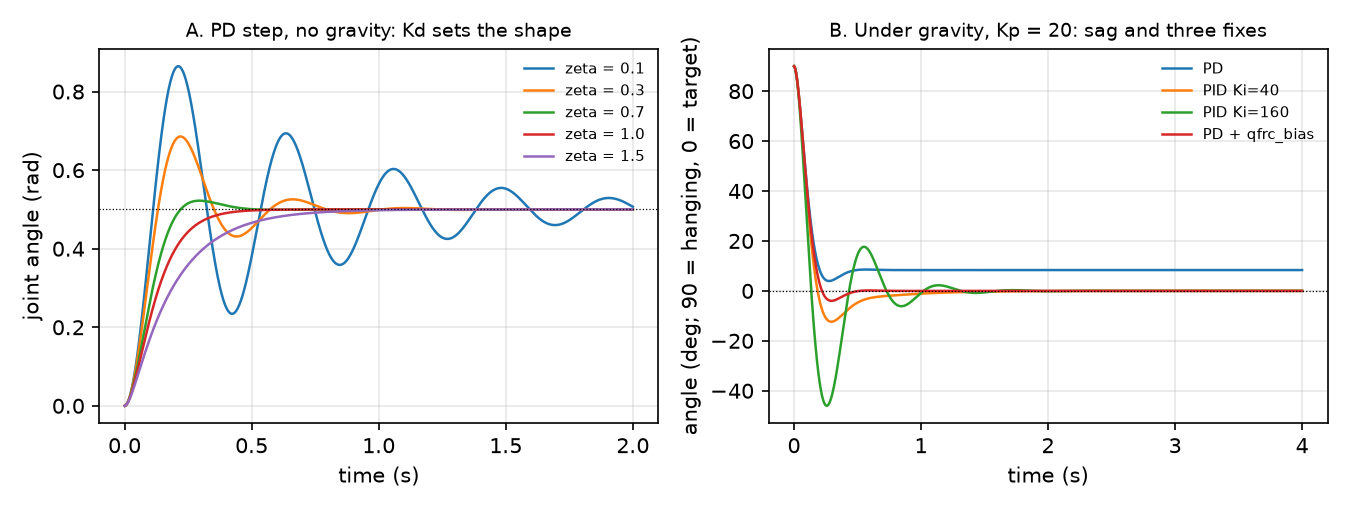
A. Damping ratio. One joint, = 0.0901 kg·m², no gravity, Kp = 20, step 0 → 0.5 rad. Predict: at which ζ does overshoot vanish, and which ζ settles fastest?
| ζ | Kd | overshoot % (sim) | formula % | settling 2% [s] |
|---|---|---|---|---|
| 0.1 | 0.268 | 72.91 | 72.92 | 2.573 |
| 0.3 | 0.805 | 37.14 | 37.23 | 0.751 |
| 0.5 | 1.342 | 16.16 | 16.30 | 0.538 |
| 0.7 | 1.879 | 4.45 | 4.60 | 0.398 |
| 1.0 | 2.685 | 0.00 | 0.00 | 0.393 |
| 1.5 | 4.027 | 0.00 | 0.00 | 0.716 |
ζ ≈ 0.7–1 settles fastest; overdamping (1.5) is slower again. At ζ = 0.7, settling halves when Kp quadruples: Kp 5 / 20 / 80 → ωn 7.45 / 14.90 / 29.80 rad/s → 0.799 / 0.398 / 0.197 s.
B. Gravity. With gravity ( = 2.943 N·m), hanging (90°) to horizontal (0°), ζ = 0.7.
| Kp | sag (sim) | sag from |
|---|---|---|
| 5 | 29.385° | 29.385° |
| 10 | 16.193° | 16.193° |
| 20 | 8.342° | 8.342° |
| 40 | 4.204° | 4.204° |
| 80 | 2.106° | 2.106° |
Then Kp = 20, Kd = 1.879, three ways to remove the 8.342° sag (4 s simulated):
tau = kp * e - kd * qd + ki * integ # PIDtau += d.qfrc_bias[0] # or: gravity feedforward from the model| controller | final error | overshoot | time into ±0.5° |
|---|---|---|---|
| PD | 8.342° | 0.000° | never |
| PID, Ki = 10 | 0.603° | 0.365° | not within 4 s |
| PID, Ki = 40 | −0.001° | 12.359° | 1.310 s |
| PID, Ki = 160 | 0.000° | 46.016° | 1.520 s |
PD + qfrc_bias | −0.000° | 3.994° | 0.463 s |
The integral trades the error for time or overshoot; feedforward removes it at once, with the ζ = 0.7 loop’s own overshoot (one step late: 4.009° with a fresh qfrc_bias, Build it, Step 5).
C. SO-101 servo. Arm stretched forward (all joints 0, gripper about 39 cm out), payload at the gripper, servos hold 0 for 3 s.
| payload | gravity torque, shoulder | shoulder sag | servo torque | gripper drop |
|---|---|---|---|---|
| 0.00 kg | −0.573 N·m | 0.033° | −0.573 N·m | 0.03 cm |
| 0.25 kg | −1.363 | 0.078° | −1.364 | 0.09 |
| 0.50 kg | −2.153 | 0.124° | −2.156 | 0.14 |
| 0.70 kg | −2.785 | 0.160° | −2.789 | 0.18 |
| 0.80 kg | −3.101 | 37.403° | −2.940 (cap) | 22.30 |
| 1.00 kg | −3.733 | 37.403° | −2.940 (cap) | 22.30 |
With near 1000 N·m/rad the sag is a fraction of a degree, until gravity passes the 2.94 N·m cap; then the arm falls to the floor. A stiff servo hides gravity; its torque limit does not.
D. Go2 case study. The Menagerie Go2 lies with folded legs (body at 10 cm); for 3 s all 12 joints get the clipped PD torque toward default_joint_angles from go2_config.py. Final = mean body height over 2.5–3 s; overshoot = (peak − final)/(final − start); “steps saturated” = share of steps with some joint at its torque limit.
| Kp / Kd | peak | t peak | feet on floor at peak | final | overshoot | steps saturated |
|---|---|---|---|---|---|---|
| 20 / 0.5 (training) | 25.6 cm | 0.45 s | 4 | 25.2 cm | 3.0% | 0.0% |
| 5 / 0.5 | 11.1 | 2.92 | 4 | 11.1 | 0.8% | 0.0% |
| 10 / 0.5 | 19.7 | 2.75 | 4 | 19.6 | 0.1% | 0.0% |
| 40 / 0.5 | 36.0 | 0.28 | 2 | 29.1 | 36.4% | 0.5% |
| 80 / 0.5 | 50.8 | 0.33 | 0 | 29.9 | 104.5% | 2.9% |
| 20 / 0 | 26.3 | 0.31 | 4 | 24.7 | 11.0% | 0.0% |
| 20 / 2 | 25.3 | 1.04 | 4 | 25.2 | 1.2% | 0.0% |
| 60 / 5 (real-robot example gains) | 29.9 | 1.11 | 4 | 29.8 | 0.2% | 0.9% |
| 20 / 0.5 + 5 kg on the body | 22.7 | 0.38 | 4 | 21.8 | 7.4% | 0.0% |
Held exactly, the targets would put the body at 32.35 cm (front legs; rear 31.39 cm). With 20 / 0.5 it stands at 25.2 cm, about 7 cm low: part B’s sag on twelve joints. In training the policy closes it by shifting the target (action_scale = 0.25).
Break it
Section titled “Break it”Kp up, Kd fixed. At 80 / 0.5 the body overshoots to 50.8 cm at t = 0.33 s with all four feet off the floor, some joint saturated in 2.9% of the steps. Kp quadrupled at fixed Kd, so ζ halved, and the stored energy throws the robot. Raising Kd with Kp (60 / 5) gives 0.2% overshoot and a 29.8 cm stance.
Ki up. In part B, Ki = 160 removes the steady error but overshoots by 46.016°: the integral winds up during the 90° move. Real controllers clamp or freeze the integrator (anti-windup) or use feedforward and keep Ki small; the 3 N·m clamp of Build it, Step 6 brings it to 4.646°.
On the real robot
Section titled “On the real robot”- Go2. 20 / 0.5 are training gains under a policy that moves the target every 20 ms;
unitree_rl_gym/deployhas real-robot configs for G1, H1 and H1_2 only (deploy_real/configs). The SDK stand example (Kp 60, Kd 5) interpolates linearly through waypoints, phases of 500 or more 2 ms ticks (go2_stand_example.cpp, Python version), the trajectory idea of lesson 13. No Go2 number here is measured on hardware. - Model differences. Menagerie’s Go2 adds joint damping 2 N·m·s/rad and friction loss 0.2 N·m; the training
go2.urdfhas no damping and a 35.55 N·m knee limit (Menagerie: 45.43 N·m). Our step is 2 ms (training: 5 ms); even “Kd = 0” has damping. Trust the qualitative results (Kp 5 cannot stand, Kp 80 leaves the floor, 20 / 0.5 stands about 7 cm low), not the exact percentages. - SO-101. The follower’s six STS3215 servos have 1/345 gearing (LeRobot SO-101 docs); you send goal positions, the position loop runs in the servo. Part C’s numbers come from the Menagerie model, not yet measured on the real arm. Procedure: stretch the arm forward, hang known masses at the gripper, read
Present_Positionof shoulder_lift, stop before the servo overheats.
Check yourself
Section titled “Check yourself”Quick check · 2 questions. Click an answer.
1. Which fix removes the 8.342° sag fastest and with the least overshoot in part B?
- PID with Ki = 160
- PID with Ki = 10
- PD plus gravity feedforward (
qfrc_bias)
Why: Feedforward reaches ±0.5° in 0.463 s with 3.994° overshoot. Ki = 160 overshoots by 46.016°, and Ki = 10 has not settled within 4 s.
2. On the Go2, Kp goes from 20 to 80 while Kd stays at 0.5. What happens?
- The body stands up faster and stops exactly at the target height.
- The damping ratio halves; the body overshoots to 50.8 cm with all four feet off the floor.
- Nothing changes, because Kp only matters for the steady state.
Why: , so quadrupling Kp at fixed Kd halves ζ. Raising Kd together with Kp (60 / 5) gives 0.2% overshoot.
- Easy. A wrist joint has = 0.01 kg·m² and Kp = 20 N·m/rad. Which Kd gives ζ = 0.7?
- Medium. In part B, what Kp would bring the PD sag of the 1 kg, 30 cm link under 1°? Use .
- Hard. Add an I term to the Go2 rule in
experiment.py. Does the ~7 cm gap close within 3 s? What happens to overshoot and feet at peak?
Answers
Section titled “Answers”- N·m·s/rad.
- rad needs N·m/rad (the table’s trend: Kp 80 → 2.106°).
- Not computed here; run it.
Takeaways and sources
Section titled “Takeaways and sources”- PD is a spring–damper: predicts overshoot (72.91% vs 72.92% at ζ = 0.1); ζ ≈ 0.7–1 settles fastest.
- Under gravity PD sags by (8.342° at Kp 20); PID removes it slowly and winds up (46.016° at Ki 160); gravity feedforward removes it at once.
- A position servo is a stiff PD with a torque cap; Go2’s 20 / 0.5 stands 7 cm low without a policy, 80 / 0.5 throws it off the floor.
Next: lesson 13 · Trajectory generation.
Sources:
unitree_rl_gym:go2_config.py,legged_robot.py,legged_robot_config.py(BSD-3-Clause, © Unitree Robotics).unitree_sdk2·go2_stand_example.cpp,unitree_sdk2_python·go2_stand_example.py.- LeRobot SO-101 documentation (read 2026-10-27).
- MuJoCo Menagerie:
unitree_go2(BSD-3-Clause, © Unitree Robotics),robotstudio_so101(Apache-2.0); MuJoCo Modeling · actuators. - Lynch & Park, Modern Robotics, ch. 11 (Robot Control).
- All measured numbers:
experiments/12-joint-control/output.txt.
Go2 model: MuJoCo Menagerie (Google DeepMind), from the Unitree Robotics URDF, BSD-3-Clause. The Unitree and Go2 names are used factually; Unitree does not sponsor or endorse this work.