32 · A MuJoCo RL environment
| Part | 8 · Reinforcement learning for robots |
| Run type | CPU · Mac or Colab CPU |
| Prerequisites | 12, 25 |
| Learn first | MDPs, States, Actions & Rewards |
| Time | ~45 min |
| Code | experiments/32-rl-environment/experiment.py |
| Status | ✅ done |
Act on this lesson
Tick each step when you have done it. Saved in this browser only.
Before any learning, write the contract: what the policy sees, what its numbers do to the motors, when an episode ends, and how often it decides.
The problem
Section titled “The problem”An RL algorithm only ever sees what the environment hands it: an observation, a reward, two end-of-episode flags. Mistakes in that interface do not crash anything; they make training quietly worse. The classic one: Gymnasium replaced the single done flag with terminated and truncated in v0.26 (Env API), because “the episode hit its time limit” and “the episode reached a terminal state” need different training targets. Unitree’s locomotion training code carries the same distinction as a config switch, send_timeouts = True # send time out information to the algorithm (legged_robot_config.py). In this lesson we build the SO-101 reach environment used in lessons 33–35 and measure the baselines that tell us later what “learned” means.
Before you read · 2 questions. Guess first; the lesson tells you why.
1. An episode hits the 1.6 s time limit while the arm is in an ordinary pose. What value target should the last step get?
- , because the episode is over and nothing comes after it.
- , because
truncatedonly means the clock stopped; the future continues. - , so that time-outs are discouraged.
Why: Only terminated removes the future. The clock is not in the 15-number observation, so cutting the target at the time limit would give the same pose two different targets (Math details).
2. The physics runs in 5 ms steps and the policy decides every 4 physics steps. How many decisions per second is that?
- 50; the action is held for 4 steps of 5 ms, a 20 ms policy period.
- 200, one per physics step.
- 800, because the four steps run in parallel.
Why: Policy period ms = 20 ms (Build it, Step 1); Unitree calls the ratio decimation, Gymnasium’s MujocoEnv calls it frame_skip.
Core idea
Section titled “Core idea”In plain words
Section titled “In plain words”An RL environment is an API with two endpoints. reset() starts a new attempt and tells you what the robot sees. step(action) applies one decision, advances the simulation a little, and returns what the robot sees now, a score for that step (the reward) and two flags. One run from reset() to the end is an episode; the function that turns what the robot sees into an action is the policy.
The two flags answer different questions. terminated says “the task itself is over”: the goal was reached, or the robot fell. truncated says “we stopped watching”: the clock ran out, but the robot is in an ordinary state and would keep collecting reward. A learner that confuses them learns that the world ends every 1.6 s, which is false.
The third part of the contract is timing. The physics runs in small steps (5 ms here), but the policy decides only every few of them, like a game that updates physics at 200 Hz and reads the controller at 50 Hz. That ratio is the frame skip (Unitree calls it decimation).
The agent–environment loop
Section titled “The agent–environment loop”sequenceDiagram
participant P as policy
participant E as environment
participant M as MuJoCo
P->>E: reset(seed)
E->>M: new target, start pose
E-->>P: obs, info
loop every 20 ms of simulated time
P->>E: step(action)
E->>M: joint targets, then 4 physics steps
E-->>P: obs, reward, terminated, truncated, info
end
The contract, as code
Section titled “The contract, as code”obs, info = env.reset(seed=k) # seed k -> the same target and start pose every timewhile True: action = policy(obs) # 4 numbers in [-1, 1] obs, reward, terminated, truncated, info = env.step(action) if terminated or truncated: # either flag ends the episode ... break
def value_target(r, v_next, terminated, gamma): # ... but only "terminated" removes the future. # r: reward of this step # v_next: the critic's estimate of all future reward from the next state # gamma: discount, how much one step later counts (lesson 33) return r + gamma * (1 - terminated) * v_next
policy_period = frame_skip * h # 4 * 5 ms = 20 ms, i.e. 50 decisions per second| Quantity | Formula |
|---|---|
| value target | |
| policy period |
is the reward at step , the discount, the learned estimate of future reward from the next state , the frame skip and the physics timestep.
Math details: why truncation must bootstrap
A value-based learner fits the expected discounted return (see AIEFS: MDPs, States, Actions & Rewards). Replacing the tail of that sum by the current estimate is called bootstrapping.
- Terminal state. After it every reward is 0 by definition, so the exact target is .
- Time limit. The last state is an ordinary state; the true return continues. Using there would make the target depend on the clock. The clock is not in our 15-number observation, so the same arm pose would get two different targets (with and without a future), and the value function cannot fit both. Bootstrapping keeps the target a function of the state only.
Seeding. reset(seed=k) re-seeds the environment’s own generator self.np_random. Episodes are reproducible only if all randomness (target, start pose) comes from that generator. Evaluation then uses a fixed list of seeds.
Frame skip. The action is held constant for physics steps while the servo’s PD loop runs at every physics step. The Go2 training config uses ms and decimation = 4, a 20 ms (50 Hz) policy (legged_robot_config.py, go2_config.py). The Menagerie SO-101 also uses ms, so we take as well.
Go deeper: MDPs, States, Actions & Rewards; Gymnasium · Env API (terminated vs truncated, seeding).
| Call | Returns | Robot meaning |
|---|---|---|
reset(seed=None) | obs, info | put the robot in a start state, sample a new task (here: a target point) |
step(action) | obs, reward, terminated, truncated, info | apply the action for one policy period, advance physics |
observation_space, action_space | Box shapes and bounds | the policy’s input and output sizes |
The reach task
Section titled “The reach task”The environment of lessons 33–35, in reach_env.py:
| Element | Definition |
|---|---|
| Robot | Menagerie robotstudio_so101; 4 controlled joints (shoulder pan, shoulder lift, elbow, wrist flex), wrist roll and gripper held at 0 |
| Action | , joint target , tracked by the model’s servo PD (lesson 34 changes this) |
| Observation (15) | , , , previous action |
| Target | per episode: forward kinematics of rad, rejected if below 4 cm or in contact, so every target is reachable |
| Start | rad, at rest |
| Reward | (metres) every step |
| Episode | 1.6 s = 80 policy steps, then truncated |
| Success | gripper within 2 cm of the target at the time limit |
Sampling targets in joint space and passing them through forward kinematics (lesson 08) is a cheap way to guarantee that a 0% success rate is the policy’s fault, not the task’s.
Build it
Section titled “Build it”You will now write the reach environment yourself, about 70 lines on top of MuJoCo, and check it against the lesson’s reach_env.py step by step: same seeds, same targets, same observations, same rewards. Gymnasium appears only at the end, as a referee.
The class is in physai/rl.py; uv run python experiments/32-rl-environment/build.py runs the five steps (output in build_output.txt).
Step 1 · The class and its timing
Section titled “Step 1 · The class and its timing”The constructor reads everything from the model: joint and actuator indices, the servo ranges, the gripper site, and the two times that define the task, the physics step and the policy period .
class ReachTask:    """SO-101 reach with the Gymnasium API: position actions around a home pose, frame skip, time limit.
    Observation (15): q - q_home, 0.1 * qdot, target - gripper, previous action. Reward: -distance [m].    """    JOINTS = ("shoulder_pan", "shoulder_lift", "elbow_flex", "wrist_flex")    Q_HOME = np.array([0.0, -1.0, 1.0, 0.5])    SPREAD = np.array([1.0, 0.6, 0.6, 0.6])        # targets = FK(q_home + U(-spread, spread)), always reachable
    def __init__(self, model_path, frame_skip=4, episode_seconds=1.6, scale=1.0, radius=0.02,                 terminate_on_success=False):        self.model = mujoco.MjModel.from_xml_path(model_path)        self.data, self._fk = mujoco.MjData(self.model), mujoco.MjData(self.model)        self.frame_skip, self.scale, self.radius = frame_skip, scale, radius        self.terminate_on_success = terminate_on_success        self.dt = self.model.opt.timestep * frame_skip                 # policy period        self.max_steps = int(round(episode_seconds / self.dt))        self.qadr = np.array([self.model.joint(j).qposadr[0] for j in self.JOINTS])        self.vadr = np.array([self.model.joint(j).dofadr[0] for j in self.JOINTS])        self.act = np.array([self.model.actuator(j).id for j in self.JOINTS])        self.site = self.model.site("gripperframe").id        self.lo, self.hi = self.model.actuator_ctrlrange[self.act].T.copy()        self.np_random = None
    def _sample_target(self):        while True:                                                    # rejection sampling in joint space            q = np.clip(self.Q_HOME + self.np_random.uniform(-self.SPREAD, self.SPREAD), self.lo * 0.95, self.hi * 0.95)            self._fk.qpos[:] = 0.0            self._fk.qpos[self.qadr] = q            mujoco.mj_forward(self.model, self._fk)            p = self._fk.site_xpos[self.site].copy()            if p[2] > 0.04 and self._fk.ncon == 0:                     # above the floor, nothing in contact                return p
    def _obs(self):        q = self.data.qpos[self.qadr] - self.Q_HOME        qd = self.data.qvel[self.vadr]        ee = self.data.site_xpos[self.site]        return np.concatenate([q, 0.1 * qd, self.target - ee, self.prev_a]).astype(np.float32)
    def reset(self, seed=None, options=None):        if seed is not None or self.np_random is None:            self.np_random = np.random.default_rng(seed)               # all randomness comes from this generator        mujoco.mj_resetData(self.model, self.data)        self.target = self._sample_target()        q0 = self.Q_HOME + self.np_random.uniform(-0.1, 0.1, size=4)        self.data.qpos[self.qadr] = q0        self.data.ctrl[:] = 0.0        self.data.ctrl[self.act] = q0                                  # the servos hold the start pose        mujoco.mj_forward(self.model, self.data)        self.t, self.prev_a = 0, np.zeros(4)        self.dist = float(np.linalg.norm(self.target - self.data.site_xpos[self.site]))        return self._obs(), {"dist": self.dist}
    def step(self, action):        a = np.clip(np.asarray(action, dtype=np.float64), -1.0, 1.0)        self.data.ctrl[self.act] = np.clip(self.Q_HOME + self.scale * a, self.lo, self.hi)        mujoco.mj_step(self.model, self.data, nstep=self.frame_skip)  # hold the action for frame_skip steps        self.t += 1        self.dist = float(np.linalg.norm(self.target - self.data.site_xpos[self.site]))        self.prev_a = a        success = self.dist < self.radius        terminated = bool(self.terminate_on_success and success)       # the task itself is over        truncated = (not terminated) and self.t >= self.max_steps      # we stopped watching        info = {"dist": self.dist}        if terminated or truncated:            info["is_success"] = success        return self._obs(), -self.dist, terminated, truncated, info
The check: four single mj_step calls and one mj_step(nstep=4) give the same state, and the period is the 20 ms of Core idea.
== Step 1. Timing ==physics step h = 5 ms, frame_skip 4 -> policy period 20 ms (50 Hz), 80 steps = 1.6 s4 x mj_step vs mj_step(nstep=4): max |qpos diff| = 0.0e+00, time 0.020 s vs 0.020 sStep 2 · reset(seed)
Section titled “Step 2 · reset(seed)”All randomness, the target and the start pose, comes from one generator, created from the seed. np.random.default_rng(seed) builds the same generator as Gymnasium’s super().reset(seed=seed), so your targets can be compared with ReachEnv’s number for number:
== Step 2. reset(seed) vs the lesson's ReachEnv, seeds 0-199 ==max |target ours - ReachEnv| = 0.0e+00 m, max |first observation diff| = 0.0e+00reset(seed=7), reset(seed=8), reset(seed=7): same target True, target [0.273 0.098 0.153] m, start distance 0.113 mreset() without a seed continues the generator: new target [0.238 0.105 0.143] mIdentical for all 200 seeds. reset() without a seed continues the same generator, so a training run sees a new target every episode while evaluation can replay a fixed list of seeds.
Step 3 · step(action)
Section titled “Step 3 · step(action)”== Step 3. step(action) vs ReachEnv, and the zero-action baseline ==5 episodes of random actions: max |obs or reward diff| = 0.0e+00zero action, 200 episodes: return -12.87 +- 4.92, median final distance 170.8 mm, success 1/200The same random actions give the same observations and rewards (difference 0.0e+00), and the zero-action baseline reproduces the Experiment’s row: −12.87 ± 4.92, 170.8 mm, 1/200.
Step 4 · terminated, truncated and the value target
Section titled “Step 4 · terminated, truncated and the value target”def value_target(r, v_next, terminated, gamma): """One-step value target: bootstrap from the next state unless the episode terminated (truncation bootstraps).""" return r + gamma * (1.0 - terminated) * v_nextRun the scripted IK controller of the Experiment through your class, once with terminate_on_success=True and once without:
== Step 4. terminated vs truncated ==scripted IK, terminate_on_success=True, 50 episodes: terminated 50, truncated 0, mean length 11.4 stepslast episode with terminate_on_success=False: terminated False, truncated True, t = 80V(s) = r / (1 - gamma) = -0.200; target at the time limit: bootstrap -0.200, treated as terminal -0.010With termination every episode ends terminated after 11.4 steps on average, the Experiment’s 50/0; without it the episode runs to step 80 and ends truncated. The last line is the Math details argument in numbers. A state that pays −1 cm per step forever is worth . At the time limit, bootstrapping gives the target −0.200, the state’s true value; treating the limit as terminal gives −0.010, as if the world ended.
Step 5 · Gymnasium’s checker
Section titled “Step 5 · Gymnasium’s checker”Gymnasium only asks for two more attributes, the spaces, and for the class to inherit gymnasium.Env:
from gymnasium import spaces
class GymReach(ReachTask, gym.Env):                     # physai's reset/step, Gymnasium's base class    def __init__(self, **kw):        super().__init__(SO101, **kw)        self.action_space = spaces.Box(-1.0, 1.0, shape=(4,), dtype=np.float32)        self.observation_space = spaces.Box(-np.inf, np.inf, shape=(15,), dtype=np.float32)
== Step 5. Gymnasium's env_checker ==check_env passed, 2 warnings warning: WARN: A Box observation space minimum value is -infinity. This is probably too low. warning: WARN: A Box observation space maximum value is infinity. This is probably too high.The checker passes: seeding, return types and spaces are as Gymnasium expects. Its two warnings are about the unbounded observation box, which the lesson’s ReachEnv declares the same way; the observation has no hard limits, so we leave it.
What you keep
Section titled “What you keep”physai.rl now has ReachTask and value_target. Lesson 33 adds the PPO pieces to the same module and trains on this task; lessons 34 and 35 change its actions and rewards. tests/test_32_rl_environment.py checks seeding, the two flags, frame skip and the equality with ReachEnv; run uv run pytest tests/test_32_rl_environment.py.
Use it
Section titled “Use it”Gymnasium has a base class for MuJoCo tasks, gymnasium.envs.mujoco.MujocoEnv. You give it the model file and frame_skip; it loads the model, defines dt = model.opt.timestep * frame_skip and gives you do_simulation(ctrl, n_frames), which sets the controls and steps the physics n_frames times. You still write reset_model, step and the observation. The time limit is usually not in the environment at all but in a wrapper, which sets truncated when the step count reaches max_episode_steps:
from gymnasium.wrappers import TimeLimitfrom gymnasium.utils.env_checker import check_env
env = TimeLimit(GymReach(episode_seconds=1e9), max_episode_steps=80) # the wrapper owns truncationcheck_env(env.unwrapped) # check the raw env, not the wrapper| Piece | This lesson / physai | Gymnasium | Go2 training (legged_gym) |
|---|---|---|---|
| physics steps per decision | frame_skip = 4 | frame_skip (MujocoEnv) | decimation = 4 |
| policy period | dt = h * frame_skip | dt property, same formula | sim.dt * decimation = 0.02 s |
| step the physics | mj_step(..., nstep=k) | do_simulation(ctrl, n_frames) | PD torque recomputed each substep |
| time limit | max_steps inside the env | TimeLimit(max_episode_steps=...) | send_timeouts = True |
Sources: Gymnasium 1.4.0’s mujoco_env.py and TimeLimit (the snippet above runs: the wrapped env truncates at step 80); the Go2 config links in The problem and Math details.
Three traps:
- The learner must see the flag. Stable-Baselines3’s PPO bootstraps a time-limit step only when the info dict says
TimeLimit.truncatedand carries theterminal_observation(on_policy_algorithm.py, “Handle timeout by bootstrapping with value function”); a custom loop that merges the flags intodoneloses the distinction silently. - Randomness outside
np_random. One call tonp.random.uniformor Python’srandominresetbreaks reproducibility, and Step 2’s equality test is the cheapest way to catch it. - Changing
frame_skipchanges the task. The policy period, the episode length in steps and the meaning of all move with it (lesson 34 measures the effect).
Check after building · 2 questions.
1. In Build it, Step 2, your reset(seed) creates np.random.default_rng(seed), and its targets equal ReachEnv’s for all 200 seeds. Why can they be equal at all?
- Because MuJoCo seeds both environments.
- By chance; with other seeds they would differ.
- Because
default_rng(seed)builds the same generator as Gymnasium’ssuper().reset(seed=seed), and all randomness (target, start pose) comes from that one generator.
Why: max |target ours - ReachEnv| = 0.0e+00 m. One call to another random source in reset would break this, which makes the equality test a cheap reproducibility check (Use it, traps).
2. You train with Stable-Baselines3’s PPO on an environment whose own step merges the time limit into terminated=True. What happens at the 1.6 s limit?
- SB3 detects the clock and bootstraps anyway.
- The step is treated as terminal and gets no bootstrap; SB3 bootstraps only when the info says
TimeLimit.truncated. - Training stops with an error.
Why: Use it, traps. Build it, Step 4 shows the cost on a state worth −0.200; treated as terminal its target is −0.010.
Experiment
Section titled “Experiment”ReachEnv’s reset and step are the ones you wrote in Build it, plus the action modes and pluggable rewards of lessons 34–35.
experiment.py checks the API, runs three baselines (fixed reference policies to compare against) for 200 episodes each (seeds 0–199) and sweeps frame_skip. The scripted controller does one damped least-squares IK step per policy step (lesson 10): , sent as . It reads the Jacobian from the model, which a policy cannot.
Predict: what success rate does a random policy get with a 2 cm radius?
MuJoCo 3.17.0, NumPy 2.5.4, Gymnasium 1.4.0, Apple Silicon Mac (Apple M5), one thread. The full script took 54 s wall-clock on a loaded machine; python experiment.py --quick (50 episodes per row, 1 s per throughput row) is a smoke test and does not reproduce the tables. Sections A, B and D are deterministic (a rerun gave identical numbers); section C is a timing and changes from run to run.
reset(seed=7)twice (withreset(seed=8)in between) gives the same target:True.- With
terminate_on_success=True, the scripted controller’s 50 episodes all endedterminated(50), nonetruncated.
Baselines (200 episodes each; the Wilson 95% interval is the range the true success rate plausibly lies in, see lesson 25):
| policy | return (mean ± std) | median final distance | success | Wilson 95% |
|---|---|---|---|---|
| random | −14.37 ± 5.10 | 185.7 mm | 1/200 | 0.1–2.8% |
| zero action (hold home) | −12.87 ± 4.92 | 170.8 mm | 1/200 | 0.1–2.8% |
| scripted IK | −1.16 ± 0.68 | 0.2 mm | 200/200 | 98.1–100.0% |
Random actions are no better than standing still (185.7 vs 170.8 mm median final distance). The scripted IK sets the ceiling; its return of −1.16 is the distance accumulated while the arm moves, not a residual error (median final distance 0.2 mm). Every learned policy in this part will be placed between these rows.
Throughput vs frame_skip (random actions, one env, one thread; process CPU time, so other jobs distort it less; approximate):
| frame_skip | policy rate | env steps / CPU s | physics steps / CPU s | sim s / CPU s |
|---|---|---|---|---|
| 1 | 200 Hz | 22595 | 22595 | 113.0 |
| 2 | 100 Hz | 22316 | 44631 | 223.2 |
| 4 | 50 Hz | 14809 | 59235 | 296.2 |
| 8 | 25 Hz | 10900 | 87203 | 436.0 |
| 16 | 12.5 Hz | 6224 | 99585 | 497.9 |
| 32 | 6.25 Hz | 3357 | 107417 | 537.1 |
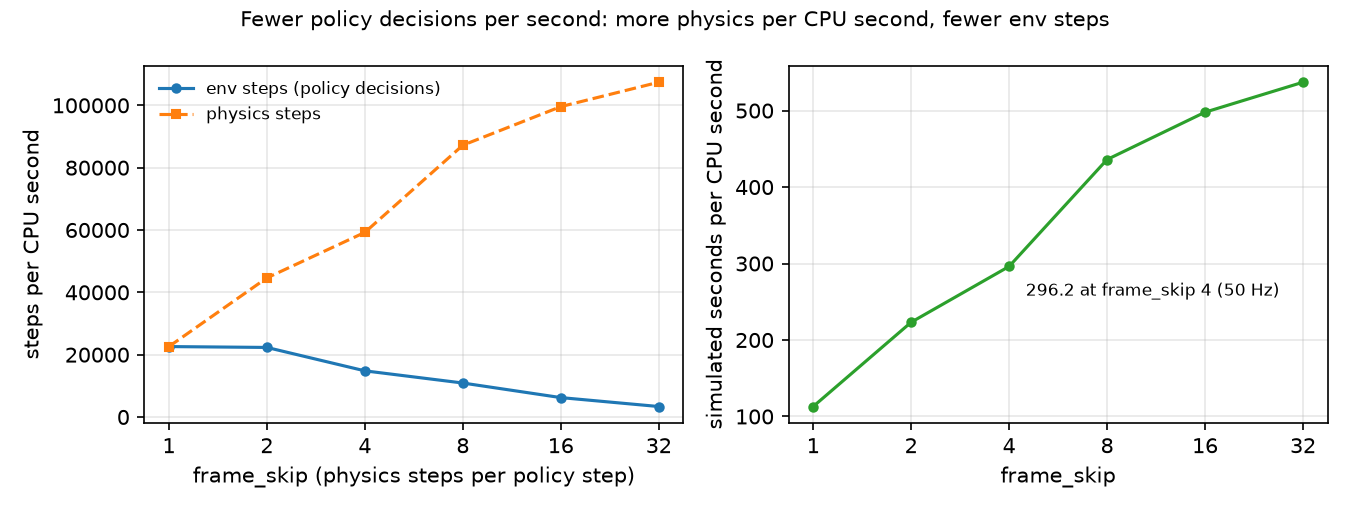
A linear fit gives 31.0 µs + 8.3 µs × frame_skip of CPU time per env.step(). One SO-101 physics step costs about 8 µs; the Python side of a step (clipping, observation, reward, bookkeeping) costs about as much as four physics steps. At frame_skip 1 the env spends most of its time in Python, one reason to batch many environments per Python call (lesson 36). At frame_skip 4 it runs 296.2 simulated seconds per CPU second.
Break it
Section titled “Break it”Truncation is part of the task definition. Shorten the time limit and run the scripted controller, which is perfect at 1.6 s:
| time limit | steps | success | Wilson 95% | median final distance |
|---|---|---|---|---|
| 0.08 s | 4 | 11/200 | 3.1–9.6% | 120.1 mm |
| 0.16 s | 8 | 43/200 | 16.4–27.7% | 50.7 mm |
| 0.24 s | 12 | 81/200 | 33.9–47.4% | 23.1 mm |
| 0.32 s | 16 | 160/200 | 73.9–85.0% | 7.9 mm |
| 0.48 s | 24 | 199/200 | 97.2–99.9% | 1.0 mm |
| 1.60 s | 80 | 200/200 | 98.1–100.0% | 0.2 mm |
Below about 0.5 s even the model-based controller misses: with torque-limited servos (±2.94 N·m) and one IK step per 20 ms, it needs between 0.32 and 0.48 s for almost every reach. It is not time-optimal (a policy can command larger target jumps), so 81/200 at 0.24 s is a reference, not a hard ceiling. Still, a learner given a 0.24 s episode is scored on a task that even a model-based controller mostly fails, and its low success would look like a learning problem. Measure a scripted or oracle baseline under the same time limit before tuning the learner.
On the real robot
Section titled “On the real robot”- On hardware
step()waits for real time: one 20 ms policy step takes 20 ms. In simulation the same env ran 296.2 simulated seconds per CPU second (section C, frame_skip 4). That ratio is why policies are trained in simulation. reset()on a real arm is a motion, not an assignment: the arm has to be driven back to and the target placed or marked, which costs seconds per episode and needs a safe trajectory (lesson 15).- The observation must be built from what the robot measures: servo encoder positions, finite-difference velocities, and a target position from a camera (lesson 20). Each has noise and delay that this simulated env does not have (Part 9).
- Procedure for the SO-101: run the scripted IK baseline on 20 fixed reachable targets, measure the final gripper position with the camera, report with a Wilson interval. Not yet measured on the real arm.
Check yourself
Section titled “Check yourself”Quick check · 2 questions. Click an answer.
1. In Break it, the scripted IK controller reaches only 81/200 targets with a 0.24 s time limit. A learner trained with that limit scores low. What is the right reading?
- PPO is broken; switch algorithms.
- The success radius of 2 cm is too strict for any controller.
- The time limit defines what is achievable; even the model-based controller mostly fails at 0.24 s, so measure such a baseline before tuning the learner.
Why: The scripted IK needs between 0.32 and 0.48 s for almost every reach (160/200 at 0.32 s, 199/200 at 0.48 s); at 1.6 s it reaches 200/200 (Break it table).
2. From frame_skip 1 to 4, env steps per CPU second fall (22595 → 14809) while simulated seconds per CPU second rise (113.0 → 296.2). Why?
- Each
env.step()has a fixed Python cost of about four physics steps, so packing more physics into each call spends less of the time in Python. - MuJoCo uses a larger timestep when frame_skip grows.
- The policy network is skipped on most steps.
Why: The linear fit in section C: 31.0 µs + 8.3 µs × frame_skip of CPU time per env.step(); one physics step costs about 8 µs.
- Easy. The scripted controller reaches the target and the env is configured with
terminate_on_success=True. Which flag is set, and what does the learner bootstrap from that step? - Medium. Add a rule: if any arm geom touches the floor, the episode ends. Should that be
terminatedortruncated? Implement it instep()and count how often the random policy triggers it in 200 episodes. - Hard. Wrap 16 copies of the env in
gymnasium.vector.SyncVectorEnvandAsyncVectorEnvand measure total env steps/s against one env. Where does the difference come from?
Answers
Section titled “Answers”terminated = True,truncated = False; the target is with no term, because the goal state is terminal by definition of the task.terminated: touching the floor is part of the task’s dynamics (a failure state), not an external clock. The count is yours to measure; we did not run it.- Open; we did not run it.
SyncVectorEnvstill steps the 16 copies one after another in the same Python process, so expect roughly the single-env rate.AsyncVectorEnvruns each copy in its own subprocess, so the gain comes from extra cores, minus the inter-process cost per step, which matters most at small frame_skip where a step is short (section C).
Takeaways and sources
Section titled “Takeaways and sources”- The environment is a contract:
reset(seed)reproduces episodes,step()returns five values, andterminated(task over) must be kept apart fromtruncated(clock over). - Baselines bracket the task: random and zero actions succeed 1/200 times, scripted IK 200/200; a learned policy must be read against both.
- Frame skip sets both the control rate and the simulator’s speed; the episode length (truncation) defines what is achievable at all.
Next: lesson 33, training a policy on this environment with PPO.
Sources
- Gymnasium ·
EnvAPI (reset,step, terminated vs truncated, seeding). - MuJoCo documentation · Python bindings.
unitree_rl_gym·legged_robot_config.py,go2_config.py(BSD-3-Clause).- MuJoCo Menagerie ·
robotstudio_so101(Apache-2.0). - Code:
reach_env.py,experiment.py,output.txt; figure fromplot.py.