04 · Friction and friction cones
| Part | 1 · Simulation |
| Run type | CPU · Mac or Colab CPU |
| Prerequisites | 03 |
| Learn first | Vectors, Matrices & Operations |
| Time | ~40 min |
| Code | experiments/04-friction/experiment.py · notebook |
| Status | ✅ done |
Act on this lesson
Tick each step when you have done it. Saved in this browser only.
Slip is decided by a ratio, not a weight: tan θ = μ, and the simulated cone has to approximate it.
The problem
Section titled “The problem”Unitree’s open base training config (the one its Go2 config inherits) randomizes floor friction but not mass: each of num_envs = 4096 parallel copies draws its friction from friction_range = [0.5, 1.25], with randomize_base_mass = False (legged_robot_config.py). For slip, friction is the right knob: whether a foot or a grasped object slips depends on the friction coefficient and on the direction of the contact force, not on how heavy the object is. This lesson measures the slip angle of a cube on a ramp in MuJoCo, checks it against Coulomb’s law, and finds the two places where the simulation deviates from it: creep below the threshold, and a pyramidal friction cone that depends on direction.
Before you read · 2 questions. Guess first; the lesson tells you why.
1. On the same ramp (μ = 0.3), does a 10 kg cube slip at a larger angle than a 0.1 kg cube?
- Yes, a heavier cube presses harder into the ramp and gets a bigger friction budget.
- No, the downhill pull and the friction budget both scale with , so the slip angle depends only on μ.
- No, the lighter cube holds longer because it has less momentum.
Why: has no mass in it. In the Experiment table all three masses slip at 16.75° for μ = 0.3 (theory 16.70°).
2. Two cubes, 0.1 kg and 10 kg, slide down the same ramp above the slip angle. Which accelerates faster?
- The 10 kg cube, because gravity pulls it harder.
- The 0.1 kg cube, because friction holds it less.
- Neither; both accelerate at , in which the mass cancels.
Why: Pull and friction budget both scale with (In plain words); Build it, Step 2 checks the formula against MuJoCo within 1.2 %, and the Experiment’s speed traces of 0.1 kg and 10 kg cubes differ by at most 2.1·10⁻¹² cm/s.
Core idea
Section titled “Core idea”In plain words
Section titled “In plain words”Friction is a budget. A surface can push sideways on an object, but only up to a limit, and that limit is proportional to how hard the object presses on the surface. The proportionality factor is the friction coefficient μ.
Put a phone on a book and tilt the book slowly. Tilting does two things at once: less of the phone’s weight presses into the book (smaller budget) and more of it pulls the phone downhill (bigger demand). At some angle the demand exceeds the budget and the phone slides. A heavy phone presses harder, but it is also pulled harder by exactly the same factor, so weight cancels: the slip angle depends only on μ.
A simulator has to represent that budget. The exact rule says the sideways force may point in any direction, up to the same limit, so the allowed forces form a round cone. MuJoCo’s default approximates the round cone with a pyramid, whose flat faces make the limit depend on direction. And because MuJoCo’s contact is soft (lesson 03), friction is soft too: below the limit an object can still creep slowly.
flowchart TD
    W["weight m·g"] --> N["pressing into the ramp<br/>m·g·cos θ"]
    W --> P["pulling downhill<br/>m·g·sin θ"]
    N --> B["friction budget<br/>μ · m·g·cos θ"]
    B --> C{"pull larger<br/>than budget?"}
    P --> C
    C -- "no" --> H["cube holds"]
    C -- "yes" --> S["cube slips"]
The slip test, as code
Section titled “The slip test, as code”pull = m * g * sin(theta) # gravity component along the ramp (N)budget = mu * m * g * cos(theta) # largest friction force the surface can supply (N)slips = pull > budget # m and g cancel: tan(theta) > mu (Build it, Step 1)
def in_elliptic_cone(f_n, f_t1, f_t2, mu): # MuJoCo's round cone, condim 3 return f_n >= 0 and f_t1**2 + f_t2**2 <= (mu * f_n)**2| Quantity | Formula |
|---|---|
| force pulling the cube downhill | |
| friction limit | |
| slip condition | |
| acceleration while sliding | |
| elliptic cone |
is the cube’s mass, gravity, the ramp angle and the sliding friction coefficient; is the contact force along the surface normal and (more with higher condim) the tangential components, each limited by its own coefficient .
Math details: Coulomb's law on a ramp, and why the simulated cone deviates
Slip condition. Static friction can supply at most , where is the normal force on a ramp. The cube holds while . Dividing by gives : mass and gravity cancel (OpenStax University Physics 1, §6.2). Above the threshold the net downhill force is , hence the acceleration in the table.
Cones. A contact force is admissible if it lies in the friction cone (Computation · Contact). The elliptic cone is the inequality in the table. The pyramidal cone is built from non-negative edge forces, where is condim; for condim=3 that is 4 edges. A pyramid has flat faces, so its cross-section is a polygon, not a circle, and the friction limit it allows depends on the direction of sliding relative to the contact frame. The docs call elliptic cones the better model of physical reality, with pyramidal cones sometimes faster and more robust (option/cone).
Creep. The friction constraint is solved softly, like the normal one, so a small steady sliding speed below the threshold is allowed. The docs call this slow slippage and list two mitigations: elliptic cones with impratio > 1, or the noslip solver (Modeling · Slow slippage).
One μ. geom/friction holds three numbers (sliding, torsional, rolling; default 1 0.005 0.0001). There is one sliding coefficient, so no separate static and kinetic friction. For a contact pair, the element-wise maximum is used unless one geom has higher priority (geom/friction, Contact parameters).
Go deeper: Vectors, Matrices & Operations (AIEFS: splitting a force into components); OpenStax University Physics 1, §6.2; MuJoCo Computation · Contact.
Friction cones in MuJoCo
Section titled “Friction cones in MuJoCo”option/cone | Definition | Rows per condim=3 contact |
|---|---|---|
pyramidal (default) | non-negative edge forces of a pyramid | 4 |
elliptic | 3 |
A row is one scalar unknown the constraint solver has to find for that contact.
Build it
Section titled “Build it”You will now write the Coulomb slip test, the sliding acceleration and MuJoCo’s pyramidal cone in about 40 lines of NumPy, and check them against MuJoCo’s motion, its constraint rows and a SciPy linear program. Type the steps into your own file and run it after each step. The finished functions are in physai/sim.py; uv run python experiments/04-friction/build.py runs all four steps with the checks (output in build_output.txt).
Step 1 · The slip test
Section titled “Step 1 · The slip test”def ramp_slip(theta, mu, g=9.81): """Does a block on a ramp at angle theta slip (tan theta > mu), and its downhill acceleration if so.""" slips = np.tan(theta) > mu return slips, g * (np.sin(theta) - mu * np.cos(theta)) if slips else 0.0Apply it on the Experiment’s 0.05° grid, then apply the Experiment’s own criterion (fast and accelerating after 2 s) to this ideal block, which starts from rest with constant acceleration, so its mean speeds over 0.5–1.0 s and 1.5–2.0 s are and :
== Step 1. Slip angle: tan(theta) > mu, then the Experiment's criterion on an ideal Coulomb block == mu arctan mu first grid angle that slips ideal block + criterion 0.3 16.70° 16.70° 16.80° 0.5 26.57° 26.60° 26.65° 0.8 38.66° 38.70° 38.75° 1.0 45.00° 45.05° 45.05°The Experiment measured 16.75°, 26.60°, 38.70° and 44.90°: one grid step before the ideal block passes the criterion (three at μ = 1). Just above the ideal block accelerates so slowly that it is still below 2 cm/s after 2 s; the MuJoCo cube adds its creep speed (up to 1.42 cm/s, Observe) on top.
Step 2 · Sliding acceleration
Section titled “Step 2 · Sliding acceleration”Above the threshold the block accelerates at . The Experiment’s 80 cm ramp is too short to measure that for long, so tilt gravity instead: a cube on a flat floor with gravity is the same physics with no edge to slide off. Fit with a parabola:
== Step 2. Sliding acceleration (mu = 0.5): g (sin - mu cos) vs MuJoCo, fit over 0.2-1.0 s == theta ours (m/s^2) elliptic pyramidal 28.0° 0.2747 0.2744 0.2745 30.0° 0.6571 0.6571 0.6567 35.0° 1.6088 1.6207 1.6117 45.0° 3.4684 3.4640 3.5092Within 1.2 % at every angle, for both cones. The residue is not noise in the formula: a sliding box tips onto its leading edge and hops (at times it has no contact at all), so the fit averages a bumpy slide.
Step 3 · The pyramid as constraint rows
Section titled “Step 3 · The pyramid as constraint rows”For condim=3 the pyramidal cone replaces each contact by four edge forces along and . In constraint form each edge is a row , and the contact force is their sum:
def pyramid_rows(j_normal, j_tangent, mu): """Constraint rows of MuJoCo's pyramidal cone: J_n + mu J_t and J_n - mu J_t for each tangent direction.""" return np.array([j_normal + s * m * jt for m, jt in zip(mu, j_tangent) for s in (1, -1)])def pyramid_to_force(edge_forces, mu): """Contact-frame force (normal, tangential...) from the non-negative pyramid edge forces.""" f = np.asarray(edge_forces, float).reshape(-1, 2) return np.r_[f.sum(), [m * (fp - fm) for m, (fp, fm) in zip(mu, f)]]Build , from the contact frame (d.contact[i].frame, normal first) and the cube’s point Jacobian at the contact (mj_jac), then compare with MuJoCo’s efc_J and mj_contactForce:
== Step 3. Pyramid rows and edge forces vs MuJoCo (cube holding at 20°, mu = 0.5, pyramidal) ==4 contacts x 4 rows = 16 rows · max |our rows - efc_J| = 0.0e+00max |force from our edge sum - mj_contactForce| = 0.0e+00 NExact: that is how MuJoCo assembles a pyramidal contact.
Step 4 · How much friction, in which direction
Section titled “Step 4 · How much friction, in which direction”Non-negative edge forces with unit normal force reach any tangential force with : a diamond, not a circle. Along a direction at angle to the first tangent the limit is therefore :
def tangential_limit(phi, mu, cone): """Largest friction force per unit normal force when sliding at angle phi to the first tangent axis.""" if cone == "elliptic": return mu return mu / (abs(np.cos(phi)) + abs(np.sin(phi))) # pyramid: |f1| + |f2| <= mu f_n, a diamond== Step 4. Largest friction force per unit normal force, by sliding direction (mu = 0.5) == phi elliptic pyramid (ours) pyramid (linprog) 0° 0.5000 0.5000 0.5000 15° 0.5000 0.4082 0.4082 30° 0.5000 0.3660 0.3660 45° 0.5000 0.3536 0.3536MuJoCo: friction impulse / normal impulse on the cube over 0.2-1.0 s (world frame) holding at 20° (tan 20° = 0.3640) elliptic 0.3640 holding at 20° (tan 20° = 0.3640) pyramidal 0.3640 sliding at 35° (mu = 0.5) elliptic 0.5000 sliding at 35° (mu = 0.5) pyramidal 0.5000SciPy’s linear program over the four edge forces agrees at every angle. Along a diagonal the pyramid allows only , 0.3536 instead of 0.5. MuJoCo’s own forces obey the law: a holding cube uses exactly the friction it needs, = 0.3640; a sliding cube sits on the cone’s boundary, ratio μ. Both cubes here slide along a tangent axis (), where the two cones agree. Whether the rotated cube of Break it slides at a different was not isolated.
What you keep
Section titled “What you keep”physai.sim now has ramp_slip, pyramid_rows, pyramid_to_force and tangential_limit. Lesson 16 needs the friction limit when the gripper squeezes an object. tests/test_04_friction.py pins them to MuJoCo; run uv run pytest tests/test_04_friction.py after you change anything.
Use it
Section titled “Use it”In MuJoCo, friction is three numbers per geom plus two global options:
<option cone="elliptic" impratio="10"/>          # round cone; impratio > 1 reduces creep (Math details)<geom ... friction="1 0.005 0.0001" condim="3"/>  # sliding, torsional, rolling; condim picks which act
f = np.zeros(6)mujoco.mj_contactForce(m, d, i, f)               # contact i: f[0] normal, f[1:3] friction, in its framef_world = d.contact[i].frame.reshape(3, 3).T @ f[:3]
Traps:
- Contact frame, not world.
mj_contactForcereturns the force in the contact frame, normal first; rotate withframe.Tbefore adding contacts or comparing with gravity (Step 4). - One μ for both bodies. MuJoCo takes the element-wise maximum of the two geoms’
frictionunlessprioritydecides (Math details): a slippery object on a μ = 1 gripper pad gets μ = 1. - Rows, not contacts.
d.nefccounts rows: four per pyramidalcondim=3contact, three per elliptic one (Step 3 found 16 rows for 4 contacts).
Check after building · 2 questions.
1. In Build it, Step 4, the pyramidal cone with μ = 0.5 allows a friction force of only 0.3536 per unit normal force along the diagonal ( = 45°). Why?
- The edge forces , reach only , a diamond whose diagonal limit is .
- MuJoCo halves μ for diagonal sliding to save computation.
- The linear program did not converge at 45°.
Why: tangential_limit gives and SciPy’s linprog over the four edge forces gives the same 0.5000, 0.4082, 0.3660, 0.3536 at 0°, 15°, 30°, 45°. The elliptic cone allows 0.5000 in every direction.
2. In Build it, Step 1, an ideal Coulomb block judged by the Experiment’s criterion slips from 16.80° (μ = 0.3), but the MuJoCo cube slipped from 16.75°. Why does the simulated cube pass the criterion one grid step earlier?
- MuJoCo uses a smaller μ than the file says.
- Just above the ideal block is still below 2 cm/s after 2 s; the simulated cube adds its creep speed on top.
- The 0.05° grid rounds the simulated angle down.
Why: The criterion needs > 2 cm/s; the ideal block’s is too small that close to the threshold. Below the threshold the MuJoCo cube already creeps at up to 0.30 cm/s for μ = 0.3 (Observe).
Experiment
Section titled “Experiment”An 8 cm cube placed at rest on an 80 × 30 × 2 cm ramp, aligned with it; both geoms get the same μ.
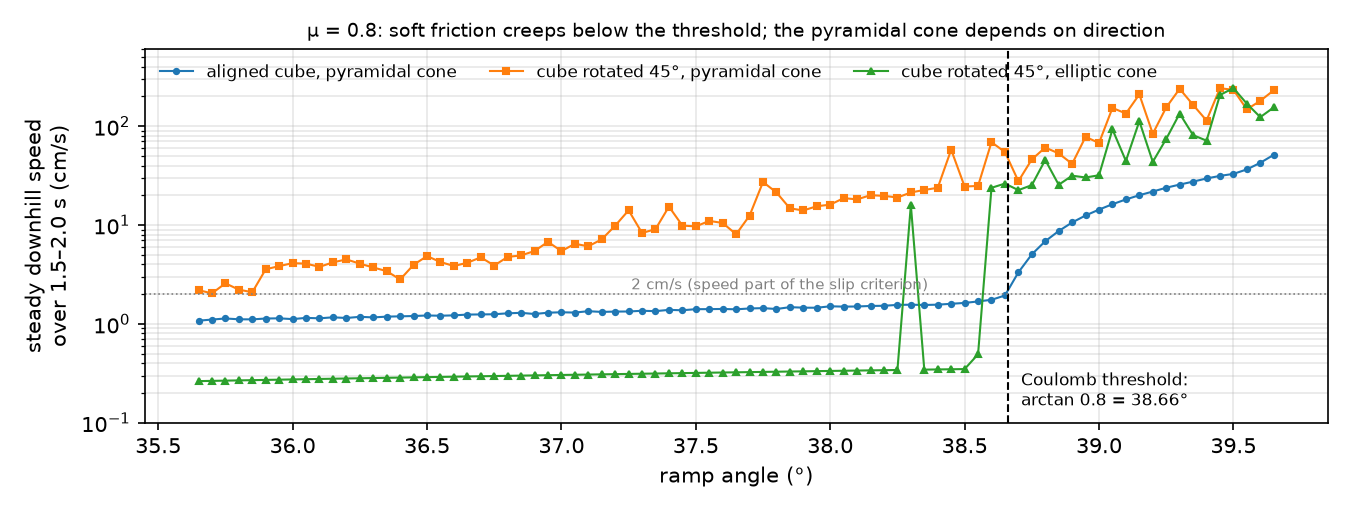
def xml(theta_deg, mu, mass, cone="pyramidal"): return f"""<mujoco> <option cone="{cone}"/> <worldbody> <body name="ramp" euler="0 {-theta_deg} 0"> <geom type="box" size=".40 .15 .01" friction="{mu} 0.005 0.0001"/> </body> <body name="cube"> <freejoint/> <geom type="box" size=".04 .04 .04" mass="{mass}" friction="{mu} 0.005 0.0001"/> </body> </worldbody></mujoco>"""2 s are simulated; and are the mean downhill speeds over 0.5–1.0 s and 1.5–2.0 s. Because of creep (slow sliding below the threshold, see Math details), “slipping” needs two conditions:
def slips(v1, v2): return v2 > 2.0 and (v2 - v1) > 0.5 # cm/s: fast AND acceleratingThe slip angle is the smallest angle from which every larger angle slips, on a 0.05° grid from 3° below to 1° above .
Predict. Does a 10 kg cube slip at a larger angle than a 0.1 kg one?
Run. experiment.py, MuJoCo 3.17.0, Apple M5, dt = 2 ms, deterministic; output in output.txt.
| μ | 0.1 kg | 1 kg | 10 kg | |
|---|---|---|---|---|
| 0.3 | 16.70° | 16.75° | 16.75° | 16.75° |
| 0.5 | 26.57° | 26.60° | 26.60° | 26.60° |
| 0.8 | 38.66° | 38.70° | 38.70° | 38.70° |
Observe.
- Mass has no effect: across the whole sweep, the speed traces of the 0.1 kg and 10 kg cubes differ by at most 2.1·10⁻¹² cm/s (rounding).
- The measured angle is within one grid step of theory (largest deviation +0.05°). For μ = 1 the script gives 44.90° against 45.00°.
- Creep. At least 1° below the threshold the cube still moves at a constant speed: up to 0.30, 0.60 and 1.42 cm/s for μ = 0.3, 0.5, 0.8, while stays below 0.05 cm/s. With a speed-only criterion ( > 2 cm/s) the “slip angle” drops to 16.35° (−0.35°) and 26.25° (−0.32°) for μ = 0.3 and 0.5. Creep, not acceleration, is what that criterion detects.
- The elliptic cone gives the same angles for the aligned cube (16.75°, 26.60°, 38.70°).
Break it
Section titled “Break it”Rotate the cube 45° about the ramp normal. Coulomb friction is isotropic, so nothing should change:
| μ | cone | slip angle | vs theory | max steady speed ≥ 0.5° below threshold |
|---|---|---|---|---|
| 0.5 | pyramidal | 26.30° | −0.27° | 7.40 cm/s |
| 0.5 | elliptic | 26.60° | +0.03° | 0.18 cm/s |
| 0.8 | pyramidal | 37.70° | −0.96° | 27.24 cm/s |
| 0.8 | elliptic | 38.60° | −0.06° | 0.34 cm/s |
With the default pyramidal cone the rotated cube slips almost 1° early at μ = 0.8 and slides at up to 27.24 cm/s where it should hold. The elliptic cone stays within one or two grid steps. A plausible mechanism is that the pyramid’s edges are tied to the contact frame, so the admissible tangential force depends on direction, but this was not isolated here (box–box contact point placement also changes with rotation). Treat it as a measured warning: if friction limits matter (grasping, foot slip), use cone="elliptic" or verify with a sweep.
The speed curves behind these numbers, for μ = 0.8, show both deviations at once (plot.py re-runs the same sweep(); the per-angle speeds are not in output.txt):
On the real robot
Section titled “On the real robot”- The Menagerie SO-101 already uses
cone="elliptic"andimpratio="10", the slow-slippage mitigation above. Its gripper collision geoms usefriction="1 5e-3 5e-4",condim="6"andpriority="1", so their μ = 1 overrides the object’s (so101.xml). Whether μ = 1 matches the printed pads against a given object is not yet measured on the real arm. - Procedure (same as this experiment): put the object on a pad-material ramp, tilt slowly, record the slip angle 5 times, μ = tan θ. Real surfaces have a static coefficient larger than the kinetic one; MuJoCo’s single μ cannot represent that difference.
Check yourself
Section titled “Check yourself”Quick check · 2 questions. Click an answer.
1. Below the threshold the simulated cube still moves at a small constant speed. What goes wrong if “slipping” just means “faster than 2 cm/s”?
- Nothing; the creep is a rounding error far below 2 cm/s at every angle.
- The measured slip angle comes out too large, because creep slows the cube down.
- Creep is counted as slip, so the measured slip angle comes out too small.
Why: Soft friction creeps. Under Observe, the speed-only criterion gives 16.35° (−0.35°) for μ = 0.3 and 26.25° (−0.32°) for μ = 0.5; requiring acceleration fixes it.
2. The cube is rotated 45° about the ramp normal. Coulomb friction is isotropic, so nothing should change. What did the run show at μ = 0.8?
- The default pyramidal cone slipped almost 1° early (37.70°); the elliptic cone stayed close to theory (38.60°).
- Both cones gave the same angle; the cone only affects solver speed.
- The elliptic cone slipped early and the pyramidal cone stayed exact.
Why: Break it table, pyramidal −0.96° with up to 27.24 cm/s of sliding where it should hold. If friction limits matter, use cone="elliptic" or check with a sweep.
- Easy. Set
massto 1000 kg. Predict the slip angle at μ = 0.5, then run--quickafter editing. - Medium. Give the ramp μ = 0.3 and the cube μ = 0.8. At which angle does it slip? Then add
priority="1"to the ramp geom. - Hard. For the policy trained on μ ∈ [0.5, 1.25], compute the slip-angle range on a ramp. Then measure, with the rotated cube and both cones, how far the pyramidal result can be off at μ = 1.25. Note it for lesson 39 · Domain randomization.
Answers
Section titled “Answers”- Unchanged, 26.60° in this setup: mass cancels.
- Without priority MuJoCo uses the larger μ, 0.8, so expect about 38.7°; with priority on the ramp, μ = 0.3, about 16.75°. Run to confirm.
- In theory from (26.57°, printed by the script) to ; the rotated-cube deviation at μ = 1.25 must be measured, not extrapolated.
Takeaways and sources
Section titled “Takeaways and sources”- tan θ = μ, independent of mass; MuJoCo reproduces it within 0.05° for μ = 0.3–0.8 (44.90° vs 45.00° at μ = 1) when the slip criterion requires acceleration.
- Soft contact creeps below the threshold (up to 1.42 cm/s here); a speed-only criterion mistakes creep for slip.
- The default pyramidal cone is direction-dependent in this test (−0.96° at 45°); elliptic is not.
Next: lesson 05 · Joints and actuators.
Sources
- OpenStax, University Physics Vol. 1, §6.2 Friction.
- MuJoCo XML reference · option/cone, geom/friction; Computation · Contact; Modeling · Contact parameters.
unitree_rl_gym·legged_robot_config.py:num_envs = 4096,randomize_friction = True,friction_range = [0.5, 1.25](read 2026-10-27).- Menagerie · robotstudio_so101.
- Our numbers:
experiments/04-friction/output.txt.