06 · Rotations: matrices, Euler angles, axis-angle, quaternions
| Part | 2 · Spatial math |
| Run type | CPU · Mac or Colab CPU |
| Prerequisites | 01 |
| Learn first | Linear Algebra Intuition · Matrix Transformations |
| Time | ~60 min |
| Code | experiments/06-rotations/experiment.py |
| Status | ✅ done |
Act on this lesson
Tick each step when you have done it. Saved in this browser only.
Store orientation as a rotation matrix or a unit quaternion; use Euler angles only for display.
The problem
Section titled “The problem”Open any MuJoCo model with a free-floating body and look at its state vector. One free body has nq = 7 position numbers (3 for position, 4 for a quaternion) but only nv = 6 velocity numbers (3 linear, 3 angular); our run prints exactly that, with the default quaternion [1, 0, 0, 0]. Why would a simulator store four numbers for a three-dimensional quantity, and why do position and velocity have different sizes?
Because every three-number description of orientation breaks somewhere. With Euler angles, a gripper pitched to 90° loses one rotational direction: no finite Euler-angle rate produces it. This lesson measures where that happens and what it costs, and shows the representations that do not break.
Before you read · 2 questions. Guess first; the lesson tells you why.
1. One free body in MuJoCo has nq = 7 position numbers but only nv = 6 velocity numbers. Why?
- The seventh position number stores the simulation time.
- Orientation is stored as a 4-number unit quaternion, while an angular velocity is a plain 3-vector.
- The quaternion’s fourth number stores the body’s scale.
Why: Position 3 + quaternion 4 = 7, linear 3 + angular 3 = 6 (Part A of the output, default quaternion [1, 0, 0, 0]).
2. Gimbal lock happens at pitch ±90°. Is a pitch of 80° safe for a controller that commands Euler-angle rates?
- Yes; the rate map is only singular at exactly 90°, everything before it is fine.
- Yes, as long as the body itself can still rotate in every direction.
- No; , so the trouble grows over a whole neighbourhood, cond(E) is already 11.43 at 80°.
Why: Step 2 table; the Euler rate needed for a 1 rad/s body rotation is 16.2 rad/s at 85° and 81.0 rad/s at 89° (Break it).
Core idea
Section titled “Core idea”In plain words
Section titled “In plain words”Orientation answers “which way is this thing facing?”. Think of a camera on a tripod head with three knobs: pan (turn left/right), tilt (look up/down) and roll (twist the picture). Three knob readings are Euler angles, easy for people to read, which is why every UI shows them.
Now tilt the camera straight up. Pan and roll now spin it about the same vertical line, and no knob turns it sideways from that pose: one direction is gone, gimbal lock. The camera can still point anywhere; it is the three-knob description that breaks, and it misbehaves in a whole neighbourhood of that pose.
The fix is to describe orientation without a sequence of turns. A rotation matrix writes down where the object’s three axes point, in the parent’s coordinates. A unit quaternion packs “turn by this angle about this axis” into four numbers. Neither has a bad pose; the quaternion’s one quirk is that and mean the same orientation, so code that compares or blends quaternions must check the sign.
flowchart TD
    E["Euler angles<br/>yaw, pitch, roll<br/>(show to humans)"] -- "mju_euler2Quat" --> Q["unit quaternion q<br/>w, x, y, z<br/>(store, interpolate)"]
    A["axis-angle<br/>axis k, angle θ"] -- "mju_axisAngle2Quat" --> Q
    Q -- "mju_quat2Mat" --> R["rotation matrix R, 3×3<br/>(compose, rotate vectors)"]
    R -- "mju_mat2Quat" --> Q
    R --> P["rotated point<br/>p' = R p"]
Rotations as code
Section titled “Rotations as code”import numpy as np
def Rz(a): # rotation by angle a (rad) about the z axis c, s = np.cos(a), np.sin(a) return np.array([[c, -s, 0], [s, c, 0], [0, 0, 1]])# Ry(a) and Rx(a) are built the same way about y and x
p = np.array([1.0, 0, 0])Rz(np.pi / 2) @ p # active: rotate the vector -> [0, 1, 0]Rz(np.pi / 2).T @ p # passive: same vector, coordinates in a frame turned +90° -> [0, -1, 0]
R = Rz(yaw) @ Ry(pitch) @ Rx(roll) # Euler z-y'-x'': composing = multiplying, and the order mattersq = np.r_[np.cos(angle / 2), np.sin(angle / 2) * axis] # unit quaternion, scalar first (Build it: slerp too)The two Rz lines are the two readings of one matrix, and the run prints exactly those vectors:
| Reading | Formula | Meaning |
|---|---|---|
| Active | rotate the vector | |
| Passive | same point, coordinates in a frame rotated by |
| Representation | Formula | Bad poses |
|---|---|---|
| Rotation matrix | none | |
| Euler angles z-y’-x” | pitch (gimbal lock) | |
| Axis-angle (Rodrigues) | – | |
| Unit quaternion | none, but and are the same rotation |
is a 3×3 matrix whose columns are the rotated frame’s axes in the parent frame; are yaw, pitch and roll; in the axis-angle rows is the unit rotation axis and the angle; is the matrix that computes a cross product, ; is written scalar first.
Composition is matrix multiplication and does not commute: and differ by a 120° rotation (measured below). In , read left to right, each new rotation is about the axes of the frame just reached (intrinsic). To blend two orientations, use slerp (spherical linear interpolation) along the shortest arc, never a straight line in Euler angles.
Why Euler angles fail, in one line: the matrix that turns Euler-angle rates into the body’s angular velocity has , which is zero at pitch ±90°.
Math details: the Euler-rate map, Rodrigues and slerp
Euler-rate map. For intrinsic z-y’-x” (yaw , pitch , roll ) the body angular velocity is linear in the angle rates:
At the first and third columns become parallel: roll and yaw turn the body about the same axis. That is gimbal lock, a singularity of the parameterization, not of the physical rotation. Near it, is still invertible but nearly singular, so producing an ordinary angular velocity needs very large angle rates (Break it).
Rodrigues’ formula. Any rotation is an angle about a unit axis . With (the skew-symmetric cross-product matrix), .
Unit quaternions. . Because of the half angle, turning by gives for the same physical rotation: the double cover, and are one rotation.
Slerp interpolates along the shortest great arc: , , after flipping if . Without the flip, the arc can cover the long way round.
Go deeper: AIEFS Linear Algebra Intuition, Matrix Transformations; the rigorous treatment of (the group of all rotation matrices) and exponential coordinates is Lynch & Park, Modern Robotics, Ch. 3.
In MuJoCo
Section titled “In MuJoCo”MuJoCo writes quaternions scalar first; the null rotation is 1 0 0 0 (MuJoCo modeling: frame orientations). It converts between representations with mju_euler2Quat (sequence string; lowercase = intrinsic, uppercase = extrinsic), mju_axisAngle2Quat, mju_quat2Mat, mju_mat2Quat, mju_mulQuat, mju_subQuat (API reference). This answers the opening puzzle: orientation is stored as 4 quaternion numbers, an angular velocity as a 3-vector, so nq and nv differ.
Build it
Section titled “Build it”You will now write the rotation toolbox every later lesson uses, quaternion algebra, conversions, Euler angles and slerp, in about 80 lines of NumPy, and check each function against MuJoCo’s mju_* routines and SciPy. Type the steps into your own file and run it after each step. The finished functions are in physai/spatial.py, next to quat_to_mat and axis_angle_to_mat (the Rodrigues formula), which lesson 09 also uses; uv run python experiments/06-rotations/build.py runs all five steps with the checks (output in build_output.txt).
Step 1 · Quaternion algebra
Section titled “Step 1 · Quaternion algebra”A unit quaternion composes by the Hamilton product, inverts by flipping the vector part, and rotates a vector by sandwiching it:
def quat_mul(a, b): """Hamilton product a * b: the rotation b followed by a (as matrices, R(a) @ R(b)).""" w1, x1, y1, z1 = a w2, x2, y2, z2 = b return np.array([w1 * w2 - x1 * x2 - y1 * y2 - z1 * z2, w1 * x2 + x1 * w2 + y1 * z2 - z1 * y2, w1 * y2 - x1 * z2 + y1 * w2 + z1 * x2, w1 * z2 + x1 * y2 - y1 * x2 + z1 * w2])def quat_conj(q): """Conjugate (w, -x, -y, -z): the inverse rotation of a unit quaternion.""" return np.array([q[0], -q[1], -q[2], -q[3]])def quat_rotate(q, v): """Rotate the 3-vector v by the unit quaternion q: the vector part of q * (0, v) * conj(q).""" return quat_mul(quat_mul(q, np.r_[0.0, v]), quat_conj(q))[1:]The matrix of a quaternion is quat_to_mat, already in the file:
def quat_to_mat(q): """Unit quaternion (w, x, y, z), MuJoCo's order, to a 3x3 rotation matrix.""" w, x, y, z = q return np.array([ [1 - 2 * (y * y + z * z), 2 * (x * y - w * z), 2 * (x * z + w * y)], [2 * (x * y + w * z), 1 - 2 * (x * x + z * z), 2 * (y * z - w * x)], [2 * (x * z - w * y), 2 * (y * z + w * x), 1 - 2 * (x * x + y * y)], ])== Step 1. Quaternion algebra vs MuJoCo (1000 random rotations) ==quat_mul vs mju_mulQuat 2.2e-16quat_conj vs mju_negQuat 0.0e+00quat_rotate vs mju_rotVecQuat 1.3e-15R(a * b) vs R(a) @ R(b) 1.2e-15R(-q) vs R(q) 0.0e+00The product order matches matrix order, , and gives exactly the same matrix (the double cover).
Step 2 · Conversions
Section titled “Step 2 · Conversions”Axis-angle to quaternion is the half-angle formula. Matrix to quaternion needs care: reading fails near 180°, where . Shepperd’s method picks whichever of is largest and divides by it:
def axis_angle_to_quat(axis, angle): """Unit quaternion for a rotation by `angle` (rad) about the unit vector `axis`.""" return np.r_[np.cos(angle / 2), np.sin(angle / 2) * np.asarray(axis, float)]def mat_to_quat(R): """Rotation matrix to unit quaternion with w >= 0 (Shepperd: divide by the largest of 4w^2, 4x^2, 4y^2, 4z^2).""" t = np.trace(R) cands = [t, R[0, 0] - R[1, 1] - R[2, 2], R[1, 1] - R[0, 0] - R[2, 2], R[2, 2] - R[0, 0] - R[1, 1]] i = int(np.argmax(cands)) s = 2 * np.sqrt(1 + cands[i]) # 4 times the largest component if i == 0: q = [s / 4, (R[2, 1] - R[1, 2]) / s, (R[0, 2] - R[2, 0]) / s, (R[1, 0] - R[0, 1]) / s] elif i == 1: q = [(R[2, 1] - R[1, 2]) / s, s / 4, (R[0, 1] + R[1, 0]) / s, (R[0, 2] + R[2, 0]) / s] elif i == 2: q = [(R[0, 2] - R[2, 0]) / s, (R[0, 1] + R[1, 0]) / s, s / 4, (R[1, 2] + R[2, 1]) / s] else: q = [(R[1, 0] - R[0, 1]) / s, (R[0, 2] + R[2, 0]) / s, (R[1, 2] + R[2, 1]) / s, s / 4] q = np.array(q) return q if q[0] >= 0 else -q== Step 2. Axis-angle and matrix -> quaternion vs MuJoCo and SciPy ==axis_angle_to_quat vs mju_axisAngle2Quat 1.1e-16mat_to_quat vs mju_mat2Quat (w >= 0) 5.6e-16mat_to_quat vs SciPy as_quat(scalar_first) 2.2e-16quat_to_mat(mat_to_quat(R)) round trip 7.8e-16180 deg about x: mat_to_quat gives [0. 1. 0. 0.] (trace -1: the x branch)MuJoCo and SciPy may return ; comparing with removes that sign.
Step 3 · Euler angles both ways
Section titled “Step 3 · Euler angles both ways”def euler_zyx_to_mat(yaw, pitch, roll): """Intrinsic z-y'-x'' Euler angles (rad) to a rotation matrix: Rz(yaw) @ Ry(pitch) @ Rx(roll).""" cy, sy, cp, sp, cr, sr = np.cos(yaw), np.sin(yaw), np.cos(pitch), np.sin(pitch), np.cos(roll), np.sin(roll) return np.array([[cy * cp, cy * sp * sr - sy * cr, cy * sp * cr + sy * sr], [sy * cp, sy * sp * sr + cy * cr, sy * sp * cr - cy * sr], [-sp, cp * sr, cp * cr]])def mat_to_euler_zyx(R): """Rotation matrix to (yaw, pitch, roll), pitch in [-pi/2, pi/2]; at pitch = +-90 deg yaw and roll are not unique.""" pitch = np.arcsin(np.clip(-R[2, 0], -1, 1)) return np.arctan2(R[1, 0], R[0, 0]), pitch, np.arctan2(R[2, 1], R[2, 2])== Step 3. Euler z-y'-x'' vs mju_euler2Quat('zyx') and SciPy from_euler('ZYX') ==vs MuJoCo 'zyx' (lowercase = intrinsic there) 8.9e-16vs SciPy 'ZYX' (uppercase = intrinsic there) 5.6e-16vs SciPy 'zyx' (extrinsic: a different rotation) 2.00mat_to_euler_zyx round trip, angles 9.9e-14 radpitch 89.0 deg: (yaw, roll) = (0.7, 0.3) and (0.9, 0.5) give matrices 3.2e-03 apartpitch 90.0 deg: (yaw, roll) = (0.7, 0.3) and (0.9, 0.5) give matrices 1.1e-16 apartThe same three angles mean in MuJoCo’s lowercase "zyx" and in SciPy’s uppercase "ZYX": the two libraries use opposite letter cases for intrinsic sequences, and SciPy’s lowercase gives a different rotation. The last two lines are gimbal lock as numbers: at 90° two different (yaw, roll) pairs give one matrix, so no extraction can recover them.
Step 4 · The Euler-rate matrix
Section titled “Step 4 · The Euler-rate matrix”def euler_rate_matrix(pitch, roll): """E with body angular velocity w_b = E @ (roll', pitch', yaw') for z-y'-x'' angles; det E = cos(pitch).""" cp, sp, cr, sr = np.cos(pitch), np.sin(pitch), np.cos(roll), np.sin(roll) return np.array([[1, 0, -sp], [0, cr, sr * cp], [0, -sr, cr * cp]])Check each column by finite differences: nudge one angle, and the body angular velocity is the skew part of .
== Step 4. The Euler-rate matrix E (roll = 30 deg) ==pitch 0.00 deg: det E 1.000e+00 (cos 1.000e+00) · cond 1.00 · |E - E_fd| 5e-11pitch 60.00 deg: det E 5.000e-01 (cos 5.000e-01) · cond 3.73 · |E - E_fd| 8e-11pitch 80.00 deg: det E 1.736e-01 (cos 1.736e-01) · cond 11.43 · |E - E_fd| 8e-11pitch 89.00 deg: det E 1.745e-02 (cos 1.745e-02) · cond 114.59 · |E - E_fd| 7e-11pitch 89.90 deg: det E 1.745e-03 (cos 1.745e-03) · cond 1145.92 · |E - E_fd| 7e-11pitch 89.99 deg: det E 1.745e-04 (cos 1.745e-04) · cond 11459.16 · |E - E_fd| 7e-11to every printed digit, and the condition numbers are the Experiment’s Step 2 table (11.43 at 80°, 114.59 at 89°).
Step 5 · Slerp
Section titled “Step 5 · Slerp”def slerp(q0, q1, t, shortest=True): """Spherical linear interpolation; with shortest=True flip q1 when q0 . q1 < 0 (q1 and -q1 are one rotation).""" dot = q0 @ q1 if shortest and dot < 0: q1, dot = -q1, -dot om = np.arccos(np.clip(dot, -1, 1)) if om < 1e-9: return q0.copy() return (np.sin((1 - t) * om) * q0 + np.sin(t * om) * q1) / np.sin(om)def quat_angle(q0, q1): """Angle (rad) of the rotation that takes orientation q0 to q1, in [0, pi]; q and -q give the same answer.""" return 2 * np.arccos(np.clip(abs(q0 @ q1), 0, 1))Interpolate 300 pairs that are 60° apart, half of them with replaced by , and add up the rotation travelled over 100 small steps:
== Step 5. Slerp vs SciPy, and the sign check (300 pairs, 60 deg apart) ==slerp(q0, q1, 0.3) vs SciPy Slerp (w >= 0): 3.3e-16 · pairs with q0.q1 < 0: 143sign check True : rotation travelled min 60.0 deg, max 60.0 degsign check False: rotation travelled min 60.0 deg, max 300.0 degThe Experiment’s Break it, from your own slerp: the sign check is the difference between 60° and 300°. (This draw has 143 negative pairs, the Experiment’s 156.)
What you keep
Section titled “What you keep”physai.spatial now has quat_mul, quat_conj, quat_rotate, axis_angle_to_quat, mat_to_quat, euler_zyx_to_mat, mat_to_euler_zyx, euler_rate_matrix, quat_angle and slerp. Lesson 07 builds rigid transforms on them; lesson 09 reads body orientations with quat_to_mat. tests/test_06_rotations.py pins them to MuJoCo and SciPy; run uv run pytest tests/test_06_rotations.py after you change anything.
Use it
Section titled “Use it”MuJoCo’s mju_* functions write into a preallocated output array, first argument:
q = np.zeros(4)mujoco.mju_euler2Quat(q, np.array([yaw, pitch, roll]), "zyx")   # intrinsic z-y'-x''R = np.zeros(9); mujoco.mju_quat2Mat(R, q)                      # row-major 3x3, flattenedmujoco.mju_mulQuat(q_ab, q_a, q_b)                              # q_a * q_bmujoco.mju_rotVecQuat(v_out, v, q)
from scipy.spatial.transform import Rotationr = Rotation.from_quat(q, scalar_first=True) # SciPy's default order is (x, y, z, w)r.as_euler("ZYX") # uppercase = intrinsic in SciPy| Tool | Quaternion order | Intrinsic z-y’-x” |
|---|---|---|
| physai, MuJoCo | euler_zyx_to_mat; mju_euler2Quat(q, e, "zyx") | |
SciPy Rotation | unless scalar_first=True | from_euler("ZYX", e); lowercase is extrinsic |
MJCF euler="..." | – | <compiler eulerseq="zyx"/>; the default is "xyz" (In MuJoCo above) |
Traps:
- Letter case flips meaning. Step 3:
"zyx"is intrinsic in MuJoCo and extrinsic in SciPy, and nothing errors. - Matrices are flat.
mju_quat2Matandd.xmathold 9 numbers in row-major order;reshape(3, 3)before multiplying. - Signs of quaternions. Two correct conversions can return and ; compare rotations with
quat_angle, not withnp.allcloseon the four numbers.
Check after building · 2 questions.
1. In Build it, Step 3, the same angles (yaw, pitch, roll) give with MuJoCo’s "zyx" and with SciPy’s "ZYX", while SciPy’s "zyx" gives a matrix up to 2.00 away. Why?
- SciPy stores quaternions scalar last, so its matrices are transposed.
- The two libraries use opposite letter cases for intrinsic sequences; SciPy’s lowercase means extrinsic, a different rotation.
- Random rounding in SciPy’s Euler conversion.
Why: mju_euler2Quat treats lowercase as intrinsic, SciPy treats uppercase as intrinsic; both match euler_zyx_to_mat to below 1e-15. Nothing errors when you mix them up (Use it, Traps).
2. Why does mat_to_quat pick the largest of first (Shepperd’s method) instead of always computing and dividing by it?
- Near a 180° rotation , and dividing by a tiny amplifies rounding errors; the largest component is always at least 1/2.
- To return instead of for half of the inputs.
- Because the trace of a rotation matrix can be larger than 3.
Why: For 180° about the trace is −1 and = 0; Build it, Step 2 takes the branch there and returns [0, 1, 0, 0]. Over 1000 random rotations it matches mju_mat2Quat to 5.6e-16.
Experiment
Section titled “Experiment”Script: experiments/06-rotations/experiment.py. MuJoCo 3.17.0, NumPy 2.5.4, Apple Silicon Mac (Apple M5), deterministic seeds, under 10 s.
Predict first. At what pitch does the Euler-rate map become a problem: 45°, 80°, or only at exactly 90°? And how far can naive Euler-angle interpolation stray from the true shortest rotation?
Step 1 · conversions agree. 1000 random rotations; hand-written matrices vs MuJoCo’s functions.
q = np.zeros(4)mujoco.mju_euler2Quat(q, [yaw, pitch, roll], "zyx") # intrinsic z-y'-x''R = np.zeros(9); mujoco.mju_quat2Mat(R, q)| Check (1000 random rotations) | max abs error |
|---|---|
mju_euler2Quat("zyx") vs | 5.6e-16 |
mju_axisAngle2Quat vs Rodrigues | 6.7e-16 |
mju_mat2Quat → mju_quat2Mat round trip | 4.2e-16 |
| vs matrix | 0.0e+00 |
| after 1000 compositions | 1.4e-14 |
Step 2 · sweep pitch → conditioning of . The condition number cond(E) says how much can amplify relative errors when you invert it: 1 is perfect, infinity means a direction is lost. σ_min, the smallest singular value, is how much shrinks its weakest direction. The analytic is checked against central differences of (agreement ≤ 9.6e-11 in every row). Roll is fixed at 30°.
| pitch | det E | σ_min | cond(E) |
|---|---|---|---|
| 0° | 1.00 | 1.00 | 1.000 |
| 60° | 0.500 | 0.366 | 3.732 |
| 80° | 0.174 | 0.123 | 11.43 |
| 89° | 0.0175 | 0.0123 | 114.6 |
| 89.9° | 0.00175 | 0.00123 | 1146 |
| 89.99° | 0.000175 | 0.000123 | 11460 |
| 90° | 6.12e-17 | 3.40e-17 | inf |
The condition number grows like , already 11.43 at 80°: the trouble is a neighbourhood, not a point.
Step 3 · sweep start pitch → interpolation error. 300 pairs per row; the goal is the start rotated 60° about a random axis. Naive interpolation is linear in (yaw, pitch, roll), with yaw and roll wrapped the short way; slerp is the reference. “dev” is the largest angle between the two paths, “path/60” is how much rotation the Euler path really travels.
| start pitch | median dev | p95 dev | max dev | median path/60° | pairs with dev > 90° |
|---|---|---|---|---|---|
| 0° | 3.71° | 6.30° | 6.95° | 1.010 | 0 |
| 30° | 4.44° | 14.88° | 20.62° | 1.014 | 0 |
| 60° | 7.83° | 23.91° | 179.74° | 1.042 | 7 |
| 85° | 14.96° | 178.59° | 179.83° | 1.149 | 22 |
| 89° | 16.99° | 178.73° | 179.99° | 1.190 | 23 |
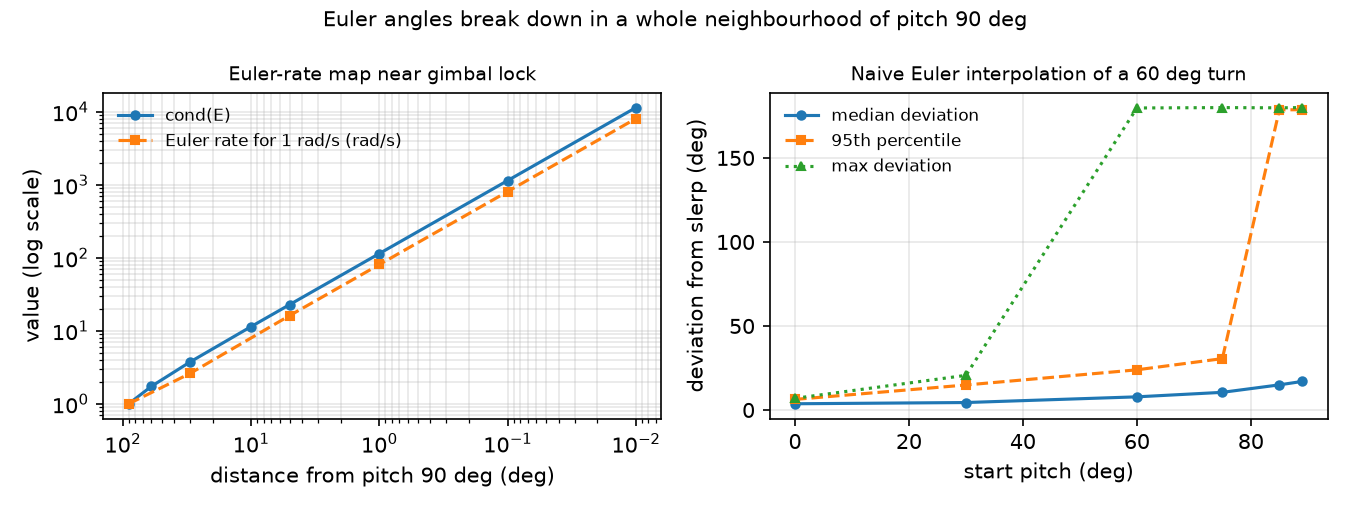
Even at pitch 0 the Euler path is not the shortest one (median 3.71° off). Near 90° the goal’s pitch can cross the ±90° boundary; the extracted yaw and roll then jump by about 180°, and the interpolated orientation swings the long way round: up to 5.595 times the 60° it should travel.
Break it
Section titled “Break it”Euler rates blow up. Ask for a 1 rad/s body rotation about the direction loses at 90° (for roll 30°: ) and solve :
| pitch | 0° | 60° | 85° | 89° | 89.9° | 89.99° |
|---|---|---|---|---|---|---|
| required ‖Euler rate‖ (rad/s) | 1.0 | 2.6 | 16.2 | 81.0 | 810.3 | 8102.8 |
A controller that commands Euler-angle rates would saturate its actuators (hit their speed or torque limit) for a perfectly ordinary motion. You will meet the same mechanism as a kinematic singularity in lesson 10: a matrix that maps rates to velocities loses rank.
Slerp without the sign check. Same 300 pairs 60° apart, but is replaced by at random (same rotation). 156 of 300 pairs had . With the check, every path travels 60.0°; without it, the worst path travels 300.0°: the long way around, because the quaternion arc covers of rotation.
On the real robot
Section titled “On the real robot”- The SO-101 joints are hinges (each turns about one fixed axis), so joint angles never suffer gimbal lock. The problem appears one level up: whenever you write a gripper orientation target as roll-pitch-yaw (teleoperation UIs, dataset labels, policy actions). Store and interpolate quaternions; convert to Euler angles only to show a human.
- Conventions differ between tools. MuJoCo puts the scalar first; its
eulerseqcompiler default is"xyz", and the docs state that URDF’s “rpy” corresponds to"XYZ"(extrinsic) in MJCF (XML reference: compiler/eulerseq). Many other libraries put the scalar last. Before trusting any logged orientation, convert one known rotation and check it. - IMUs and camera trackers deliver orientation estimates with noise. Nothing in this lesson was measured on hardware; the numbers above are pure math in double precision.
Check yourself
Section titled “Check yourself”Quick check · 2 questions. Click an answer.
1. In Experiment Step 3, naive Euler-angle interpolation deviates from slerp by up to 179.83° when the start pitch is 85°. What causes such a jump?
- Slerp itself is unstable near 90°.
- The goal’s pitch crosses the ±90° boundary, so its extracted yaw and roll jump by about 180°, and the straight line in angles swings the long way round.
- Floating-point rounding grows like .
Why: The orientation itself is fine; the three-angle description jumps. The Euler path can travel up to 5.595 times the 60° it should, while slerp always travels 60.0°.
2. Slerp between two orientations 60° apart travels 300.0° in the worst case when the sign check is removed. Why?
- and are the same rotation; without flipping when , the arc goes the long way, 360° − 60°.
- Slerp is inaccurate for angles above 45° and needs smaller steps.
- The quaternions were not normalized before blending.
Why: Break it, 156 of 300 pairs had ; with the check every path travels 60.0°.
- Easy. Is the active rotation by −90° about x, or the passive change of coordinates into a frame rotated by +90°? (Answer both.)
- Medium. Repeat Step 2 for the extrinsic sequence
"XYZ"(each turn about the fixed parent axes). At which pitch is its rate map singular? - Hard. Modify
interp_statsso naive interpolation first unwraps the goal’s Euler triple to the branch closest to the start (try both and ). Does the max deviation at start pitch 85° fall below 90°? Does the median?
Answers
Section titled “Answers”- Both: as an active rotation, and it also maps coordinates in the parent frame into a frame rotated by +90° about x.
- Extrinsic X, then Y, then Z (fixed axes) gives : the same matrix as intrinsic z-y’-x”. So it is singular at the same place, middle angle ±90°. Check it by feeding the extrinsic sequence to
mju_euler2Quatand comparing matrices. - Not computed in this lesson’s script. Run it and compare with the Step 3 table; whatever you find, the median deviation at pitch 0 cannot reach zero, because a straight line in Euler angles is not a geodesic (shortest path) in .
Takeaways and sources
Section titled “Takeaways and sources”- Rotation matrices and unit quaternions are singularity-free; Euler angles have a rate map with , already cond 11.43 at 80° pitch.
- Never interpolate Euler angles; slerp with the flip travels the true 60.0°, naive Euler paths travelled up to 5.595 times that.
- Know your convention: scalar-first vs scalar-last, intrinsic (lowercase) vs extrinsic (uppercase), active vs passive.
Next: lesson 07 · Rigid transforms and frame trees.
Sources
- K. M. Lynch, F. C. Park, Modern Robotics: Mechanics, Planning, and Control, Cambridge Univ. Press, 2017, Ch. 3 “Rigid-Body Motions”. Book page and free preprint.
- MuJoCo documentation: Modeling · frame orientations, XML reference · compiler/eulerseq, API functions (
mju_*math).