22 · Configuration space and sampling-based planning
| Part | 6 · Planning and optimal control |
| Run type | CPU · Mac or Colab CPU |
| Prerequisites | 10 |
| Learn first | Probability and Distributions |
| Time | ~60 min |
| Code | experiments/22-motion-planning/experiment.py |
| Status | ✅ done |
Act on this lesson
Tick each step when you have done it. Saved in this browser only.
A sampling planner never sees the obstacle. It only sees the collision checker’s answers at the configurations it asks about.
The problem
Section titled “The problem”Inverse kinematics (lesson 10) gives a goal configuration (one set of joint angles), not a way to get there. Put a 20 × 20 × 50 cm box in front of a Franka Panda, with the hand left of the box at the start and right of it at the goal. Both configurations are collision-free; the straight line between them in joint space is not: re-checked every 0.005 rad, it pushes the arm 139.0 mm into the box. We need a path through the free part of the 7-D joint space, and we need to know when a “found path” is actually free.
Before you read · 2 questions. Guess first; the lesson tells you why.
1. Start and goal poses of the arm are both collision-free. Is the straight line between them in joint space free too?
- Yes, a segment between two free poses is always free.
- Not necessarily; here the straight line pushes the arm 139.0 mm into the box.
- Only if both poses have the same joint-limit margin.
Why: The free space of C-space is not convex, so two free points do not imply a free segment. The Problem measures 139.0 mm of penetration on the straight line.
2. A planner tests one pose every res radians along each step. What can go wrong if res is coarse?
- The planner always fails, because it rejects too many steps.
- Nothing; the tested poses are enough to see any obstacle.
- A step can jump across a thin part of an obstacle and the planner still reports success.
Why: Whatever happens between two tested poses is assumed free (In plain words); at 1.0 rad every run reports success but 80/100 paths go through the box.
Core idea
Section titled “Core idea”In plain words
Section titled “In plain words”Picture a maze whose coordinates are joint angles instead of metres: for a 7-joint arm, one point in it is one complete pose, seven numbers. The walls are all poses in which some part of the arm overlaps an obstacle. This maze is the configuration space (C-space). A plain box in the room becomes a curved wall in it that nobody draws: in 7 dimensions that is far too expensive.
What is cheap is asking a collision checker about one pose at a time: “put the arm here; does anything overlap?” A sampling-based planner explores the maze with only that yes/no oracle. RRT (rapidly-exploring random tree) explores by throwing darts: pick a random pose, find the closest pose the tree has already reached, take a short step from it toward the dart, and keep the step if it is collision-free. Big unexplored regions catch most darts, so the tree spreads out fast. RRT-Connect grows one tree from the start and one from the goal and, after every step, tries to join them.
The catch is the step itself: a straight segment in joint space, tested at one pose every res radians. Whatever happens between two tested poses is assumed free, so with a coarse res a step can jump through a thin part of a wall and the planner still reports success. After the search, shortcutting replaces detours in the zig-zag result by straight segments that pass the same check.
The RRT-Connect loop
Section titled “The RRT-Connect loop”flowchart TD
S["throw a dart:<br/>random pose in the joint limits"] --> N["nearest node in tree A,<br/>step at most ε toward the dart"]
N --> C{"step collision-free?<br/>(tested every res rad)"}
C -- "no" --> W["swap trees A and B"]
C -- "yes" --> A["add the new node to tree A"]
A --> B["tree B steps toward the new node<br/>until it reaches it or is blocked"]
B --> M{"trees joined?"}
M -- "no" --> W
W --> S
M -- "yes" --> P["path → shortcutting →<br/>dense re-check"]
RRT-Connect as code
Section titled “RRT-Connect as code”A, B = Tree(q_start), Tree(q_goal) # one tree grows from each endfor _ in range(budget): q_rand = uniform(joint_lo, joint_hi) # the dart: a random pose inside the joint limits q_near = A.nearest(q_rand) # closest pose tree A has already reached q_new = step(q_near, q_rand, eps) # move at most eps rad (L2) toward the dart if edge_free(q_near, q_new, res): # test poses every res rad along the step A.add(q_new, parent=q_near) if B.connect_greedily(q_new): # tree B walks toward q_new until blocked or there return join(A, B, q_new) # start ... q_new ... goal, then shortcut it A, B = B, A # alternate which tree growsreturn None # budget used up (not proof that no path exists)| Quantity | Formula |
|---|---|
| Free space | |
| Poses tested on one edge | |
| Worst motion of a point between two tests |
Here is one pose (joint vector), the box of poses within the joint limits, the poses that collide, and the ends of a tree edge, res the edge-check resolution in radians, the change of joint between two tested poses, and the distance of a point on the arm from joint ‘s axis.
The experiment compares RRT-Connect (Kuffner & LaValle 2000) with plain single-tree RRT (LaValle 1998), which differs in two ways: it samples the goal itself with 5 % probability (goal bias), and it stops when a new node is within of the goal and the edge to the goal is free.
Math details: C-space, collision queries, edge checks and completeness
Configuration space. A configuration is one joint vector; joint limits make a box. The obstacle region and the free space are
A box in the workspace becomes a curved 7-D set in that nobody computes explicitly (Lynch & Park ch. 10; LaValle ch. 4). Sampling-based planners only ask a membership question: is free? is in general not convex, so two free poses do not imply a free segment between them.
What an edge check guarantees. A tree edge from to is the segment , , tested at points. A point at distance from a joint axis moves when that joint turns by , so between two tested poses no point moves more than . With the Cauchy–Schwarz inequality and this is at most . An overlap shallower than that bound can start and end between two tests and is never seen.
Probabilistically complete, not optimal. If a free path exists, the probability that either RRT variant finds one tends to 1 as iterations grow. That says nothing about how many iterations it takes or about path quality (LaValle ch. 5).
Narrow passages. A uniform sample lands in a region with probability equal to its share of the volume of ; a passage thin in several joint directions at once has a tiny 7-D volume (Break it).
Go deeper: Probability and Distributions (uniform sampling, probabilities as volume fractions); LaValle 1998 (RRT); Kuffner & LaValle 2000 (RRT-Connect); LaValle, Planning Algorithms, ch. 4–5; Lynch & Park ch. 10.
Build it
Section titled “Build it”You will now write RRT-Connect yourself, about 80 lines of NumPy: the edge check, a tree, the planner and the shortcut. MuJoCo answers only one question, “is this pose free?”. Type the steps into a file of your own and run it after each step. The finished functions are in physai/planning.py; uv run python experiments/22-motion-planning/build.py runs all five steps with their checks (output in build_output.txt).
Step 1 · The oracle and the edge check
Section titled “Step 1 · The oracle and the edge check”The oracle is the Experiment’s depth(q) (put the arm at q, run mj_kinematics and mj_collision, return the deepest contact); free(q) is depth(q) == 0. The edge check tests equally spaced poses no farther apart than res, and all() stops at the first collision:
def edge_free(free, a, b, res): """True if free(q) holds at points spaced at most res (L2, rad) along the segment a -> b.""" n = max(1, int(np.ceil(np.linalg.norm(b - a) / res))) return all(free(a + (b - a) * (k / n)) for k in range(1, n + 1))def worst_along(f, path, res): """Largest f(q) at points spaced at most res along a piecewise-linear path, both ends included.""" worst = 0.0 for a, b in zip(path[:-1], path[1:]): n = max(1, int(np.ceil(np.linalg.norm(b - a) / res))) worst = max(worst, max(f(a + (b - a) * (k / n)) for k in range(n + 1))) return worstworst_along is the dense re-check: the largest value of any function, here the penetration depth, along a whole path. On the straight line from start to goal:
== Step 1. The edge check on the straight line start -> goal == start free: True | goal free: True | length 1.60 rad res (rad) poses on edge tested until answer edge_free says 0.005 320 98 False 0.050 32 10 False 0.250 7 3 False 0.500 4 2 False 1.000 2 1 False dense truth: worst penetration on the line = 139.0 mm
Every resolution rejects this line, because it runs through the middle of the box, 139.0 mm deep as in the Experiment. The edges that slip through are the ones that graze a corner (Step 5).
Step 2 · Steer and a tree
Section titled “Step 2 · Steer and a tree”def steer(a, b, eps): """Move from a toward b by at most eps (L2).""" v = b - a dist = np.linalg.norm(v) return b.copy() if dist <= eps else a + v * (eps / dist)class Tree: """Poses in a preallocated array; parent[i] is the index of node i's parent (-1 for the root)."""
def __init__(self, root, capacity=100_000): self.q = np.zeros((capacity, len(root))) self.parent = np.full(capacity, -1) self.q[0], self.n = root, 1
def nearest(self, x): return int(np.argmin(np.sum((self.q[:self.n] - x) ** 2, axis=1)))
def add(self, x, parent): self.q[self.n], self.parent[self.n] = x, parent self.n += 1 return self.n - 1
def branch(self, i): """Poses from node i back to the root.""" out = [] while i != -1: out.append(self.q[i].copy()) i = self.parent[i] return outThe tree stores poses in one array and, for each node, the index of its parent; branch walks back to the root. Nearest neighbour by brute force is one vectorized distance per node, fast enough for a few thousand nodes:
== Step 2. Steer and nearest neighbour vs scipy cKDTree (1000 random nodes, 200 queries) == nearest index identical in 200/200 queries steer 0.5 rad toward the goal: step length 0.5000 rad; with eps = 2 it returns the goal itself: True
Step 3 · RRT-Connect
Section titled “Step 3 · RRT-Connect”The loop of the Core idea, with the two trees swapping roles after every iteration:
def rrt_connect(free, lo, hi, q_start, q_goal, rng, eps=0.5, res=0.05, budget=2000): """RRT-Connect (Kuffner & LaValle 2000). Returns (path as a list of poses, or None; iterations used).""" ta, tb, a_is_start = Tree(q_start), Tree(q_goal), True for it in range(1, budget + 1): x = rng.uniform(lo, hi) # the dart i = ta.nearest(x) y = steer(ta.q[i], x, eps) if edge_free(free, ta.q[i], y, res): ja = ta.add(y, i) jb = tb.nearest(y) # CONNECT: tree b walks toward y while True: z = steer(tb.q[jb], y, eps) if not edge_free(free, tb.q[jb], z, res): break # tree b is blocked jb = tb.add(z, jb) if np.allclose(z, y): # the trees touch path = ta.branch(ja)[::-1] + tb.branch(jb)[1:] return (path if a_is_start else path[::-1]), it ta, tb, a_is_start = tb, ta, not a_is_start # alternate which tree grows return None, budgetWith the Experiment’s parameters and seeds:
== Step 3. RRT-Connect, res 0.05 rad, 100 seeds, budget 2000 iterations == success 100/100 | median iterations 33 | median collision checks 431
This is exactly the Experiment’s res 0.05 row: the same algorithm with the same seeds draws the same darts.
Step 4 · Shortcut
Section titled “Step 4 · Shortcut”def path_length(path): """Sum of the L2 lengths of the segments (rad).""" return float(sum(np.linalg.norm(b - a) for a, b in zip(path[:-1], path[1:])))def shortcut(free, path, res, rng, tries=200): """Random shortcutting: replace the poses between two waypoints by a straight edge if it is free.""" p = [q.copy() for q in path] for _ in range(tries): if len(p) < 3: break i, j = sorted(rng.choice(len(p), 2, replace=False)) if j - i >= 2 and edge_free(free, p[i], p[j], res): p = p[:i + 1] + p[j:] return p== Step 4. Shortcutting (200 tries, same res) == median length raw 5.57 rad -> shortcut 3.59 rad | median waypoints after: 4
The shortcut keeps using the planner’s generator, so the lengths match the Experiment’s 5.57 → 3.59 rad as well.
Step 5 · Re-check densely
Section titled “Step 5 · Re-check densely”Re-check every returned path with worst_along(depth, path, 0.005):
== Step 5. Dense re-check of every returned path at 0.005 rad == paths in collision: 7/100 | worst penetration 4.5 mm
All 100 paths passed edge_free at 0.05 rad; 7 of them still clip the box by up to 4.5 mm. That is the gap between “the planner says free” and “it is free”, which the Experiment sweeps.
What you keep
Section titled “What you keep”physai.planning now has edge_free, worst_along, steer, Tree, rrt_connect, path_length and shortcut. They take any free(q), so the same code plans for the 5-joint SO-101 or a toy 2-D world; lesson 23 turns such a geometric path into a trajectory. tests/test_22_motion_planning.py checks them on a 2-D wall with a gap and on the Panda scene; run uv run pytest tests/test_22_motion_planning.py after you change anything.
Use it
Section titled “Use it”MuJoCo, NumPy and SciPy have no sampling planner. MuJoCo supplies the oracle: mj_collision runs a broad phase (cheap bounding volumes find the geom pairs that might touch) and a narrow phase (exact distance for those pairs), the same contacts mj_forward would produce without the dynamics. SciPy supplies a faster nearest-neighbour search:
d.qpos[:7] = qmujoco.mj_kinematics(m, d)                 # place every body for this posemujoco.mj_collision(m, d)                  # broad + narrow phase -> d.contact[:d.ncon]depth = -min(d.contact[i].dist for i in range(d.ncon)) if d.ncon else 0.0gap = mujoco.mj_geomDistance(m, d, g1, g2, 0.1, None)   # signed distance of two geoms (clearance)
from scipy.spatial import cKDTree           # nearest neighbour for large treesdist, i = cKDTree(tree.q[:tree.n]).query(q_rand)
Dedicated planning libraries name the same two knobs differently:
| Tool | Extend step ε | Edge-check resolution |
|---|---|---|
| physai | rrt_connect(..., eps=0.5) (rad, L2) | res=0.05 (rad, L2) |
| OMPL | RRTConnect::setRange: “the maximum length of a motion to be added in the tree” | StateSpace::setLongestValidSegmentFraction: a fraction of the space’s maximum extent |
| MoveIt (OMPL interface) | range in the planner’s YAML config | longest_valid_segment_fraction / maximum_waypoint_distance |
Sources: OMPL RRTConnect and StateSpace reference; the MoveIt OMPL tutorial.
Traps:
- Joints you do not plan for still collide. Set every
qposthe planner does not control (here the fingers, 0.04 m) before each query, or you check a different robot. d.nconcounts everything. Self-collisions and floor contacts count too; look atcontact.geom1/geom2when start or goal is unexpectedly “not free”. With a non-zero geommargin, contacts with positivedistappear as well, so testdist < 0, notncon > 0.- One radian is not one radian. An L2 resolution treats a shoulder radian like a wrist radian, although the shoulder moves the hand far more (Math details).
Check after building · 2 questions.
1. Build it, Step 3 reproduces the Experiment’s res 0.05 row exactly (100/100, 33 iterations, 431 checks). Why exactly and not just approximately?
- The same algorithm with the same seeds draws the same darts in the same order.
- MuJoCo caches the collision results of the Experiment.
- Medians over 100 seeds hide any difference between the two planners.
Why: rrt_connect consumes the generator exactly like the Experiment’s planner, and the shortcut continues with the same generator, so Step 4 also matches 5.57 → 3.59 rad.
2. You give some geoms a non-zero contact margin. What does d.ncon > 0 after mj_collision mean now?
- Exactly the same as before, a penetration.
- Contacts with positive distance are reported too, so test
contact.dist < 0instead. - Only self-collisions are counted.
Why: Use it, traps: with a non-zero margin, contacts with positive dist appear as well, so test dist < 0, not ncon > 0.
Experiment
Section titled “Experiment”Prediction. A coarser edge-check resolution needs fewer collision checks and plans faster. It should also let some edges jump across the corner of the box.
The full script is experiments/22-motion-planning/experiment.py. The collision query:
def depth(self, q):                       # penetration (m) at q, 0 if free    d.qpos[:7] = q; d.qpos[7:] = 0.04     # fingers fixed open    mujoco.mj_kinematics(m, d)    mujoco.mj_collision(m, d)    return 0.0 if d.ncon == 0 else -min(d.contact[i].dist for i in range(d.ncon))
# free(q) is depth(q) == 0; edge_free(a, b, res) is physai.planning.edge_free (Build it)
RRT-Connect uses rad (L2 over the 7 joints), a budget of 2000 iterations and 200 shortcut attempts; every returned path is re-checked at 0.005 rad, the ground truth for “paths in collision”. MuJoCo 3.17.0, NumPy 2.5.4, Apple Silicon Mac (Apple M5), deterministic seeds, 100 seeds per row.
| res (rad) | success | median iterations | median collision checks | median length raw → shortcut (rad) | paths in collision | worst penetration (mm) |
|---|---|---|---|---|---|---|
| 0.01 | 100/100 | 33 | 2070 | 5.62 → 3.61 | 0/100 | 0.0 |
| 0.05 | 100/100 | 33 | 431 | 5.57 → 3.59 | 7/100 | 4.5 |
| 0.10 | 100/100 | 33 | 225 | 5.55 → 3.58 | 17/100 | 8.0 |
| 0.25 | 100/100 | 29 | 96 | 5.37 → 3.44 | 42/100 | 26.5 |
| 0.50 | 100/100 | 26 | 52 | 5.01 → 3.12 | 66/100 | 72.0 |
| 1.00 | 100/100 | 25 | 48 | 4.98 → 3.00 | 80/100 | 156.4 |
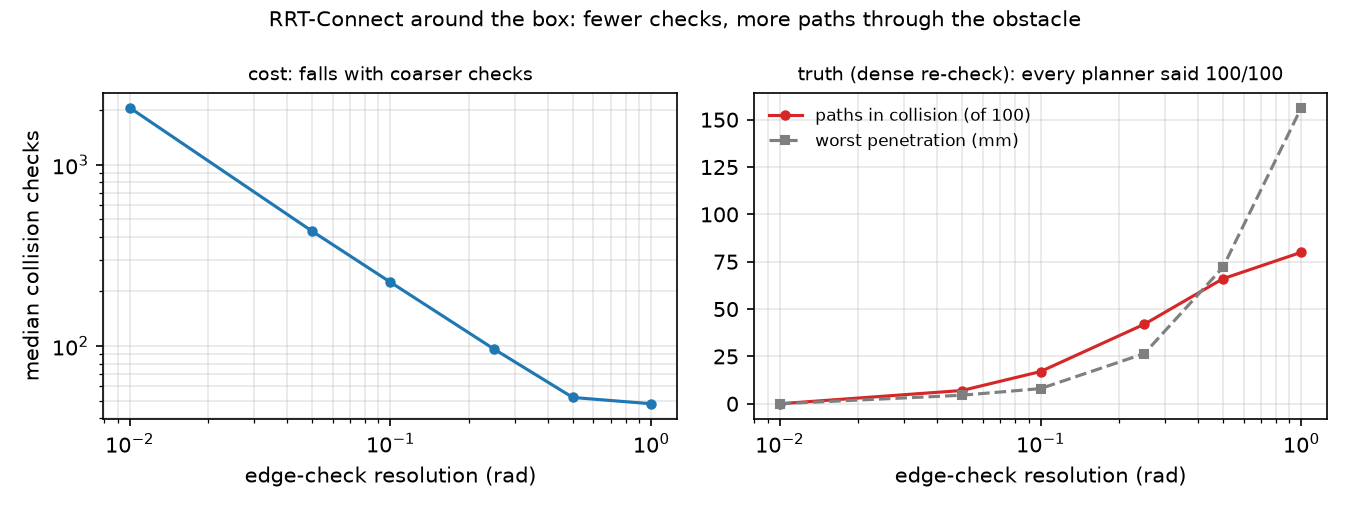
What the data says:
- The success rate is useless as a quality metric here. Every row reports 100/100; only the dense re-check shows that at 1.0 rad 80 of 100 “solutions” go through the box, the worst 156.4 mm deep, deeper than the naive straight line (139.0 mm).
- Coarse checking looks better on every metric you would log by default. Collision checks fall from 2070 to 48, iterations from 33 to 25, and the shortcut path gets shorter (3.61 → 3.00 rad), because shortcuts may now cut through the obstacle.
- Even 0.05 rad is not safe. 7 of 100 paths clip the box by up to 4.5 mm. With m, a 0.05 rad step of one joint moves a point 3 cm; a shallower overlap can begin and end between two checks.
RRT vs RRT-Connect (res 0.05 rad, 100 seeds, same budget):
| planner | success | median iterations | median checks | median length raw → shortcut (rad) |
|---|---|---|---|---|
| RRT | 42/100 | 151 | 1438 | 5.47 → 3.33 |
| RRT-Connect | 100/100 | 33 | 431 | 5.57 → 3.59 |
Growing from both ends and connecting greedily solves this query in a few dozen iterations; single-tree RRT succeeded in only 42 of 100 seeds.
Break it
Section titled “Break it”Replace the box by a 2 m wide wall at m with a horizontal slot centred at m. The goal has the hand behind the wall and the forearm inside the slot, so every solution must thread the slot. Shrink the slot (RRT-Connect, res 0.05 rad, 30 seeds, budget 3000 iterations):
| slot height (m) | success | median iterations | median checks | paths in collision |
|---|---|---|---|---|
| 0.40 | 30/30 | 9 | 128 | 2/30 |
| 0.30 | 30/30 | 102 | 896 | 4/30 |
| 0.25 | 30/30 | 360 | 2747 | 5/30 |
| 0.22 | 30/30 | 856 | 6372 | 5/30 |
| 0.20 | 25/30 | 1487 | 10520 | 0/25 |
From 0.40 m to 0.20 m the median iteration count goes from 9 to 1487, and 5 of 30 seeds run out of budget. At 0.20 m the 25 successful paths pass the dense re-check, so a free route exists: the failures are the planner running out of budget, not an infeasible problem.
The mechanism: halving the slot height shrinks the free tube through it in several joint directions at once, so its 7-D volume, and with it the chance that a uniform dart lands inside, drops much faster than the gap in the room. This is the narrow-passage problem. In the four wider rows 2 to 5 of 30 paths still clip the wall at res 0.05 rad: low clearance is exactly where a coarse edge check lies.
On the real robot
Section titled “On the real robot”- Edge resolution is a real parameter. MoveIt’s OMPL interface exposes it as
longest_valid_segment_fraction/maximum_waypoint_distance, and its documentation warns: “Set too high and collisions will be missed around small or narrow objects” (MoveIt OMPL tutorial). Our table is that sentence in numbers. - Panda. Joint limits come from the Menagerie
panda.xml(e.g. joint 4 in [−3.0718, −0.0698] rad). MuJoCo collides the convex hulls of the link meshes, not the real arm surface. - SO-101. The Menagerie
so101.xmlhas 5 arm joints plus a gripper: a 5-D planning space with the gripper fixed. Procedure: measure and inflate the obstacles, plan in MuJoCo, re-check the final path densely, execute it slowly through the position servos. Not yet measured on the real arm. - Model error is collision error. A box 1 cm off in reality is a 1 cm unmodelled penetration. Inflate obstacles (or set a contact
margin) by at least your calibration error (see lesson 20).
Check yourself
Section titled “Check yourself”Quick check · 2 questions. Click an answer.
1. At res 1.0 rad, RRT-Connect reports success in 100 of 100 runs. What does the dense re-check at 0.005 rad show?
- All 100 paths are free, because every edge was approved by the collision checker.
- 80 of the 100 paths go through the box, the worst one 156.4 mm deep.
- The planner fails more often, because coarse edges keep hitting the box.
- The paths get longer, because coarse checks force detours around the box.
Why: Part A table: success is 100/100 in every row; at 1.0 rad 80/100 paths collide, worst penetration 156.4 mm, deeper than the straight line (139.0 mm).
2. In Break it the slot shrinks from 0.40 m to 0.20 m and the median iteration count rises from 9 to 1487. Why?
- A uniform dart hits a region with probability proportional to its volume, and the free tube through the slot shrinks in several joint directions at once.
- At 0.20 m no free path exists any more, so the planner searches in vain.
- The 0.05 rad edge check rejects every edge that comes near the wall.
Why: Break it: start and goal are free and the 25 successful paths at 0.20 m pass the dense re-check, so the 5 failures of 30 are the budget running out (the narrow-passage problem).
- Easy. Start and goal are both free, yet the straight segment between them is not. What property of does this show?
- Medium. Assume no point of the Panda is farther than m from any joint axis. Which L2 edge resolution guarantees that no point moves more than 1 cm between two checks? (Use .)
- Hard. Plan at res 0.25 rad against the box inflated by 2 cm, then re-check the paths against the original box at 0.005 rad. Does inflation recover safety without the cost of res 0.01 rad?
Answers
Section titled “Answers”- is not convex: two free points do not imply a free segment. The measured straight-line penetration is 139.0 mm.
- rad. The bound is conservative; real displacements are smaller.
- Not computed here; run it. Expect fewer paths in collision than the 42/100 at 0.25 rad, but an inflation smaller than the largest gap between checks can still be crossed.
Takeaways and sources
Section titled “Takeaways and sources”- A planner reports success against its own collision checker. Always re-check the final path at a fine resolution; at 1.0 rad, 80/100 “successful” paths went through the box.
- RRT-Connect solved the box query in a median of 33 iterations where single-tree RRT succeeded in only 42 of 100 seeds; shortcutting cut the median path from 5.62 to 3.61 rad.
- Narrow passages break uniform sampling: a 0.20 m slot needed a median of 1487 iterations versus 9 for 0.40 m, and 5/30 seeds failed.
Next: lesson 23, turning a geometric path into a dynamically feasible, torque-limited trajectory.
Sources
- K. M. Lynch, F. C. Park, Modern Robotics, ch. 10 “Motion Planning”. Book page and PDF.
- S. M. LaValle, Planning Algorithms, Cambridge University Press 2006, ch. 4 “The Configuration Space”, ch. 5 “Sampling-Based Motion Planning”. lavalle.pl/planning.
- S. M. LaValle, “Rapidly-exploring random trees: A new tool for path planning”, TR 98-11, Iowa State University, 1998. PDF.
- J. J. Kuffner, S. M. LaValle, “RRT-connect: An efficient approach to single-query path planning”, ICRA 2000, pp. 995–1001. PDF.
- MuJoCo API reference:
mj_kinematics,mj_collision. - MoveIt, OMPL interface tutorial.
- All tables:
experiments/22-motion-planning/output.txt(MuJoCo 3.17.0, 2026-10-27).